


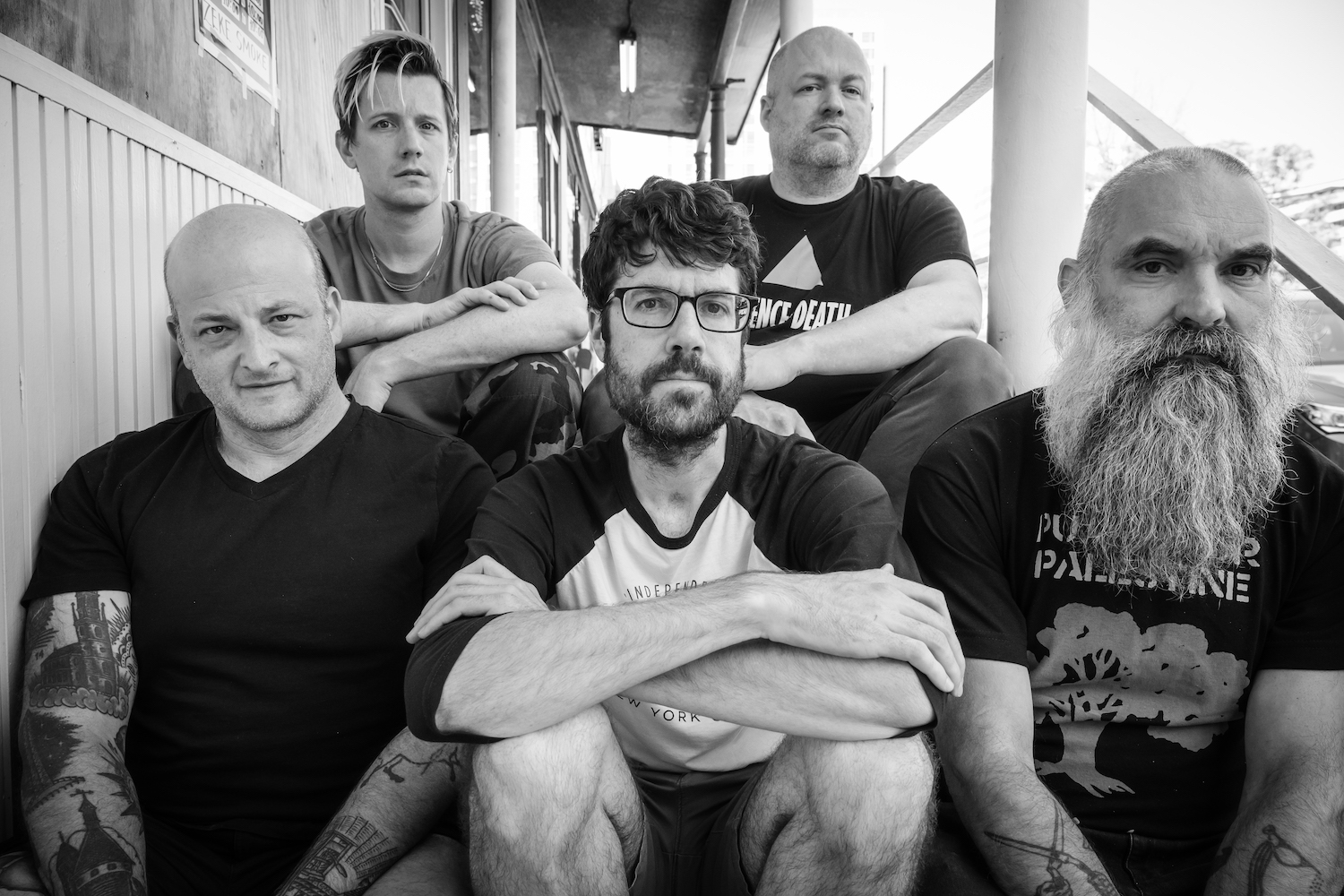
Back when Black Eyes was wreaking noisy, chaotic and skronky havoc during its initial—and all-too-brief—run in the early-to-mid 2000’s, Dischord, long cemented in the DIY annals as putting the staunchly independent, anti-corporate ethos on the map, was in the midst of a creative resurgence. Fugazi was at the top of its game, as was the beloved Lungfish, and new blood like Q and Not U, Faraquet, Beauty Pill, El Guapo and others all banded together as a community injecting new life into the indefatigable D.C. label and scene. That period is truly an unjustly overlooked and vibrant stretch in Dischord storied history.
Black Eyes, a then-twenty-ish punk outfit consisting of Dan Caldas, Daniel Martin-McCormick, Hugh McElroy, Jacob Long and Mike Kanin, were also front and center as an integral driving force, furiously rattling off experimental-tinged, clinking and clattering, groove-intensive and neck-snapping angularity in their singular blend of sociopolitical art-punk. Black Eyes’ eponymous debut, released in 2003, and their follow-up, the dub-boom and sax-squealing eclecticism of Cough, stand as stone-cold classics in the Dischord canon.
Black Eyes disbanded before Cough was even dropped but in the subsequent years since its members have remained active in the underground, as evidenced by Long’s Earthen Sea, Martin-McCormick’s Relaxer and myriad other bands and festival happenings.
Two decades after its untimely demise, Black Eyes have returned, not for a nostalgia-fueled victory lap to just revisit the old songs, but with a flurry of new activity. That first included a run of shows that celebrated the 20th anniversary of their debut album in 2023, which was coupled with putting out a ‘zine called Speaking in Tongues that traced the early history of the band. Ultimately, that led to the writing of a brand-new record and a festival (also named Speaking in Tongues, happening from October 8th through October 11th).
With Hostile Design out now and with Ian MacKaye once again in the producer’s chair, Black Eyes are officially back in more ways than one. There’s nothing like having your ears instantly seared off as the needle hits on the 29 earth-scorching minutes that make up Hostile Design when Martin-McCormick’s high-pitched yelps, the hyper-speed double drum attack and hurricane-force sax blows kick in on album opener “Break a Leg.” It’s quintessentially Black Eyes.
Treble caught up with Martin-McCormick, McElroy and Kanin on a video call to talk all things Black Eyes.
Treble: Was there a watershed moment when the band originally reunited to play shows in 2023 where you felt things clicked and new material was a possibility?
Daniel Martin-McCormick: When we did the first weekend of shows, we only played old material and it was really exciting and I think one thing we experienced each in our own way was that it didn’t feel like we were playing old music. I was really pleasantly surprised when we began rehearsing almost a year before those shows to feel how alive the music remains for us as a group. Once we got our sea legs and ironed out some kinks of just basic performance stuff, it felt like we were really playing together and that the music felt of a piece and really vital.
We did the first weekend of shows and it just emerged out of a little bit of jamming and it was like, “Let’s try it. Let’s just see.”
Mike Kanin: Once we started working on new stuff again, I think it felt just as good I think, as Daniel was saying, playing the old stuff did—it just felt right to get back into it.
Treble: So, you went into that first run of reunion shows with playing just the old songs in mind and writing new material wasn’t even in your purview yet?
Martin-McCormick: That’s right. We agreed to do the first weekend and there were some concerns, just in terms of how it would feel to play for three nights, four nights in a row, and just keep that as a very fixed goal of “Let’s just play these shows. We’re going to re-release the first record, it’s the 20th anniversary, we’ll play with each other, we’ll play with our friends and we’ll see how it goes.” And it was a blast, something we immediately agreed we wanted to do more of.
When we were operational before, we were always writing new material, always trying to find ways into new ideas. When we were writing originally, we wrote our first batch of songs then we wrote the songs that would end up on the first record and then we wrote the second record and each of those are like waves. Some of our earliest songs are on the first album but there was a “first four months window”—the first wave and then the album wave and then the Cough wave. Each time we were riding those waves. It felt like, “We’re really on some new shit.”
When we began playing again, I really felt like all the music fits together actually—more than I remembered it. I remembered it more as these chapters and I didn’t experience it the same way at all; I don’t know if anybody else did but to me it flows very naturally.
It just felt like we have this music that exists, this uniting thread of the whole catalog became clearer to me than it ever been before playing together again. And that’s something where we could draw more out of that—that core energy that we share.
Treble: And that’s where Hostile Design was born from, basically?
Hugh McElroy: Yeah, I think we decided, “Why don’t we try writing some new stuff?” and we approached it the same way we approached that first weekend of shows in 2023 and just see where this goes. We don’t know if it’s necessarily going to be something that works but [let’s] give it a shot. And then we were happy with it and wanted to keep going, so…
Treble: How different was it writing new songs for Hostile Design as opposed to the first two records? I think all of you were spread out across the states?
Kanin: I was living in Austin, Texas at the time that we were writing the record. I’ve since moved back to Washington so I’m back in D.C. now, happily. When we were writing this [Hostile Design], we were sending ideas back and forth; it wasn’t so much live jamming as we had with the first two. But the songs didn’t really come together until we all got in the space, I think July ’23, when we really started working together on them. That kind of writing felt like old school Black Eyes to me.
I think also one of the things I’ll say, to Daniel’s point, is how this experience felt like a continuation of an existence rather than like a period. One of the interesting things about this record for me is that it also synthesizes some of the stuff I think that we’ve all collectively and individually been thinking about for the last 20 years, insofar as any one thing can do that and that also has spread out into older material. We’ve updated some of the work that that we did 20 years ago and that reflects where we all are now, at least that’s how it feels to me.
Treble: In the subsequent years since Black Eyes broke up, all of you have pursued music in one way or another, being in bands like Relaxer and Earthen Sea and running a label. How did those experiences reflect on making new Black Eyes music? I imagine all of you developed your own processes, influences and such over the last two decades.
Martin-McCormick: For me, it’s hard to say. I’ve played music consistently since ‘99 and the band was a huge part of that. The experience of being in Black Eyes, the original two and a half years, was totally foundational. Prior to that, playing with Mike and Jacob in Trooper and witnessing everyone else’s previous band No-Gos and getting schooled by Hugh and other people on music was the most foundational formative musical experience. It formed me. You only get formed once and that was forming.
Everything that’s happened since then has been influenced heavily by the core lessons learned of that time and then collaborations. Working on Relaxer music is like this whole field of play of hardware and digital technology, computers, DAWs, DJing, club music, all that stuff. But that’s not how we play. We have experimented with different technological additions and approaches, which has been cool. But one thing about the band is, as unwieldy as our rig is with all of our crap that we have to schlep to every show, there’s a sense of practicality to it in a perverse way where it’s, like, we don’t do something that where it’s just not going to work live. Black Eyes has always been like this live animal and everything we’ve done has been about “Can we actually execute it? Is this going to work with the way we physically play?” It’s not about translating something from the studio back to live; the studio is always a capture of an experience that’s very, very physical and very communal—that’s what it’s about. If we bring in some triggers or we use some dubbing, it’s got to fit within the way we’re going to be existing together, moving together.
Kanin: I think that also honors the experiences that we’ve had in the last 20 years. The dubbing stuff that we’re doing live now—I don’t know, I guess maybe we might have done it 20 years ago but it feels more like a thing that we would do now.
Martin-McCormick: Totally.
McElroy: I worked on some music before and after Black Eyes where some of the goal was to do some of that kind of stuff live. It just never really had legs so that’s something that’s always been in my mind as something that would be really cool and now that we’re doing it it’s just, like, “Oh, cool. Now I’m getting that thing I wanted—awesome.”
Treble: Ian MacKaye produced the first two Black Eyes records and he once again worked with you on Hostile Design. Was it like “old times” in the studio with Ian who you have a history with? Was it easy?
Martin-McCormick: It’s incredibly easy. I do want to reiterate this isn’t a nostalgia trip. When we started playing together again, I was curious how it would feel and what emerged was not something nostalgic or like, “leather jacket still fits.” It’s music… playing music together. Ian is an amazing musician and an amazing producer and he has a really developed ear and very quick and penetrating insight into what’s happening in a song. So, when we go in and we play, he just grabs it and can hear what’s happening and offer very simple and clear and actionable feedback to get a better take or to adjust something or whatever…or just keep spirits high. That was our experience before and it’s our experience again. The best to work with.
He’s a huge inspiration, of course, but also he’s produced, I don’t know, fucking how many sessions over the last 50 years or whatever. But it wasn’t like “Ian’s gonna bring that special touch” or whatever. He’s really helped us in the studio, especially there’s five of us so there’s five opinions and he cut through the bullshit.
There’s five people’s perspective on the song, each centered around their part. No one has the same granular lens on everybody else’s part than they do on their own. Ian can just get us to a place of centered clarity. We tracked and mostly mixed it in three days. He’s really good at his job.
Treble: The release of Hostile Design is also timed with a festival you are putting on called Speaking in Tongues, which was also the name of a ‘zine you put out. There’s a lot going on in the world of Black Eyes.
Kanin: I think it’s all part of the piece. The festival is an attempt, I hope, to reflect the feelings of community that we’ve been lucky to be a part of again and hopefully the record is the same way. It’s amazing to be able to share this work with people, with other human beings and it’s amazing to share that ethos with other human being and I hope that both things are a celebration of that.
Martin-McCormick: When we got back together, we had the idea to do a ‘zine off of a random conversation with a friend—I thought it was a terrible idea (laughing). Then it became this amazing project and we called it Speaking in Tongues and it’s like 48 pages that go through the history of the band but one thing that became very clear, immediately, was if we were going to tell the history of the band, we had to talk about the milieu and the people who we had been in community with, played shows with, toured with, lived with, talked to and been influenced by. We really wanted to give a sense of that time from 2001 to 2003 and 2004 and what was happening in D.C. around us that was exciting and relevant and also you might not have heard or you might not be aware of. It would be remiss to just be like “Then Black Eyes did this and then Black Eyes did that” because we were so connected with these other people. That’s something we don’t want to be, and we don’t feel like, that we’re here on some island doing our obscure work or whatever. We’re excited by and inspired by our friends and other artists. It’s really energizing and catalyzing for us so the festival kind of grew out [of that].
Treble: You’re obviously all older now in this second iteration of Black Eyes but it seems like you’re looking forward as much as looking back.
Martin-McCormick: I just think it’s been really cool because… realizing now, when I was younger, you’re just going forward and everything you’re doing feels different kind of than the last. You’re like, “Next, next, next. You’re in a band, you write one song, what’s the next song going to be? We write one record, what’s the next record going to be? What’s the next musical obsession? What’s the next project I want to tackle?” It just felt like this charging into the future.
When we were operational the first time on Dischord and the big influence of Fugazi and ethics, the ethics of that band and that label, the approach people took, the style of music—whatever you want to say—like D.C. hardcore or post-hardcore, it can never be encapsulated, but I think people are right to identify there’s a certain something that is in the water.
As I look back on what I hope are the first 25 years of my creative life, you can see that this time was totally generative of how I’ve approached, personally, so many projects. Right now, I run a music festival called Dripping and the ethos of Dischord has influenced the way I think about business of putting on an event like that. My partner who I do that with is also a punk and we are doing something that’s not really punk but is rooted in punk.
And it’s cool. It feels like everybody’s just being together again and having this has really been a heartening experience of seeing how my whole life is cut from this cloth that we started back in the day. I can look back and say like every chapter that’s followed makes sense in the lineage of this—and not in the shadow of this—because the lineage is a way of life that like we’re all schooled in without even realizing it as growing up in D.C. at that time. I’m proud of that, not proud because I accomplished something, but I’m proud to be a recipient of that lineage and to participate in it.
Treble: And the ‘zine, the festival and the new record is a continuing manifestation of that.
Kanin: And I think it’s why all those things and just echoing Daniel, it’s part of who I am. Part of those formative experiences were super important and just like Daniel described, and also, they made me who I am.
Treble is supported by its patrons. Become a member of our Patreon, get access to subscriber benefits, and help an independent media outlet continue delivering articles like these.
