


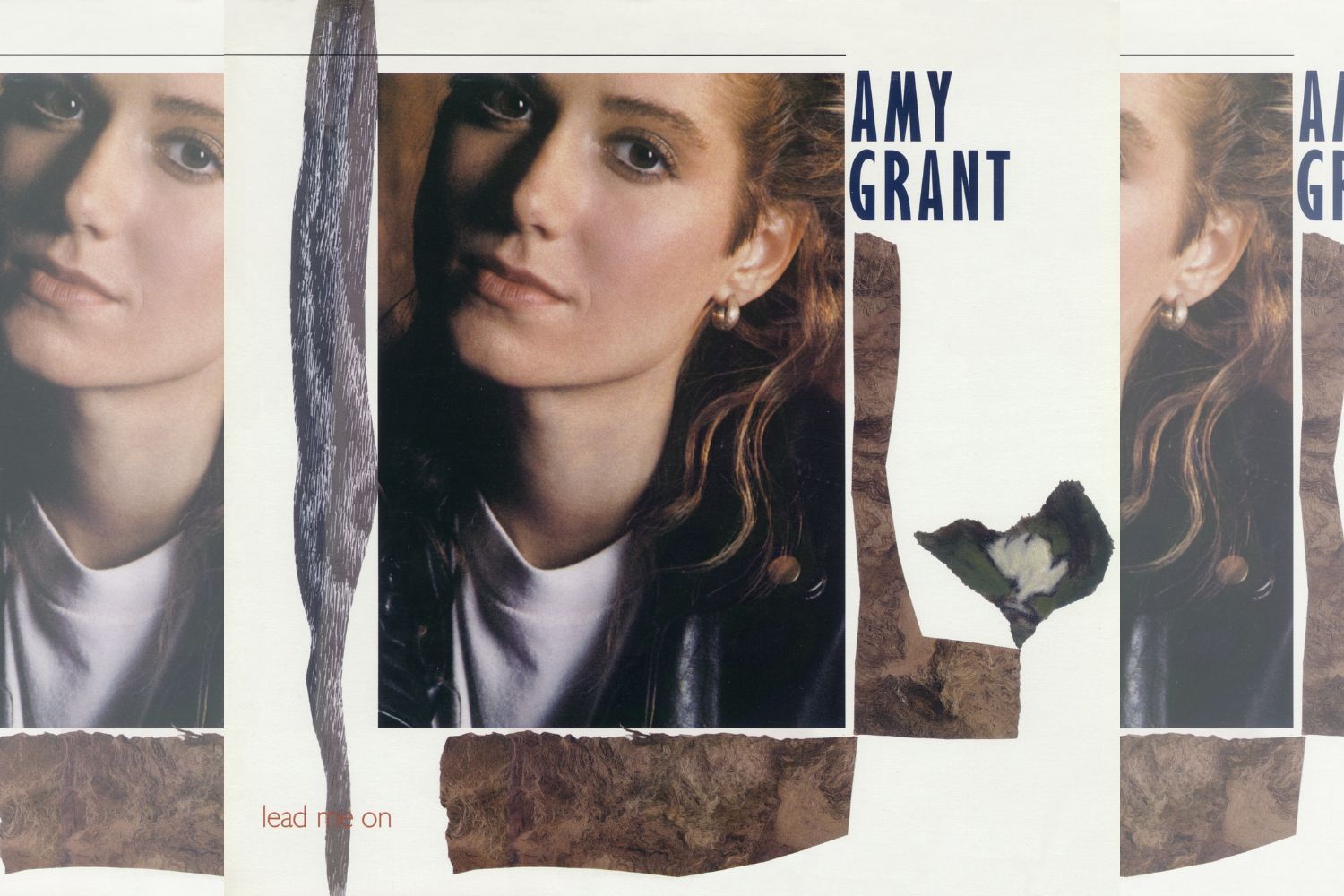
Amy Grant defined Contemporary Christian Music (CCM) of the ‘80s. After conquering the Christian music world, she then released multiple songs in the 1990s that became mainstream crossover hits. When you ask someone who doesn’t listen to CCM to name a Christian artist, Grant is frequently the first name they mention. When Liz Lemon makes a reference to your career in a random episode of 30 Rock—complete with a costume change—you’ve made it as the cultural touchpoint for an entire style of music.
There are three basic eras to Grant’s career: the devout Christian folk singer (1977-84), the peppy pop singer (1985-96), and the introspective country singer (1997-present). She signed her first contract in the late ‘70s while still in high school, mostly serving as a Carole King-inspired singer-songwriter. Along with Keith Green, Larry Norman, and a few others, she helped CCM achieve new heights in marketing power and record sales.
In the folk days, her tunes exceeded the “Jesus-Per-Minute” (JPM) ratio. This was the not-so-subtle industry regulation enforced on any Christians artist who wanted to have a career that extended beyond doing it for “ministry.” To make any money, you needed to secure the approval of both the industry label heads and the loudest media-savvy Christian leaders. If you wanted radio play and sales, your music needed to be as simple and overt as possible about your theological bona fides.
Many of Grant’s songs still get sung in evangelical Christian circles to this day, including “Father’s Eyes,” “Sing Your Praise to the Lord,” “El Shaddai” and “Thy Word.” But with the release of Unguarded in 1985, Grant massively expanded her sound and cultural impact. Traditionally, CCM trails a few years behind mainstream music trends. But on Unguarded, Grant embraced a contemporary pop sound and production aesthetic. Singles such as “Love of Another Kind” and “Find a Way” featured synths and electric guitars, creating danceable pop numbers that found their way to Top 40 pop radio stations.
Her chart success across both CCM and mainstream pop continued for nearly a decade. Chief among those accomplishments was 1991’s Heart in Motion, which went quintuple platinum. Yes, a CCM artist sold five million copies of a single album, though getting airplay on secular radio and video helped. It remains the best-selling CCM album of all time, and it was nominated for the 1992 “Album of the Year” Grammy.
Not that I paid close attention as this was happening. In my Christian household, I was listening to other music entirely, which as a child typically meant whatever my parents played in the car or on the home stereo. With my dad, it was George Strait, Randy Travis, The Judds, and other country icons of the era. On family road trips, it was Raffi and other kid-friendly sing-along music that would entertain four kids so we wouldn’t bother Dad while he drove. With Mom, it was soaring Christian anthems sung by women with big voices and even bigger hair. I didn’t like the music much, but I also didn’t have much choice in the matter.
By the ‘90s, I had my first Walkman, money to buy cassettes, and the influence of older kids in my life. However, I only listened to Christian music—because I was afraid of sinning and going to hell—but I didn’t like most of the stuff on Christian radio. I quickly gravitated to DC Talk, Newsboys and Petra before graduating to Starflyer 59, Pedro the Lion, and the rest of the Tooth & Nail catalog by the end of the ‘90s.
Which is to say that Amy Grant had very little impact on my life and musical tastes during the first two eras of her career. I equated Amy Grant with Christmas; my mom didn’t necessarily like most of Grant’s music, but 1983’s A Christmas Record was a holiday staple in our house, right next to 1984’s Christmas by Mannheim Steamroller.
Despite her big sales numbers, however, the Christian radio stations where I grew up in Southeast Texas didn’t play much of the music from Grant’s second era. In fact, if you would have asked me about the biggest female CCM artist in 1993 (my freshman year of high school), I would have probably replied with Point of Grace. That quartet had six number one singles on Christian radio from their self-titled debut album.
Why was Grant’s music conspicuously missing from those Christian radio stations? It all goes back to the JPM ratio, which on those big ‘90s albums for Grant, was pretty low. Many of the CCM gatekeepers didn’t like that she kept making pop music after achieving her crossover success. According to the unwritten rules of the genre, she was supposed to appeal to sinners with a single pop hit and convert them to Christianity—not stay in the secular realm.
Grant likewise underwent a lot of great personal change after that. In 1999, she divorced her husband, Gary Chapman, after 17 years of marriage and then married country star Vince Gill in 2000. This pissed off a lot of evangelical Christians. Christian media outlets denounced both the divorce and her second marriage. Several of the largest Christian radio stations in the U.S. stopped playing her music for years. Leading publications and message boards on the early ‘00s Internet were rife with conspiracy theories about the timeline of events. Christian media became tabloid overnight because Grant made decisions in her personal life that didn’t meet with the approval of evangelical gatekeepers.
It didn’t help that cultural leaders within evangelical circles had tried to take Amy Grant down a peg or three since the mid-‘80s. The lyrics of her lovey-dovey pop songs didn’t meet the JPM ratio, and the accompanying videos showed her wearing trendy yet modest clothing (including a leopard-print jacket) and dancing with men who weren’t her husband. With this divorce, they finally had a real reason to boycott her music and highlight other artists who would fulfill CCM’s very specific and regimented expectations for what a Christian role model should be.
It was almost as if the patriarchy didn’t agree with the choices made by a woman.
Even though I attended a fundamentalist Christian church at the time and worked in a Christian bookstore, I openly took Grant’s side in the entire kerfuffle without being a fan of her music. On one hand, it was easy to be an obnoxious college-aged guy actively irking the suburban busybodies who patronized the store. Customers would come into the store openly complaining that we shouldn’t sell her records any longer because of the divorce and remarriage. I would take the contrary position as politely as possible just for the sake of argument.
I really didn’t see why it was a problem. I might not have liked divorce, but I also didn’t understand why people were throwing out Grant’s albums and renouncing her legacy because of it. They accused her of infidelity without any evidence and then proclaimed that she was watering down the message in her music to appeal to non-Christians. It was a double whammy of evangelical fervor within Christian culture writ large: Grant was openly sinning, and she’d left behind her CCM roots.
I didn’t buy it. Even though I wasn’t anything close to a feminist at this time, I believed that Christians were treating her unfairly and not showing a Christ-like attitude. I decided I needed to be more informed about Grant’s music and accompanying message, since CCM as a genre is all about the lyrical contenet. To do so, I started with 1997’s Behind the Eyes, mostly because I got an old demo copy for free from my manager.
My burgeoning rock snob heart was humbled from the very first listen. On that album, I found an artist baring her soul, hurts, pains, doubts and internal conflicts about life and faith through twelve inspired country-folk tunes. It quickly took residence alongside all the classic rock, indie rock, and second-wave emo that filled up my stereo in 2000. I then decided it was time to listen to Lead Me On for the first time since middle school.
That 1988 release is now regarded as one of the most profound albums in the entire CCM canon. Grant talked about issues like fear, marital struggle, love, adulthood, and parenthood through the lens of honest reflections about faith, belief and doubt. It was the sort of stuff that mature Christians often experience, even though many of them—especially in the evangelical subculture—won’t admit it. The lyrics were a balm to my soul when I listened to them in 2000. They instantly made me an Amy Grant super-fan and remain powerful to this day.
The music itself has an earnest feel that suited both the pop and Nashville country of the ‘80s. The combination of shimmering electric guitars and folksy acoustic strumming serves as the foundation to the entire project. However, the rhythm section showcased elite session players who knew how to create a clean pocket while leaving room for groove. Floating above it all, light horn licks and supple keyboard fills arrive directly from ‘80s central casting to add some necessary sonic textures.
It’s hard not to get into your feelings as Grant’s tender voice powers these 12 songs. Her breathy, accessible alto provides an emotional ebb and flow that conveys equal amounts of joy, introspection, and downright frustration. Even before the release of Lead Me On, her music transparently showcased the influence of songwriters like Carole King and James Taylor. However, Grant elevates those influences with a hearty injection of Bonnie Tyler, Bonnie Raitt and Emmylou Harris.
I have a few favorite tracks on this record and for different reasons. “1974” is a jangly country-inspired tune about an intense spiritual experience mixed with the nostalgia for a simpler time in life. On “Faithless Heart,” the protagonist admits to occasional struggles with her beliefs, which was a bold move for CCM in 1988. With “What About the Love,” we get an excellent ‘80s rock ballad that rails against flawed morality and hypocrisy both in and outside the walls of the church. And “Sure Enough” is a glistening ‘80s pop-rock track that discusses the ups, downs, successes, and struggles in marriage with refreshing alacrity.
But it all comes back to the title track. It kicks off with a fantastic guitar riff that would have fit right into a Dire Straits or Christopher Cross song. That lick serves as the song’s melodic core, weaving in and out of the intro, chorus and bridge. Lyrically, Grant offers a fervent and determined paean to God, one that asks for guidance and direction on her journey: “Lead me on, lead me on / To a place where the river runs into your keeping / Oh, lead me on, lead me on / The awaited deliverance comforts the seeking, lead on.” She doesn’t deny the hard realities of daily life, but she does believe in a God that can help her through and out of them. I needed to hear those ideas throughout college and my early 20s, even if my own beliefs have moved beyond them now.
In terms of her larger body of work, Lead Me On occupies a moody resting place between the ebullience of Unguarded and the romanticism of Heart in Motion. Not only is this triptych her best three-album run, but it showcases the core of Grant’s approach to music: Be honest with yourself, your friends, your family, your loved ones, and your God. She writes music that comes from her heart, unafraid of letting people peer into the rough spots in her own life. You should want that from a singer-songwriter in any style of music. You should want to connect with a lyric being delivered by a relatable artist and their believable emotions. It’s what’s made Amy Grant such a success for entire career—both inside the world of CCM and out.
Unlike nearly all of the CCM of my youth, I continue to listen to Amy Grant now. Sure, parts of her catalog are cheesy and dated—especially her early records—but most of it stands up as superb pop and folk music that’s reflective of something real. There’s very little sugar-coating with her music compared to many of CCM’s other biggest stars, and that’s why it continues to resonate.
There’s a reason I didn’t get Grant’s music when I was younger—she wasn’t singing about anything that was relevant to me at that age. I had no way of connecting with songs about love, marriage, faith and doubt. But the older I’ve become and the more life I experience, the more resonant those messages are.
Treble is supported by its patrons. Become a member of our Patreon, get access to subscriber benefits, and help an independent media outlet continue delivering articles like these.
