


The problem with a once-in-a-lifetime phenomenon is having to accept the permanence of its absence. There has only ever been one Fugazi, and countless imitators aside, their decade-and-a-half run a cosmic event the likes of which we scarcely see in punk let alone music at large. More than a band but a cultural force, Washington, D.C.’s Fugazi were the underground equivalent of rock stars but without having to endure much of the baggage that comes with actual industry-approved rock stars, and they called it a wrap after a still-too-brief 16 years. Which is why after another 24 years, there are still those holding out hope that maybe this year will be the year that Fugazi finally gets back together.
I’m not saying I wouldn’t go for that—I’ve confessed that one of my biggest regrets is having never caught one of their legendary live shows when I had the chance, limited as it was. But it wouldn’t be the same; the band’s Spartan ethos and ability to yield unprecedented success by abandoning the corporate model of promotion is hard to square in an algorithmic lottery. Their success wasn’t accidental by any means. Ian MacKaye’s reputation as the former frontman of Minor Threat no doubt helped draw a potential audience in while their relentless touring continued to nurture their devoted following. Selling copies in the six-figure range with no videos or radio airplay and without a big-label budget would be effectively impossible for most other bands. But not Fugazi.
Similarly remarkable during the band’s tenure was the level of collective discipline they adopted, from their commitment to low ticket prices and playing all-ages venues to their no-frills approach to gear, employing relatively few effects other than amp distortion. And with the sole exception of first drummer Colin Sears’ early departure, they managed what even the most well-adjusted bands can scarcely manage in even half the time by maintaining the same lineup of MacKaye, Guy Picciotto, Joe Lally and Brendan Canty.
Which is why it’s a little disorienting to hear not one but two drummers playing at once on a song like “Ex-Spectator,” a standout among many on the band’s final album, 2001’s The Argument. Brendan Canty’s rhythms overlap and leapfrog with those of Jerry Busher, dual resonant pulses realigning and separating and realigning in brutally elegant choreography. It’s unlike anything on any Fugazi album before it, a thing of muscular wonder.
A significant portion of The Argument is, in fact, unlike anything on any Fugazi album before it, with rare exception, like the exclamatory post-hardcore roar of “Full Disclosure.” For a band with such an identifiable sound as theirs—throbbing grooves and sandpaper guitar riffs, and two vocalists known for barking indictments of consumerism or America’s genocidal past—The Argument presented a radical shift, at once the prettiest and strangest album they ever released. Yet there’s something sinister roiling beneath its elegant exterior, a flame of anger that burns white hot in spite of the restraint it projects.
The Argument doesn’t kick the door open so much as emerge from a disorienting haze, Amy Domingues’ cello providing a tense and mournful drone against the crackle of radio static. A sudden scrape of a string halts the transmission, but “Cashout” doesn’t roar in guns blazing either. As Fugazi album openers go, it’s a slow burner but one that builds in intensity, its sparse groove carrying an eerie ambience rather than a full-throated roar. The anger and socio-political commentary remain at surface level, however, even as Ian MacKaye adopts a tone of restraint in his narrative of gentrification and displacement: “On the morning of the first eviction/They carried out the wishes of the landlord and his son… Development wants this neighborhood gone so the city just wants the same.”
In its roaring climax, “Cashout” erupts into something more like classic Fugazi, unsettling beauty transformed into cathartic purge, as MacKaye expands his frame from political to personal to universal: “Everybody wants — SOMEWHERE!”
Though The Argument is still built with mostly the same raw materials as on the albums that preceded it, with the notable exceptions of Busher’s second layer of drums or Domingues’ cello, it’s more texturally rich. MacKaye and Picciotto create a dizzying swirl of jangle on “Life and Limb,” while the slow-burning “Strangelight” is wrapped in spindly licks and the understated “The Kill” is flecked with disorienting guitar harmonics.
When the moments of bombast arrive, however, they leave a substantial impact. “Ex-Spectator,” with its lengthy drum intro and extended upward swing, is a masterclass in tension, MacKaye juxtaposing observation and experience in a philosophical struggle: “If the view is all that I can ascertain/Pure understanding is out of range/If I make that call/Why can’t I make that change?” “Epic Problem,” another song with dual drumkits, finds MacKaye barking his lyrics in the format of a telegram (“Congratulations! STOP! Wish I could be there! STOP!“) in what unfolds as a confession of deteriorating mental health despite all appearances: “And outside it’s all production, It’s all illusion, set scenery.”
As The Argument enters its final act, the climactic title track, it returns to the sound of a distorted transmission interrupted by a series of monotone, staccato guitar notes that arrive like a message tapped out on Morse code. When “The Argument” takes shape, it’s something of a parallel to “Cashout,” MacKaye returning to his subdued vocal delivery to illustrate a universal anti-war statement: “When they start falling, the executions will commence/Sides will not matter now, matter makes no sense.” And though it likewise makes a triumphant rise, it finds an eerily calm respite in its gorgeous and unsettling bridge, twinkling notes up against a distorted strum that could easily be mistaken for a mandolin—just before its explosive finish. If they needed a song to exit the stage, this would do nicely.
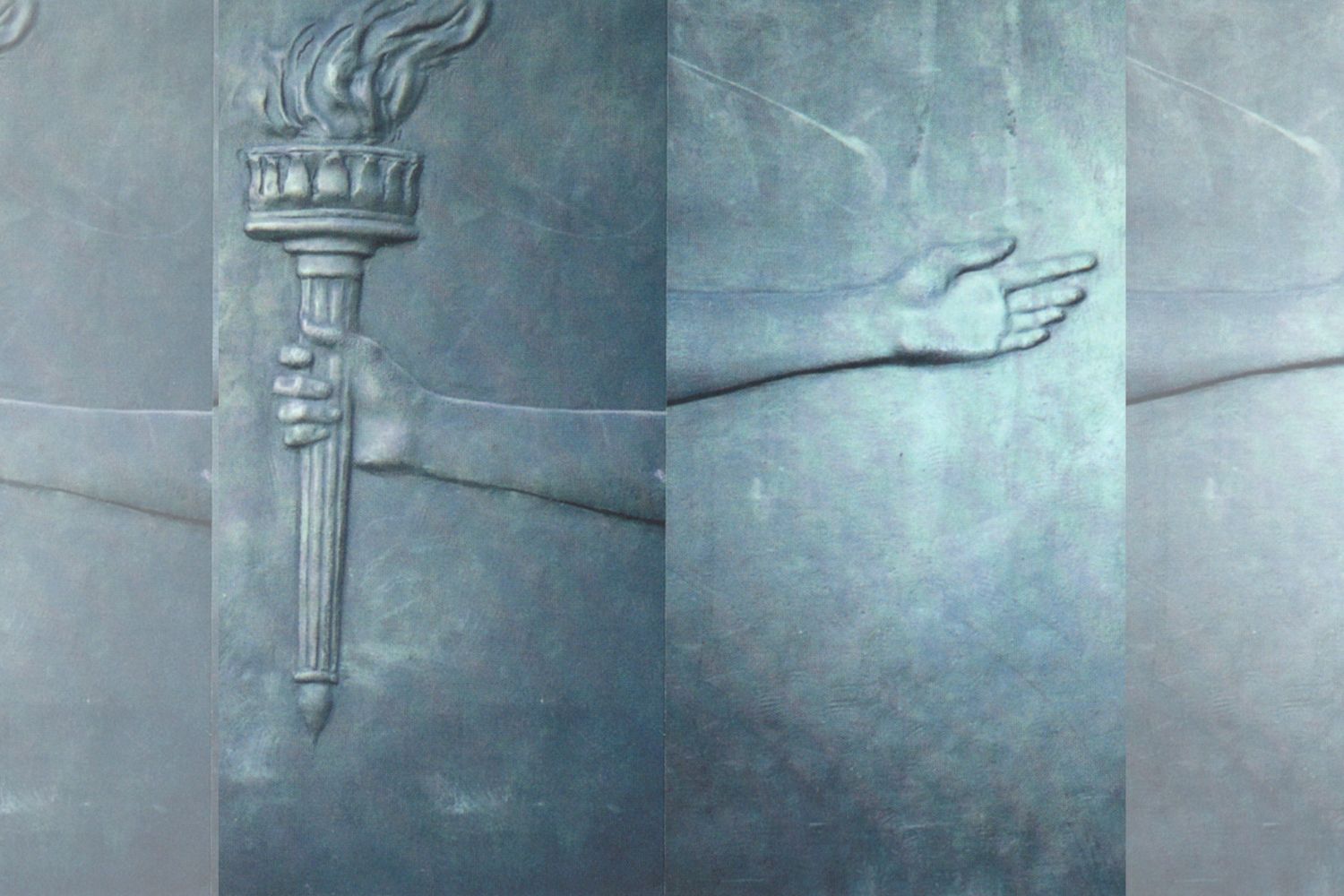
Of course, Fugazi wouldn’t have known that it would have been their final statement at the time (and you’ll have to forgive me: It still might not be—only they’d know for sure). But they also couldn’t have predicted that they would release an album that’d prove so timely, hitting record store shelves just weeks after the September 11th attacks. The album’s haunting tone reflected the creeping dystopia in the U.S., the coldness and ugliness of the world that existed in its aftermath. Though as students of history, they almost certainly understood that perpetual war and aggression was already an American reality; their decision to include an image of a memorial to Sandra Lee Scheuer, one of the victims of the Kent State massacre in 1970, seems even more poignant now, in a country at war with itself.
It’s hard not to recognize the vitality of a record like this now, and to reach the admittedly subjective conclusion that in times like these, we could really use a band with such clarity of principles, and the ability to transform them into such powerful artistic statements. Still, they ended things on their own terms, with their strongest set of songs. And though they stopped releasing records or performing together, none of the members retired, Ian MacKaye playing as one half of The Evens in the years that followed, Lally and Canty forming the rhythm section of The Messthetics, and Picciotto taking on a number of different projects, from recording albums by Blonde Redhead and Downtown Boys to recording and touring with Vic Chesnutt.
Not that I’m saying their absence is necessarily permanent. Canty recently said that “there’s always a chance” that Fugazi could return to the stage, however much of that probability is shaved off with each passing year. And in a sense, the band have already reunited—they do continue to play music together as friends, simply for the fun of doing it. They’ve also said more than once that no amount of money could make up for any reluctance on their part; for a group that kept their ticket prices lower than what most corporately owned venues would charge for a beer, money was never the point.
Maybe it’s better this way. We’ll never have to endure agonizing over the size of the font on the Coachella poster, or have to endure the frustration of surge ticket prices for a reunion show, or come to terms with the idea of a Fugazi TikTok. The world is a much different place than when they began their extended hiatus and even more so when they began playing in the first place. But when I hear this one perfect, final statement of theirs, I can’t help but think what a gift it would be to bear witness to their singular power once more.
Treble is supported by its patrons. Become a member of our Patreon, get access to subscriber benefits, and help an independent media outlet continue delivering articles like these.