

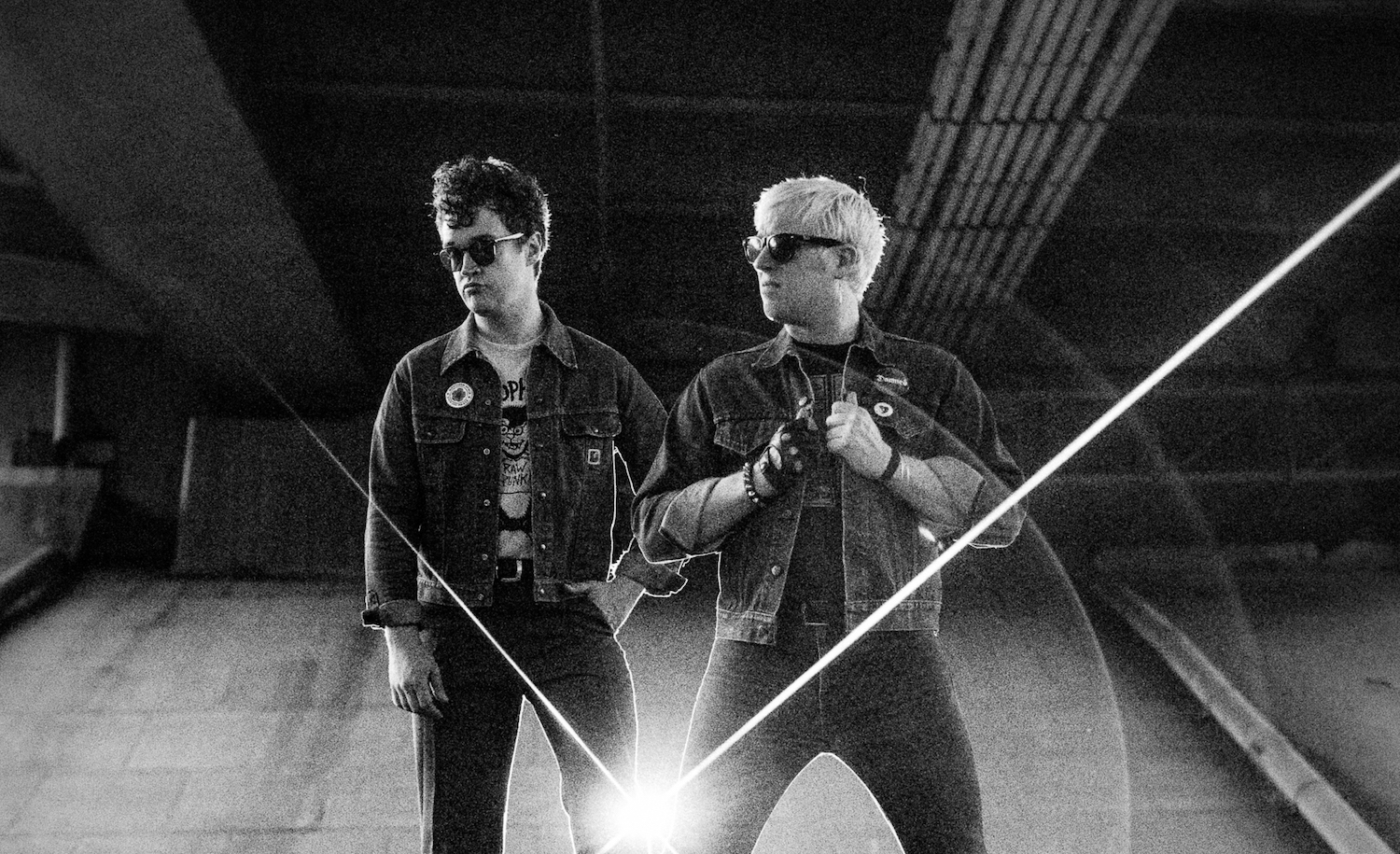
Before Home Front began bringing their high-energy and highly animated live shows before instant-convert audiences, they were strictly a studio project. Formed in Edmonton, Alberta, by Grant MacKinnon and Clint Frazier, formerly of The Wednesday Night Heroes and Shout Out Out Out Out, respectively, the project began in a rehearsal space during pandemic lockdown when live music wasn’t an option. The two musicians wrote and recorded their 2021 debut EP Think of the Lie from loose ideas that paired synth-pop with a more urgent punk rock muscle, which they solidified with their 2023 debut LP, Games of Power.
But as the opportunity finally arose to take Home Front to the stage, the band—which expanded to include bassist Brandi Strauss, guitarist Ian Rowley and drummer Warren Oostlander—the idea of what Home Front was began to evolve as well. In front of audiences, that colder, more contained form of post-punk transformed into something wilder and more physical.
“Playing these songs every night and hearing the recorded versions, they’re so different to me,” MacKinnon says in a Zoom call from his home in Edmonton. “Maybe it’s just because I’m standing on stage and hearing whatever in-house mix is going through the monitors, but sometimes it’ll be so chaotic that there’s elements that I love about the band, and there are elements that I think, I wish we had that on the record.”
Home Front’s sophomore album Watch It Die, out this month via La Vida Es Un Mus, finds their sound world continuing to expand. Their synth-pop melodies are bigger, brighter, while the punk undercurrent roars with even more ferocious anthems. A deeply cathartic listen, Watch It Die finds MacKinnon frequently addressing death and grief while delving into just how difficult it can be to endure a day-to-day existence. But that thematic heaviness comes in the form of massive punk and new wave anthems that are intended to be shouted back at them live.
It’s easy to hear how that live energy seeped into this album, even as they continue to see the stage and studio versions of the band as entirely different entities.
“The songs on this record are also going to take on a new life when we play them live,” he adds. “But I feel to make the record into something it needs to be, we have to strip it down. And the live show is its own thing. And that’s more interesting for Clint and me.”
We spoke to MacKinnon and Clint Frazier about Watch It Die, the ongoing evolution of Home Front, brutal winters and where to find hope when you’re inundated with anxiety and chaos.
Treble: Did you have a specific direction you wanted to pursue with Watch It Die?
Graeme MacKinnon: Clint just reminded me that we actually started working on this after we had just played our first show as a live band, so Games of Power was still being mixed. My partner, Kate, she came with us on our trip to Vancouver, and we were taking photos for Games of Power around the same time that we started work on the very first song. So when we came home, Clint and I went to the rehearsal space to work on the first song, which had come to me during that trip, which ended up being “Watch It Die.” Interestingly enough, at the time I think I was inspired by the Setting Sons album by The Jam, I was listening to that on heavy rotation. So “Watch It Die,” the song, I think I was trying to make it like a Jam tune, and Clint, when he was doing the drum fills, we were doing it in that spirit as well. But the song changed, obviously. But Paul Weller’s lyrics were something that really inspired me, especially going forward. That introspective kind of take. I think that’s how we got the ball rolling. And by no means when Clint and I when we made that tune think we had it all figured out.
Clint Frazier: With the previous two records, they were done during the pandemic, we weren’t playing shows, it was just a recording project. So when we started working on Watch It Die we had just started playing shows, so we would work in the studio on the tracks, and it was a totally new way of doing a record for us than what we were used to with the previous two.
GM: I was checking the first notes we had got for the first set of songs we had written. Jonah (Falco, of Fucked Up), the guy who records all our stuff, was laying out his game plan, and that was the only thing that was the throughline. His notes were like, “This album shouldn’t be a remake, it should be a sequel, or its own standalone. But it shouldn’t be Games of Power Part 2.” We didn’t want to fall back on the tropes we’d done before.
Treble: Watch It Die feels like a bigger and brighter record in some ways than Games of Power.
G: Clint and I mentioned this in another talk, but Games of Power came about when we didn’t have a band. All those songs were kind of written and recorded as ideas. How Clint and I wanted to see them come to fruition. But Watch It Die, having a live band and touring as a live band, we started recognizing elements of the live sound. There’s essentially two versions of Home Front. The studio version and the live version, and the live version has an energy to it that we couldn’t deny it from the record. Games of Power, I think we wanted to strip back the guitars a little bit, make it colder. At the time it was all kind of new.
CF: It’s kind of been a natural progression. The first record we did remotely and we didn’t know what the hell we were doing, and the second one we did way more together. But we were still figuring out how to use technology and how to make our sound. So by the third one, we really have kind of started to hone our sound and figure out how to use our synths and technology wisely.
Treble: Is Home Front a constantly evolving project?
GM: Yeah, I definitely think Clint and I, our tastes are always changing, and the one thing I think is really freeing about this band is it’s never “oh, it’s gonna be just this.” I like that we can approach each song with a completely new vibe. To be honest, technology has helped us a lot. The knowhow that we have for just recording demos has pushed things up for us. The other side of things I find is with that free spirit and feeling like there’s no chains on us to make music a certain way, though, sometimes…there’s small things that you just know, “oh this feels right.” Like, what is it—we start every record in the key of D?
CF: Yeah, we start on a sustained D major on every album. (Laughs) That’s just a comfort sound.
GM: Even on Games of Power, “Faded State” wasn’t going to be the first song, but someone moved it into the number one spot and it was like, oh this feels right. So that’s just kind of the thing, these aren’t even on purpose, but D major is always a nice way to kick off a tune for us, it seems. Maybe that’s part of that brightness.
Treble: I heard you discuss on a podcast how, in Edmonton particularly during a harsh winter, it takes more effort to just get out and go to a show, so you don’t hold back.
GM: Oh yeah.
CF: Oh yeah! (Laughs)
Treble: How much does that environment affect how you operate?
GM: For us, Clint and I grew up and started going to shows, there was such a vibrant local scene that when touring bands did come through, it’s like OK, well, let’s see what you got, we got our own thing going so you better impress us. It was kind of that vibe when we started. Like, “these guys we know from other bands, let’s see what the fuck they got going now.” But as far as the effort that it all takes, it’s more the idea that everyone here has to dig their way out of the snowbank and find their path to the place and it’s like, OK, we can absorb this to make these winters not feel so long.
CF: Even going to shows in the winter here is ridiculous. People are in their fuckin’ Shackleton gear, in minus 38. I run a venue and there are nights where snowbanks are literally piling up against the door. So you really have to want it. And there are times when Graeme and I go into the jam space and we have to write and record, and it’s minus 30 outside and it feels like it’s minus 40 inside, and he has to play guitar with these giant mitts. (Laughs)
GM: Our jam space is the ultimate training zone. Because in winter it’s so fucking cold. And in the summer it’s like being on the planet Mercury. It’s fuckin’ brutal. And we’ll be working in the summer in little Adidas shorts and sweating like maniacs trying to get ideas across to each other. But I do think every city and every place has their own specific—environment plays such a specific role in the sounds of bands. Think of American hardcore in the ‘80s and you can think of every regional scene in the U.S. having its own sound because it’s like, pretty much everyone is having to make their own noise, you know? And I think in Canada, too, like Edmonton, even though we have a lot of expats that live in Toronto, what’s going on in Edmonton and what’s going on in Toronto is very different. Things are in the water here that maybe aren’t in the same flavor in Toronto.
Treble: There’s darkness on this record, grief, despair even, but it’s also wildly fun. Is it therapeutic for you to take those heavy themes and transform them into something energizing?
GM: I would say on this record more so than on the other records. When I listen back to the first two, you can kind of tell that there was—they’re very bleak in some of the subject matter. But in my mind, I probably didn’t think so at the time. It was just how we were feeling. But with this one, the hope that comes through our music is trying to find a way out of some of the shit that we’re just constantly seeing all the time. Like every time you turn on the TV or open up a device, it’s just constant chaos. This isn’t a record trying to make sense of it, it’s more like trying to cope with all the shit. And recognizing that, for Clint and I, all our limbs are moving, we’re breathing, we have food in our fridge. There’s a lot that I’m not depressed about. But I think the overall thing is just having that hope for, not so much a better future in terms of the world, but hope in terms of, OK, if we can get together with people we can physically see and touch, maybe we can give them an outlet just like they give us an outlet. It’s a positive exchange of energy. We can talk about a lot of heavy subjects, but the overall purpose of Watch It Die was taking an older part of us and letting it die in order to move forward, achieve enlightenment or some understanding of ourselves. All the shit we hung onto, all the tropes that we fall back on.
Treble: What’s a source of hope for you?
GM: For me, it’s immediate community action. There’s people, friends who continue to inspire. When I see people who are risking their neck on frontline work for harm reduction, or people pushing themselves to stop war in Gaza, or sticking their neck out to challenge the atrocities that are going on. That energizes me, because these people are talking the talk and walking the walk, so for me, the community is kind of a big part of it. If they’re energizing me with this, then maybe we can give something back with our music. That’s the hope, that the energy is circular, the input and output are keeping that free-flowing exchange that’s going to make our lives better.
Treble is supported by its patrons. Become a member of our Patreon, get access to subscriber benefits, and help an independent media outlet continue delivering articles like these.