Two guitars, two voices and a lot of great songs: Gillian Welch and David Rawlings live

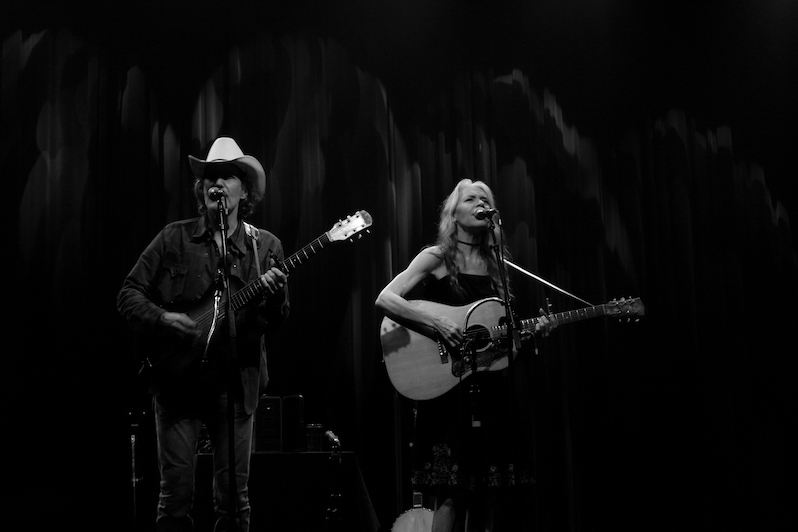
Gillian Welch and David Rawlings brought few bells and whistles with them to their tour stop in Richmond. No elaborate light display. No costume changes, other than Rawlings taking off his jacket about halfway through the show. They didn’t stand in front of a bright, Merv Griffin Show-style stage backdrop like Waxahatchee did when she played the same venue a year earlier. Just two voices, two guitars, and a repertoire of songs that span three decades yet are essentially timeless.
It’s not that the folk/Americana duo are above delivering a big surprise when the moment calls for it—just a few nights after gracing the stage of The National, they were joined by Norah Jones for a pair of covers of songs by Townes Van Zandt and The Band at Carnegie Hall. And though for about two-thirds of the show they had the backing of upright bassist Paul Kowert, a member of bluegrass group Punch Brothers, Welch and Rawlings offered no unnecessary distraction from the magic and mystery of their own haunting songwriting and occasional selection of well-curated covers.
After three decades recording as Gillian Welch, a “band” comprising both Welch and Rawlings, as they’ve described it, the duo last fall released their first album under both of their names: Woodland, named after their Nashville Studio that was ravaged by a tornado in 2020. They’ve also released records under Dave Rawlings Machine, as if to make the arrangement simultaneously more equitable and confusing. But to hear them sing together on a song like Woodland closer “Howdy Howdy,” wherein their voices combine over the stark pluck of a banjo in a moment of breathtaking convergence, it drives home that theirs is a partnership that runs deeper than the name on the album spine. It’s enough to give you chills.
It’s not easy to command a crowd with only a pair of vintage acoustic guitars and a banjo that, as Welch noted in an anecdote, one Australian fan described as a “sexy beast.” Hell, it’s damn near impossible on the wrong night with the wrong crowd and the right amount of alcohol, but once Welch and Rawlings began plucking their way through set opener “Elvis Presley Blues,” you could scarcely hear a sneeze in the 1,500-capacity room—until Rawlings started ripping into a guitar solo, that is. (The man plays a mean guitar.) And when they closed their second of two sets (pre-encore) with rollicking Time (The Revelator) standout “Red Clay Halo,” you’d be hard pressed to find a member of the crowd—itself a patchwork of walks of life comprising indie rock dudes (guilty, sorta), NPR moms and dads and Deadheads—who wasn’t caught up in the revelry.
Early on, Welch commented that they’d already began to stray from the setlist, and based on a few between-song huddles, they clearly made a few calls on the fly, like when they played the Boots box set rarity “Strange Isabella,” or later on, dusting off their cover of Radiohead’s “Black Star.” And based on their set history, no one night of the tour is going to be exactly like the last; their bank of songs, comprising sounds that range from progressive folk epics to bluegrass barnburners, is rich enough to sustain limitless configurations. Not that they neglected the hits, to the extent they can be described as such coming from two artists whose patiently crafted sound winds some distance from where the pop charts lead.
As much fun as it is to hear them raise the revival tent with O Brother Where Art Thou gospel highlight “I’ll Fly Away” or conjure up some fiery energy with “Cumberland Gap,” it was during the quieter, more meditative moments in which Welch and Rawlings had a singular presence. The slow layering of “Hard Times” made the most of their stark setup, Welch first performing solo, with Rawlings lending his voice and guitar in the second verse, and Kowert bowing his bass in the next. The Woodland track “Lawman” tapped into the duo’s outlaw country roots with a stunning interplay of harmonies, both guitar and vocal, while “The Way It Will Be,” a bitter ballad of a soured friendship, delivered a mesmerizing juxtaposition of brutal lyricism and gentle, meditative sounds.
Still, perhaps it was because I’ve had Time (The Revelator) in rotation of late, or that I’ve developed a closeness to the album overall, that its title-ish track “Revelator” stood as the highlight of the evening for me. In the context of this show, it was one of the quieter ones perhaps, though I might have heard a whoop or a holler or two after Welch sang the line, “Leaving the valley, fucking out of sight.” It’s not even the longest song on that album—the 14-minute “I Dream A Highway” has only occasionally been incorporated into their live shows—but it’s an epic all the same, a journey of a song that’s almost Dylanesque in its myriad references, unfolding travelogue and invocation—and contradiction—of Biblical allegory. When they reached the key change after the fourth verse, I felt those chills again.
The enduring quality of folk music is that it’s simple, yet contains a great deal of depth. Few contemporary artists put its richness and breadth, as well as a reverence for its deep roots, into practice quite like Gillian Welch and David Rawlings do. And fewer still make it feel so vital and alive.
Treble is supported by its patrons. Become a member of our Patreon, get access to subscriber benefits, and help an independent media outlet continue delivering articles like these.