



Video (allegedly) killed the radio star, but it didn’t stop the previous generation of rockers from finding their niche in the audiovisual age. Among the first videos aired on MTV’s debut on Aug. 1, 1981 alongside the expected Blondie, Talking Heads and The Pretenders were clips from Rod Stewart, The Who, Styx, Fleetwood Mac and .38 Special. And throughout the ’80s, the rock canon’s stadium MVPs adapted to the new wave era, Yes’ Orwellian clip for “Owner of a Lonely Heart” airing next to the energy-dome absurdity of Devo and Genesis’ grotesque puppetry in “Land of Confusion” sidling up against claymation shenanigans from their former bandmate Peter Gabriel—to say nothing of Bruce Springsteen’s dominance circa 1984.
Prior to the release of their eighth album Eliminator, Texas trio ZZ Top had never actually made a music video, their bluesy Southern boogie rock an unlikely match for the nascent, youth-oriented cable network dominated by pop phenomena such as Madonna and Michael Jackson. But after nearly 15 years, amid a changing landscape where rock and pop were once again becoming more closely intertwined, they gave it a shot, making their MTV debut with “Gimme All Your Lovin'” in 1983. The concept was simple: At a gas station in the middle of nowhere, three hot babes show up in the bright red hot rod on the cover of their newly released album, take the young attendant for a joyride, drop him off and then split town—with a shimmering, silver key attached to a stylized “ZZ” keychain in his hand. And as the crimson cruiser speeds down the road, the trio of Billy Gibbons, Dusty Hill and Frank Beard emerge from the ether, gesturing in unison toward the suggestive high-speed exploits before fading away once more.
The image of ZZ Top in “Gimme All Your Lovin’,” long of beard and dark of sunglasses, is the one that’s endured through the years, instant icons even as supporting players in a campy and horny short-film narrative format (as Gibbons himself described it, a “Greek chorus”). It worked once, and they played up that mystical rock ‘n’ roll magi role again on the clip for “Sharp Dressed Man,” granting gifts of sexual abundance to a hapless dude in a tuxedo, and then again in “Legs,” wherein another trio of models shows up to help an at-first covertly babely working-class woman take revenge on rude customers and then go on a shopping spree. Only in the latter, they played guitars wrapped in sheep’s wool that they spun 360 degrees—neat trick!
It’s impossible to understate the transformational nature that the video format played on ZZ Top’s legacy, helping to raise the stakes on a successful career by turning platinum certifications into diamond (10 million sold). Yet these clips of bearded bluesmen appearing like mirages mostly provided advertisements for what was already a phenomenal rebranding. The pop harmonies, laser beam synthesizers and limitless hooks of “Gimme All Your Lovin'” make it clear from the start that Eliminator was the beginning of a new era.
To say that Eliminator renders the boogie merchants of 1973’s Tres Hombres nearly unrecognizable would be a slight exaggeration, but not by much. Inspired by synth-pop groups such as Depeche Mode and Orchestral Manoeuvres in the Dark, Gibbons sought to incorporate electronics in the group’s music, a seeming incongruity on paper that captured lightning through arpeggiators and fuzz pedals. It’s an unlikely reimagining of blues rock filtered through the Giorgio Moroder space disco. It shouldn’t work—in the wrong hands it almost certainly wouldn’t. But by god, Eliminator works.
In all of its 120 BPM pulses and throbbing pop energy, Eliminator never once discards ZZ Top’s core elements but rather outfits them with a more modern sensibility. Against the metronomic beat of “Got Me Under Pressure,” Gibbons layers a lament of a living-too-fast woman with infectious riffs, while strip-club strutter “I Need You Tonight” echoes with serpentine licks. The appeal of blasting down the road in fast cars resurfaces in “Thug,” along with some slap-bass interludes with mechanized beats that veer closer to industrial, while they bring back their bluesy strut on the silly “TV Dinners” (“Twenty-year-old turkey in a thirty-year-old tin“), touched up with a few futuristic flourishes.
Through its forward-thinking production and the band’s embrace of the tools of electronic music, Eliminator‘s as much a pop album as a rock record. They wouldn’t tilt the ratio even more toward the former until 1985’s Afterburner, and its glossier single “Rough Boy,” but here the balance is seamless. It doesn’t hurt that the songs likewise mostly concern themselves with the sort of subject matter that you’d expect to hear in a great pop song, like sex (“If I blow my top/Will you let it go to your head?“), how dressing well can lead to sex (“Black shades, white gloves/I’m lookin’ sharp and I’m lookin’ for love“), and on “Legs,” well, the title pretty much tells you all you need to know. However, the latter song’s origins are not unlike that of Jimi Hendrix’s “Foxy Lady,” only instead of trying to persuade a dog to let him in front of a fireplace, Gibbons took inspiration from a woman trying to find a ride to escape a rainstorm: “We circled back and—boom—she was gone. She had legs and knew how to use ’em!”
As forward-thinking and savvy a hybrid of pop elements with a rock sound as Eliminator was, few old-guard rockers had similar successes with their own modernist pursuits. The previous year’s It’s Hard from The Who yielded one absolute banger, “Eminence Front,” and a bunch of filler, while Judas Priest took an unjustified amount of flak for Turbo in 1986. And despite adopting a similar dancefloor tempo on Undercover, The Rolling Stones mostly sounded like they were jamming a square peg into a parallelogram. As unlikely a comparison it might seem on its face, the closest parallel to Eliminator‘s sound is The Jesus and Mary Chain‘s Automatic—each one a driving rock record bolstered by technology rather than fighting with it.
At the time Eliminator seemed to suggest a future path for rock music, though from certain angles—its heavy-rotation videos that helped it go 10-mil in particular—it’s still emblematic of its era. But beneath the fresh coat of paint and spokesmodels, Eliminator is simply a great record about sex, TV dinners and rock ‘n’ roll—and that never goes out of style.
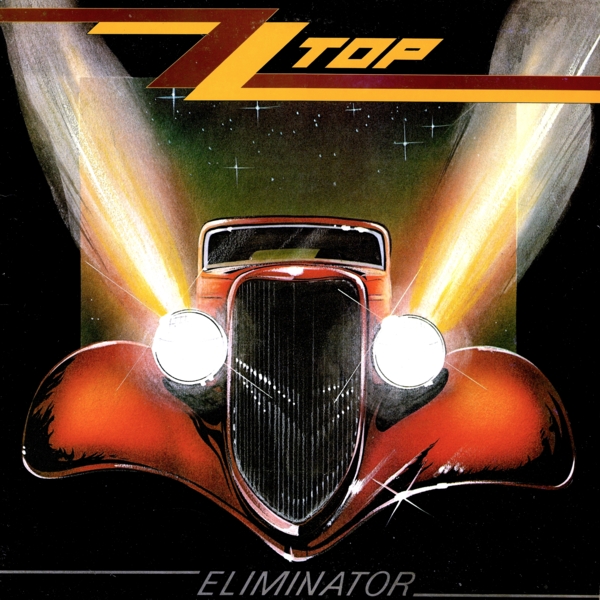
ZZ Top : Eliminator
Note: When you buy something through our affiliate links, Treble receives a commission. All albums we cover are chosen by our editors and contributors.
Treble is supported by its patrons. Become a member of our Patreon, get access to subscriber benefits, and help an independent media outlet continue delivering articles like these.