


A great artist doesn’t run out of ideas, at least not often. A full decade after Prince’s death, we still haven’t even scratched the surface of the material left unreleased in his famed Vault. And last year’s Tracks II box set proved Springsteen’s leftovers as worthwhile as the established canon. But the puzzle isn’t one of creation but rather, once you’ve amassed all that material, what to do with it? Pare it down to the best of the best, or release a seemingly unending string of records a la Robert Pollard?
Suppose all that music is sonically diffuse and stylistically varied, covering arguably too much material to please everybody, or in some cases, anybody. A sensible editor might advise against releasing it all at once in one, self-contained omnibus album, but the past 50 years of popular music is riddled with expressions of excess, almost always in the aftermath of a critical success. Smashing Pumpkins put all their eggs in the Mellon Collie and the Infinite Sadness basket following the grunge-era perfection of Siamese Dream and were rewarded with diamond-certified sales, while Wilco took advantage of the wave of publicity from 2002’s Yankee Hotel Foxtrot with the decidedly more all-over-the-place A Ghost Is Born. And The Clash dropped a triple-album behemoth with loss-leader pricing in Sandinista!, just two days shy of a year after 1979’s London Calling. (Though Cut the Crap seems to refute the argument that they never ran out of ideas.)
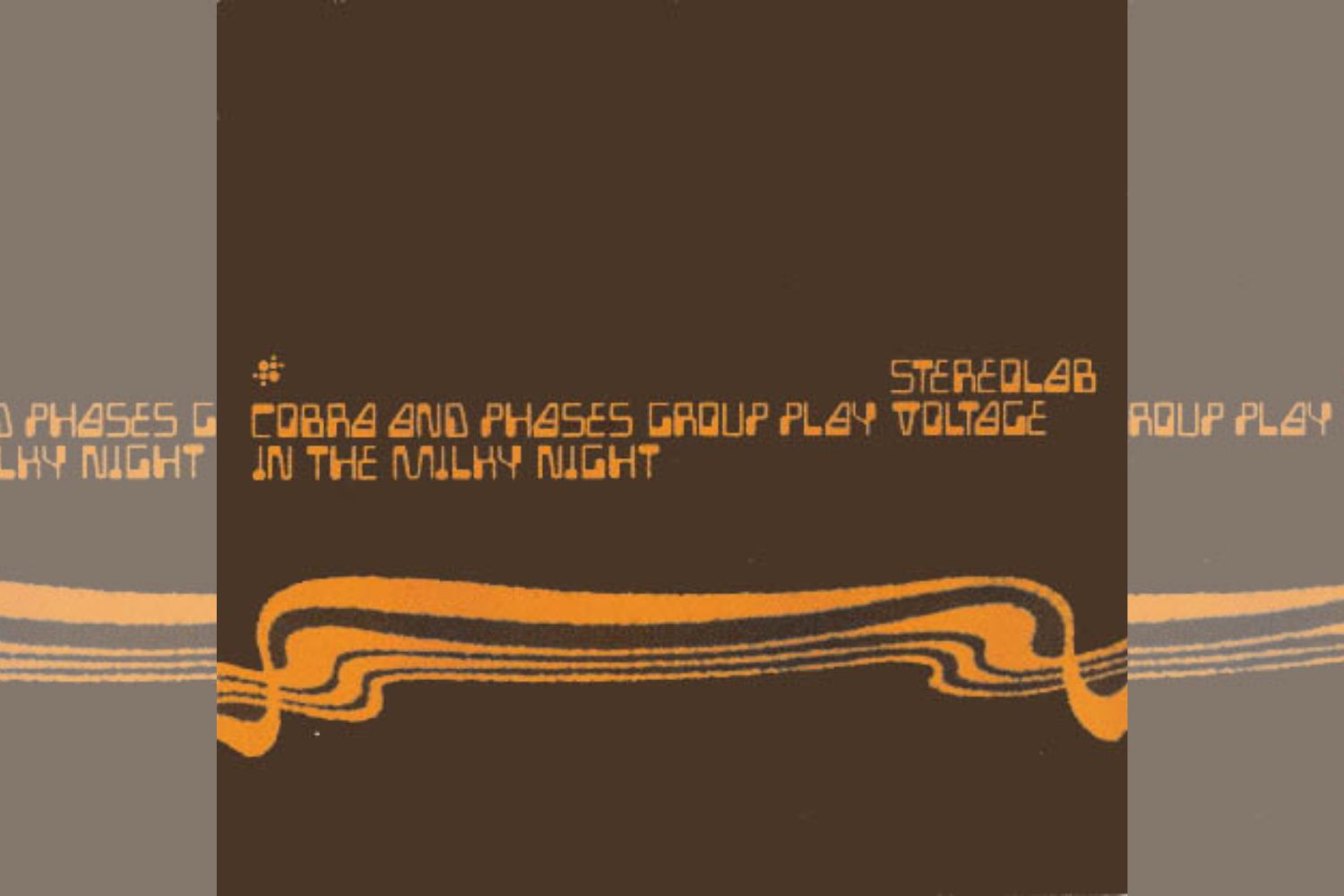
So when Stereolab released Cobra and Phases Group Play Voltage in the Milky Night in 1999, two years after their kaleidoscopic lounge-pop masterpiece Dots and Loops, they were just following a tradition of sorts. From their formation in the early ‘90s in London by unemployed twentysomethings Tim Gane and Laetitia Sadier, Stereolab found themselves in a constant state of evolution. Early singles like 1991’s “Super-Electric” paired the repetition of krautrock pioneers Neu! with The Velvet Underground’s pioneering noise-rock primitivism, clamping down on a one-chord drone for several measures at a time. But in short order, drones turned into grooves, one chord became two and three chords, and 4/4 gave way to 5/4 and ⅞. To identify Stereolab’s signature sound, at least in their first decade, depended entirely upon what album you were listening to at the time.
Cobra and Phases Group does all of that at once, a kitchen-sink album that seems to capture every last facet of the band’s sound, no matter how peculiar, in one self-contained studio album that threatens to lose containment at any given time throughout its 76 minutes. It’s a beautiful mess, the album in which Stereolab threw everything at the wall regardless of whether it stuck—but to their credit, nearly all of it does.
Despite the more-is-more nature of the album, in its individual parts it doesn’t seem any more inaccessible or indulgent than any other Stereolab album (for the most part, hang with me). Where their earlier noise-pop drones found the band at their most direct, the jazz, lounge and psych-pop sounds here are undeniably fun and at times even comprise their best material. But even when simply setting the stage, as they do on the modular synth-heavy cool jazz jam session “Fuses,” it’s a dazzling sound regardless.
Cobra and Phases Group isn’t a wholly accessible album from front to back, and indeed a considerable chunk of it comprises some of the most difficult material of their Technicolor pop period. But its tracklist is lined with stellar oddball pop numbers like the midcentury modern funk of “Infinity Girl,” or the motorik jazz of “Strobo Acceleration” or the twinge of dissonance on “Op Hop Detonation,” the latter adding a dose of the Marxism-informed revolutionary politics that colored their 1994 album Mars Audiac Quintet (“Suffer you little children, remain passive and fearful, suffer and don’t grow out of it”). “People Do It All the Time” is a space-age Bacharach groove session, complete with trumpet, and various moments channel Pet Sounds-era Beach Boys, like “The Spiracles” and the eight-minute “Caleidoscopic Gaze” (which is honestly a bit long, I’ll admit). And “Puncture in the Radax Permutation,” a song seemingly about a lost robot, opens with a darker, more tense permutation of a similar motif, before undergoing a progression into Theremin exotica and marimba looping, Vocoder transmission space-psych.
There’s also “The Free Design,” the album’s sole single, a dizzying and spectacular three-plus minutes of 6/8 jazz-pop maximalism, Brubeck and Jobim looping in space. I’ll admit that while Cobra and Phases Group might not be the most cohesive album of the band’s career, it’s overflowing with glorious standouts—this in particular. It’s far from a consensus opinion, but it’s my favorite Stereolab song. After 27 years, I’m still under its spell.
Yet “Blue Milk” is the moment where some listeners will find their skip-button finger start to itch, and fair enough, I suppose—15 minutes of dissonant krautrock repetition isn’t for everyone, and it’s not exactly “Sister Ray.” But while it demands a fair amount of patience on the part of the listener, there are rewards to be found therein, offering a fascinating evolution despite being one of their least conventionally pretty moments on record.
Throughout Stereolab’s journey of sonic expansion, critical favor had mostly followed them wherever they ventured, Emperor Tomato Ketchup and Dots and Loops having been the most celebrated of their consistently evolving output to date. Cobra and Phases saw much of that critical support collapse overnight, the overstuffed nature of the album coupled with its detached cool drawing everything from shrugs to venomous screeds. Rolling Stone’s review noted that Stereolab had an “attitude problem,” namely that “They never have quite enough.” Pitchfork’s Brent DiCrescenzo countered the band’s chaotic tangle of sounds with a similarly inscrutable review—until he gets to the part about “Frigid noodling, insipid harmonies, and unmemorable repetition.” And then there was the review written by NME critic Johnny Cigarettes that actually included a mention of Hitler. In the 2019 reissue of the album, Gane acknowledged Cigarettes’ 0-out-of-10 review, saying that they were on tour when they were faxed the review that published under the headline, “Gane Over.” “Well I’m still here,” he said.
Cobra and Phases Group isn’t above criticism by any means, but the irony-poisoned perspective of some of the at-least-as-indulgent snark they received vastly overstated the matter. Sure, it’s a little bit of a shambles, but they’re glorious, exquisite shambles, a breathtaking indulgence. They took their major label budget, which never made that much sense in the first place, and ran with it, following every impulse, chasing every creative spark. Frankly, I’d be more disappointed in them if they hadn’t.
Gane, for his part, described Cobra and Phases Group as their “weirdest album,” yet the chaos, as with that of 2001’s Sound Dust, makes it one of his favorites. “I like things that are sprawling and not identified really easily, not easy to digest but there’s a lot of possibilities in them,” he told The Guardian in 2019.
I bought a CD copy of Cobra and Phases Group on the same day I picked up Nine Inch Nails’ double-disc The Fragile. Fall of 1999 was apparently a good time to be a major label artist with too many ideas, and the beginning of the end of an era in which releasing them all was still a viable option (though only The Fragile went double platinum). Neither album sounded much alike but both offered similar challenges in terms of an album listening experience and whether too much of a good thing was a bad thing. Yet I don’t remember it being a problem—if I skipped over the entirety of “Blue Milk,” well, I still had “Infinity Girl” and “The Free Design” and “Op Hop Detonation.” Much like Gane, I hear nothing but possibilities.
Stereolab : Cobra and Phases Group Play Voltage in the Milky Night
Note: When you buy something through our affiliate links, Treble receives a commission. All albums we cover are chosen by our editors and contributors.
Treble is supported by its patrons. Become a member of our Patreon, get access to subscriber benefits, and help an independent media outlet continue delivering articles like these.