

Mono : Snowdrop

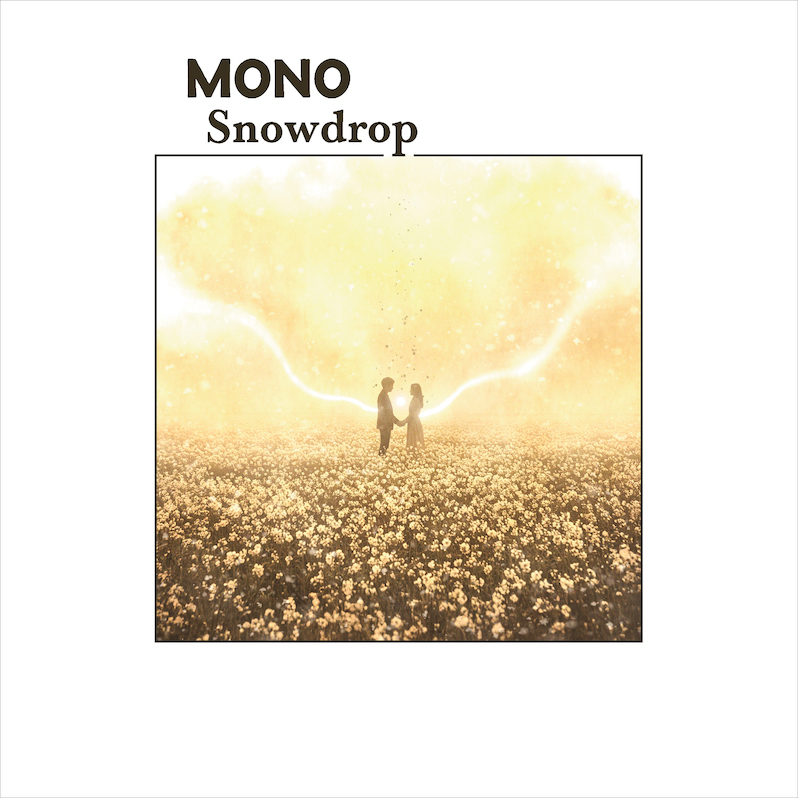
It wasn’t a trend per se, but in the late ‘90s, three Japanese bands of exceptional talent voyaged to the States and were welcomed with open arms: psych-rock sorcerers Acid Mothers Temple, post-metal stage strutters Boris and Mono. It’s remarkable enough that the trio of bands are all still active, touring and making new music. Even more notable, however, is that while Mono’s contemporaries occasionally release music of negligible quality, Mono has still maintained the high standard the quartet set for themselves with their Under the Pipal Tree debut in 2001.
The proof is in the pudding—or, rather, in the purin—on Mono’s 13th studio effort, Snowdrop. Just like poker players have a “tell,” so do songs by eminently admired post-rock instrumentalists Mono. Faintly reminiscent of The Twilight Sad or Godspeed, but not enough to call them copycats, Mono songs typically start on a gentle note, slowly crescendo into a state of guitar noise, burst into a shimmering shower of affirmation, and conclude with a carefully crafted, rarely abrupt descent. Perhaps because Mono fans are accustomed to the shape of the band’s songs, or more likely due to the fact that this is the post-rock squadron’s 13th studio effort, Snowdrop is their smoothest deployment thus far.
With all that in mind, after well over a decade of making instrumental music that invariably enchants, often penetrates the soul and rarely alienates, Mono faced a new, real-world challenge this time around. Even though it does not contain lyrics, Snowdrop is a document of sorts that captures the emotional tumult of musicians recovering from tragedy and the soul-burrowing grief that accompanies it. All four of the multi-instrumentalists— ead guitarist Takaakira “Taka” Goto, rhythm guitarist Hideki “Yoda” Suematsu, bassist Tamaki Kunishi and drummer Dahm Majuri Cipolla—grieved the loss of Steve Albini, who engineered more than half of their studio albums.
Producing in Albini’s stead—quite literally, as Snowdrop was recorded in the engineer’s Electrical Audio facility—is another esteemed producer, Brad Wood, who started twiddling the knobs for Snowdrop in September. (In a devastating turn of events, Wood suffered his own personal tragedy when his wife died the following February.) Despite or perhaps because of the cloud of loss that shadowed the group and perhaps the recording itself during the creation of Snowdrop, the musicians (three of whom play glockenspiel too, wouldn’t you know) write and perform more delicately than ever. It’s if they were the ones consoling a distraught person who just lost a loved one, even though that role was theirs for the taking.
Mono’s sensitivity toward human emotion and even the human condition reveals itself in the band’s knack for expertly executed evocative music, which is felt immediately at the album’s soothing start. Mono took great pains, or so it seems, to ensure that Snowdrop was not a sad or even somber eight-song affair. The leadoff title song recalls the beatific guitar tones that Mogwai utilizes in their most tender moment; all in all, it feels like Mono, altogether, are draping a warm blanket over a despondent widow or widower. After a few hushed minutes, “Snowdrop”—and “Statice,” which comes later in the listen—bursts open like that grieving soul finally breaking down in tears.
Other Snowdrop songs (“Winter Daphne,” “Hedera”) are even more peripatetic, though never downright jarring—again, much like the cascade of emotions one experiences while processing grief. The boisterous “Gerbera” is a pure exaltation of life, while “Shion” leaves an opening for the afflicted to shout from the rooftops about how cruel life can be. With the grief-stricken main character of Snowdrop now depleted of energy, the “Bells of Ireland” tolls (albeit with piano instead). The closing song, “Farewell to Spring,” functions as an epilogue of sorts, with the irony being that Snowdrop encapsulates the process of nature and human beings regenerating themselves, which poetically occurs in that very season.
Snowdrop doesn’t measure up to the musical perfection that Mono achieved on Hymn to the Immortal Wind. But we tend to forget that human beings aren’t biologically drawn to music, and art at large, to witness performative excellence. We listen to songs and attend concerts for emotional relatability, and even collective catharsis. Mono’s focus on that North Star is what makes Snowdrop not just a winner but a transcendent work in which the band lays bare their grief, hope and desire to live—all without speaking a single word.
Label: Temporary Residence
Year: 2026
Similar Albums:

Mono : Snowdrop
Note: When you buy something through our affiliate links, Treble receives a commission. All albums we cover are chosen by our editors and contributors.
