

“I’d like to know I’m not the only one,” barks Tobias Osland in “The Scene,” the leadoff track from Hammok‘s sophomore album When Does This Place Become Our Scene, a phrase he slightly alters just a couple lines later: “When does a space become a scene?”
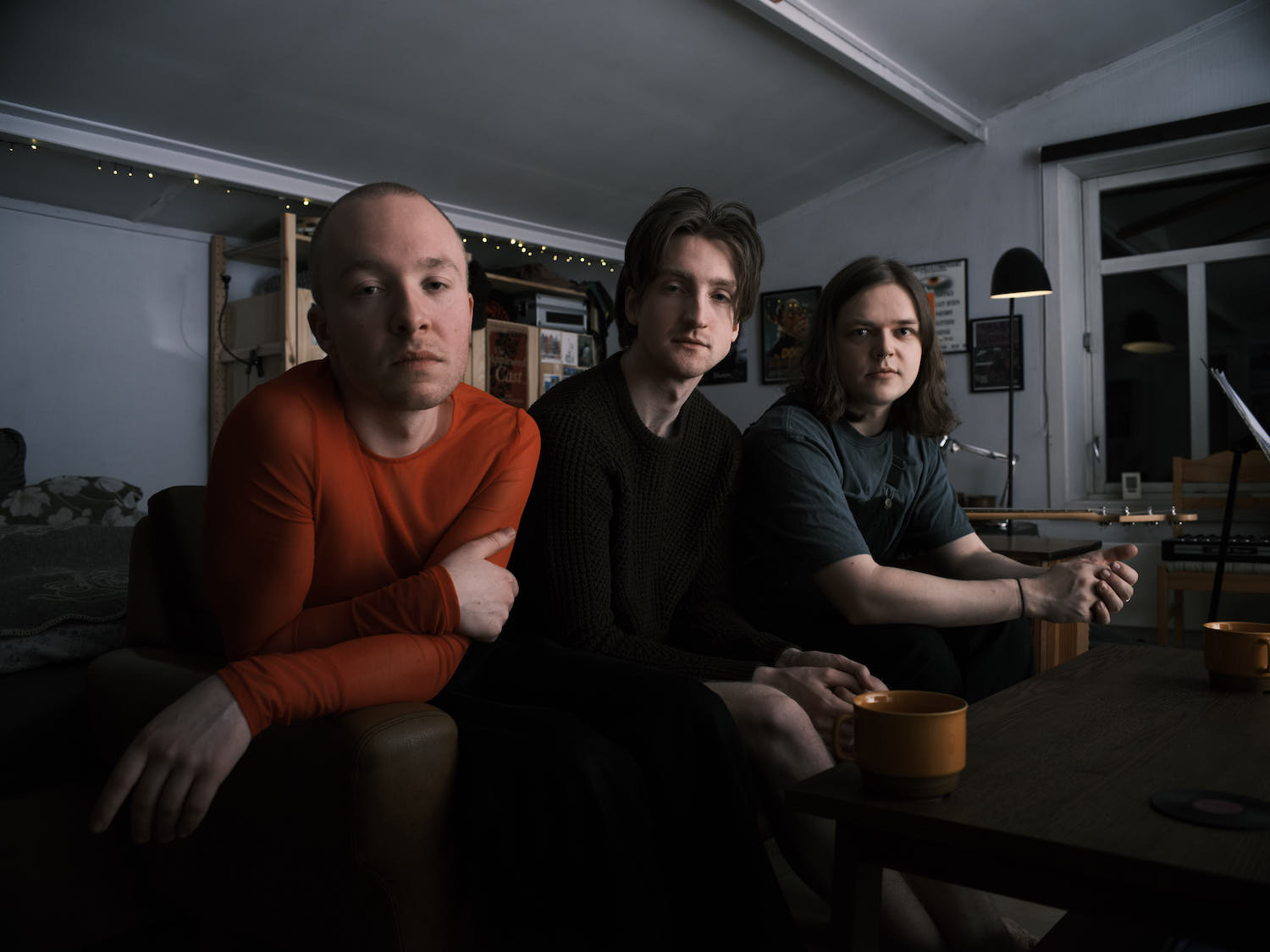
For the Norwegian post-hardcore trio, who formed during the 2020 Covid pandemic, these are both practical and existential questions. Punk and hardcore bands thrive in an active scene, but a year and a half without a crowd to play for proved nearly unbearable for every band. But the members of Hammok—guitarist/vocalist Osland, bassist Ole Benjamin Thomassen and drummer Ferdinand Aasheim—made the most of it, plotting an EP, which eventually led to a second EP, and then the release of their self-recorded 2024 debut album, Look How Long Lasting Everything Is Moving Forward For Once, one of that year’s underrated rippers.
The time spent honing their sound and tightening up their performance paid off once lockdown restrictions were lifted, leading to an even tighter and more dynamic sound on When Does This Place Become A Scene, out this week via Sargent House. Similar to bands such as Fucked Up, Gouge Away or Drug Church, Hammok’s sound is rooted in hardcore but with well defined melodies and hooks, and a playful experimentalism that pulls their aggressive sound into different, unexpected directions. And as evident in songs like “The Scene,” the themes on the album frequently return to the idea of community and creating something real, which Osland explains through an observation about their live performances.
“The live show is always about the crowd,” he says over a Zoom call from the band’s Oslo rehearsal space, backed by a wall of amps and a Sabrina Carpenter poster. “It’s not about just trying to grab your attention but having a conversation. That’s the most important thing for me, that it’s somehow inclusive in a way, that it makes you want to join whatever it is, whether it’s a movement or a scene or even just a vibe or a feeling. If it’s funny, if it’s dark, if it’s saying something stupid, it’s trying to shake you up in a way, to make you react, whatever way that is.”
The members of Hammok spoke to me about starting a hardcore band without being able to play live shows, learning the ropes as you go along, and why human interaction always outweighs social media.
Treble: Hammok started during lockdown, when there were no live shows happening. With no avenues to play in front of people or feed off energy, did that present any challenge to you?
Tobias Osland: Yeah, we couldn’t test anything out, nothing was tested on anything but us. So you have to be your own source of energy.
Ferdinand Aasheim: Yeah, it got very studio-based in the first year.
TO: It’s funny having a hardcore band be studio first. That’s the most pandemic thing ever, because the studio isn’t even the second thing, it’s the third or fourth thing. You make a record to go on tour, but that was very much the opposite way around.
FA: Looking back, though, I’m kind of happy for it, because when we played our first live show, we were so fucking ready.
TO: At sound check, that was the first time we heard our songs onstage, and we played the song “J/D/F,” and it was such a kick. We were in a shitty practice space for a year, over a year? Whatever it was, it was a long time. So when we kicked into that first riff it felt so huge. This is a song, and it moves the air and it’s really loud. It felt so great.
Ole Benjamin Thomassen: I also remember walking from the place we lived to the rehearsal space, and saying if someone asked us to play a show in 10 minutes…
FA: We’re ready.
TO: We were always ready.
OBT: We could play [our songs] blindfolded and backwards.
FA: We had a lot of songs in the bank already, so it was never an issue where we had to fill out a set or anything.
TO: Play a Weezer song just to fill time. (Laughs)
Treble: At the beginning, was there a specific idea of what the band was going to be, that it would be hardcore or that you’d incorporate different styles?
TO: We had the experience of doing this band in a different form when we were kids. We just started a band, we didn’t start a type of band, so we didn’t have that on our backs, “oh we’re going to do this kind of band and take inspiration from these bands.” It was never like that, and when we started up during the pandemic, we wanted to do five singles, get those mixed, put those out during the year and make an EP, and then whatever’s gonna happen is gonna happen. It’s always been in our DNA to make certain types of music. It’s always gonna be in a certain form or a certain vibe, but that can be stretched pretty far. That can be influenced by what you’re listening to, what’s happening in the world, where you are.
FA: It came together pretty naturally, with all of us listening to the same music and wanting to do high energy live shows.
Treble: Your first album, Look How Long Lasting Everything Is Moving Forward For Once was self-produced. Was that a learning experience for you?
TO: (laughs) Yeah, it was! Everything has been. But making an album, that’s such a different thing than anything else. It’s so much more work. Making an EP is fun, you can do that in your spare time. But making an album, it becomes a whole different thing to do. So the first album is very much an amalgamation of learning. Everything is, but knowing it’s the first album and kind of leaning into that, going into it knowing that you’re making a statement. And I feel like this one is a reaction to finishing that album and feeling almost happy to do something different, putting that aside and focusing on something new and finding that sound, it felt more like a [sense of] freedom making the demos and making the songs for the new album. Because the first album was very much—we knew we wanted to make an album because we wanted to tour and play shows, so we had a deadline and there was a whole thing, so when that was over, it felt nice to kind of just be free flowing and making lots of stuff, and I somehow caught that wave of inspiration. And all of that fell into a body of work that kind of defined itself. It kind of came together pretty quickly. But you’re always learning, always stumbling across something new. You’re learning how to edit drums, how to export something the right way and not destroy the song or destroy the sound. It’s all kind of chaotic until it’s done, and then it’s over.
Treble: Once you did start playing shows, how much did that influence the music that you wrote afterward?
TO: I think songs like “Gooning for Free” would not exist if the live element was not very present. Right now, being a live band is not more important than anything else, but it is a huge part. That’s where you meet your people, where you do your face-to-face interaction which is the most important thing. Online is kind of a hellscape and it’s all fucked because of rich people destroying the world. So meeting actual people, that is the root of the album, just traveling to a place, meeting people who care in a real way about the community, about the music, about the culture. And they show up with energy and they give it to you and you give it back. You have a scene, you have a community, and you have a place to go where people care. It all goes in a circle.
Treble: That in-person energy and community interaction is so important to hardcore—which is sort of a recurring theme on When Does This Place Become Our Scene—but social media and online spaces have become this whole other thing. Does it feel to you like what happens online can be detrimental to that?
TO: I think sometimes the internet is taking all of the attention and kind of steering everything. People were freaking out when they noticed Geese had this whole digital marketing campaign on TikTok. But I do think…almost every place has young kids who are in bands, playing in bands, showing up and supporting other bands, and so many bands that are doing good in the hardcore scene are based on the principle of playing shows and giving a shit about their community. Of course you have the Turnstiles, and Drain and Show Me the Body. A lot of these, they’re grassroots grown bands and they’re doing things the right way and people are really happy to be there. And sometimes the internet is just there to facilitate this. And sometimes a label is trying to pay a bunch of influencers to make something cool. But if the music isn’t good, that isn’t going to work. If it’s real and it’s good, I’d like to believe that it’ll break through and mean something.
Treble is supported by its patrons. Become a member of our Patreon, get access to subscriber benefits, and help an independent media outlet continue delivering articles like these.