

Parts and Labor give a track-by-track breakdown of new album Set of All Sets, their first in 15 years

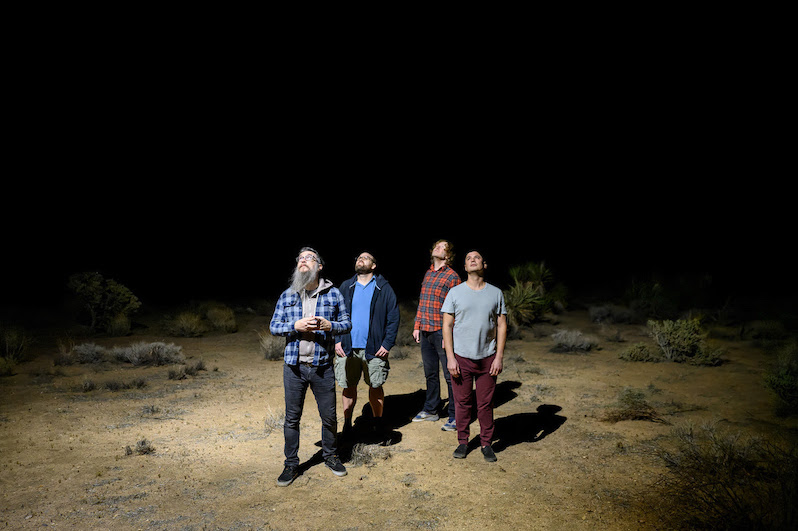
In the annals of the vibrant DIY Williamsburg underground rock scene of the late ’90s and 2000s, Parts & Labor, alongside peers like Oneida and Liars, were its noisy catalysts who were front and center of a movement that has achieved stuff-of-absolute-legend status. Back then, you couldn’t find a makeshift warehouse show, sweaty rooftop party or local park gig that didn’t feature Parts & Labor on the bill. Led by its two cofounding constants, guitarist, keyboardist and vocalist Dan Friel and bassist and co-singer BJ Warshaw with music scribe/drummer Christopher Weingarten and, later on, Joe Wong behind the kit, P&L unleashed a Day-Glo maelstrom of glorious synth noise chunks, arena-tailored Hüsker Dü-ish pop melodies, fist-pumping protest anthems and wildly experimental goodness over the course of five seminal albums and a few EP’s in a productive decade-long period.
Then sometime after 2011’s Constant Future, they went on hiatus. Until now.
In a case of completely unexpected and entirely welcome comebacks, Parts & Labor have made their grand return back into the fold–in a ginormously epic way. The sprawling Set Of All Sets is friggin’ huge in every possible way: its 79-minute double album length, its double-drummer onslaught (both Weingarten and Wong have joined forces here) and its massive sonics and glitchy and blown-out majesty. Without missing a beat after a decade-and-a-half away, Set Of All Sets finds Parts & Labor hitting on all cylinders of cosmic power.
Here, Friel and Warshaw go deep on every track, lyrically, sonically and aesthetically, that make up Parts & Labor’s first album in 15 long years. Read their commentary and hear the album in its entirety.
SIDE A
“Endless Cycle Pt. 1: Repetition Nil”
BJ Warshaw: From the outset, we knew we needed a big song to open this big record. But we also intentionally wanted to defy expectations, and what better way than a two and a half minute ambient intro before the band comes crashing in. It’s meant to be one of many mission statements for the record and this new double drummer version of the band. I wrote it near linearly on an acoustic piano, and it was one of those rare and beautiful moments where the lyrics just tumbled out right in place. Like many of my lyrics for this record, there are antimonious and dueling meanings, depending on how you view the words. Sometimes I think it’s about the ceaseless negative feedback loops of bad human behavior, our endless cycling around self destruction. Other times, it’s the complete opposite, a response to that cynicism, a call to action, we will not repeat the mistakes of the past. “Repetition? Nil!” The end crescendo is an imperfect and noisy experiment with Shepard tones, meant to feel physically like levitating beyond Earthly confines.
“Endless Cycle Pt. 2: Edges of Forgetting”
BJ Warshaw: In contrast to “Repetition Nil,” this was one of the most stubbornly elusive tracks out of my contributions to the album. There are tens of different demo versions, entirely different songs and failed attempts to burst forth from the heaviness of the preceding track in a way that felt right. But it all, eventually, came together. In the year and change before we decided to take a stab at reuniting Parts & Labor, I was grappling with the deaths of multiple loved ones in a very short time period, especially my Aunt Julie. I was meditating on the impermanence of things, and about that slow continued dying that happens after physical death, the dying of our memories of those we held dear. And yet, I land in a place of tremendous awe towards the whole thing, clinging to my gratitude over life shared. We dwell perpetually in a storm before a permanent calm. Matter can neither be created nor destroyed. It just goes on and on and on.
“Many Worlds”
BJ Warshaw: I dabble constantly in trying to understand higher mathematics and quantum physics, and am light obsessed with notions of multiple universes. For me, the concept of infinite realities can be equally comforting and anxiety inducing. I tend towards overthinking, and always wonder about life’s decision points, about the versions of ourselves that might have been, or might be on some other plane beyond our reach. Metaphors abound in this one, then, from four-dimensional hypercubes to Schrödinger’s Cat, all in service of wondering where the paths not taken may have led. And harkening the “observer effect” in quantum mechanics, “Many Worlds” musically exists in two different keys, depending on how you choose to hear it.
“Descending”
BJ Warshaw: One of three interludes that…
SIDE B
“Haunted Limbs”
Dan Friel: Most of my songs on this record are inspired by reading about 19th century utopian colonies, trying to capture that ecstatic belief in the future. “Haunted Limbs” basically sums up that rabid optimism, both sonically, and with the lyric “It haunts us like a limb we haven’t grown yet.” Sonically I wanted to try jumping back and forth between the more punk/metal drum influences on our earlier records, and the droning krautrock of the later stuff, which this song does, leaping back and forth between those two modes, faster and faster, as the song goes on. This song also ended up being a little bit about reforming the band, and the feeling of unfinished business calling out to you.
“Seamripper”
Dan Friel: In writing a set of songs about utopians, I needed to write about the alternative, a people who are “all broken and frayed, all broke and afraid.” It’s probably the most evil sounding riff in the Parts & Labor catalog, by a long shot. A major double-drums reference point for us was the Melvins + Big Business albums from the 2000s, and we really leaned into that kind of sludge here (and in a few other spots). I also wanted somewhere to let some of our harsher, stranger electronics take the lead, which works out well on this one. The chorus shares some DNA with our other songs, but the rest is new territory.
“Arterial Material”
BJ Warshaw: This one started with an hastily sequenced electronic beat, synth bass, and keyboard melody. I had been deeply nerding out on singeli, an incredibly frantic genre of electronic music out of Tanzania, and the label Nyege Nyege Tapes (as well as their sister label Hakuna Kulala), especially the Sounds of Sisso comp. Infuckingcredible shit, still sounds futuristic nearly 10 years on. Gradually, the chorus melody crept in, during a time where I was going through an absolute litany of back-to-back health issues and deeply feeling my mortality. So the song became a bit of a diatribe against the challenges of seeking health care, especially in the US, against my inevitable physical decline, against never knowing for certain whether a medical treatment will be a boon or bane. That said, I’m no MAHA stooge. I believe, strongly, in scientific methods, and feel so fortunate that I was able to get a life-saving cervical spinal fusion surgery right at the start of the pandemic, among tons of other care. The song kicks off with a noise collage created from audiology tests and holding my hearing aids (prescribed to help mitigate severe tinnitus) tightly in my fist until they produced feedback. There’s also a nearly 20-second break of dead silence in the middle. Originally, it was going to be a gnarly harsh noise solo, but at one point I muted it in the session and the drop to silence was so much more impactful and surprising, so we kept it that way. I like that it forces the listener to hear their own surroundings, bodies, or even tinnitus. It might sound weird or self-deprecating to say, but those 20 seconds of silence comprise one of my favorite moments of the album.
“Anti-Lions and Lemonade”
Dan Friel: This one came together late, with the rest of the band constantly nudging me to flesh it out, despite my doubts. It ended up being about the unease of living in the imperial core, and seeing the walls between you and the rest of the world. The title and lyrics reference Charles Fourier, a French utopian socialist who inspired the formation of several North American “phalanxes,” believing that they were creating a world so perfect that the oceans would turn into lemonade, and the lions of the world would lay down and become domesticated.
“Descending”
BJ Warshaw: …when played back-to-back form an…
SIDE C
“Endless Cycle Pt. 3: Better Run”
Dan Friel: I wrote this while thinking about stubborn elderly politicians. It’s about older generations clinging to power, the younger cohort that they eventually give way to, and that cycle repeating itself a few decades down the road. I like that “Better Run” can also mean superior iteration. I also acknowledge that I am now old, turning 50, and seeing people my age become the calcified apologists they might have raged against in their youth.
“Endless Cycle Pt. 4: Working in Storm”
Dan Friel: I learned the phrase “Working in Storm” from the book “Paradise Now: The Story of American Utopianism” by Chris Jennings. It’s a phrase used at the Oneida perfectionist colony to describe the 300-person community coming together to complete a collective task, with live music. Sonically this is a pretty straightforward tribute to the Japanese band Boredoms’ multi-drummer albums, with a very Parts & Labor melody on top, played by our friend and amazing violist Karen Waltuch.
“Indecision Tree”
BJ Warshaw: With most of my other songs on the record being exceedingly maximalist, I wanted to experiment with more spaciousness, patience, and building tension. I had the keyboard hook first, and wasn’t sure whether it was cool enough to pursue, but Dan encouraged me. I took a stab at it one day, and it was another moment where the song just fell out, written linearly, part leading into part in an intuitive and natural way. The lyrics overtly concern the climate crisis, or, rather, our inability to collectively do something about the known impending ecological collapse for longer than I’ve been alive. If someone would give me the budget, I’d love to make a music video for this song where the forests come alive, Ent-style, and level every oil refinery on Earth to the ground.
“Descending”
BJ Warshaw: …infinite loop. I’m playing again with hallucinatory auditory effects like Shephard tones, using chord inversions to make the descending whole tone chords feel like a constant, perpetual, sinking motion. It’s all meant to invoke the queasy feeling of our current situation, caught in a nascent Anthropocene of declining sustainability, assaulted by a kind of static chaos that feels to me like we’re both plummeting and standing still at the same time. It’s also a not so subtle nod and response to a previous Parts & Labor outing, our split album with Tyondai Braxton, Rise, Rise, Rise.
SIDE D
“Parallel Tracks”
Dan Friel: This one ties together BJ and my two parallel themes on this record: parallel universes, and utopian dreams. The narrators can see the track they want to be on, as theirs falls apart. Musically I wanted to open a song with vocals, and then fuck ’em up, like garbled transmissions to/from the life they want.
“Off by One”
BJ Warshaw: I find this song the hardest to talk about, and I feel like more than others benefits from being open to some degree of interpretation. Suffice it to say, it’s a pretty little pop song masking my abject despondence over humanity’s never-ending cycles of violence generally, and recent genocides in Gaza and Ukraine specifically. But, just as acts of violence recursively replicate, so do acts of solidarity, as do decisions towards inaction. What do you choose?
“Like They’re Here to Stay”
Dan Friel: This one ended up serving as a hallucinatory lullaby send-off to my utopian theme at the end of the album, singing about the way the drive to make a more peaceful and equitable world just sticks around, no matter the state of things. Musically I love the way the two drum sets call back and forth here, and don’t tell anyone, but I like that it sounds like the intro to Paradise City.
“Set of All Sets”
BJ Warshaw: I granted myself full indulgence of my nerdiest preoccupations on this one, where I’ve envisioned some kind metaphysical court hearing where the concept of Nothing is bearing judgement upon the concept of Infinity. I find the paradoxes inherent in contemplating infinity (or more accurately infinities, as there’s infinitely many of them) oddly comforting. It’s the closest I get to having some kind of spirituality, or, within my atheistic and secular humanist tendencies, a gut-level awe over how little we understand in this unbearably vast existence. From all of that, which entity wins, ultimately? Nothingness or everythingness? Are they even different things? In the end, the shout-along finale remains all that I can be really certain of: that no future is certain, that if you’re going to do something, you better do it now. That this (gesturing at everything) all may be of little significance. But the doing, in and of itself, may nonetheless be everything for you, and the many possible other yous, and those you love, and those that love you back.
Treble is supported by its patrons. Become a member of our Patreon, get access to subscriber benefits, and help an independent media outlet continue delivering articles like these.
