


The word ‘folk’ is thrown around often enough in popular music discourse that it can be tricky to remember that it does, in fact, have a meaning beyond being a slightly lazy shorthand for “this has an acoustic guitar in it!” And this is, of course, in no sense a slight on the many artists who (by choice or otherwise) have become entangled with the term or any of its offshoots (folk-punk, folk-pop, folk-rock, and so on). I don’t blame them for it, nor do I have any real problems with the multitude of people who are happy to apply the term in cases where my inflamed sense of pedantry tells me another description would be preferable. That’s not because I don’t think I’m right. I just don’t have the energy. I’m hopelessly outnumbered, and giving a shit about that sort of thing is the definition of a lost cause. My efforts would be far better spent fighting slightly more winnable music battles (like convincing everyone that The Strokes are not that good and did hardly anything original or worth talking about, for example).
But every now and again, along comes a band to whom the “folk” label is attached, and—lo and behold—it actually kind of makes sense. Belle and Sebastian’s 1996 debut record, Tigermilk, is about so much more than whipping out an acoustic guitar and calling it a day. This is an album that is dedicated to building a connection with you—one that’s so easy, so patient, so warm, and so inviting that by the time you even notice it, you’re completely gripped already.
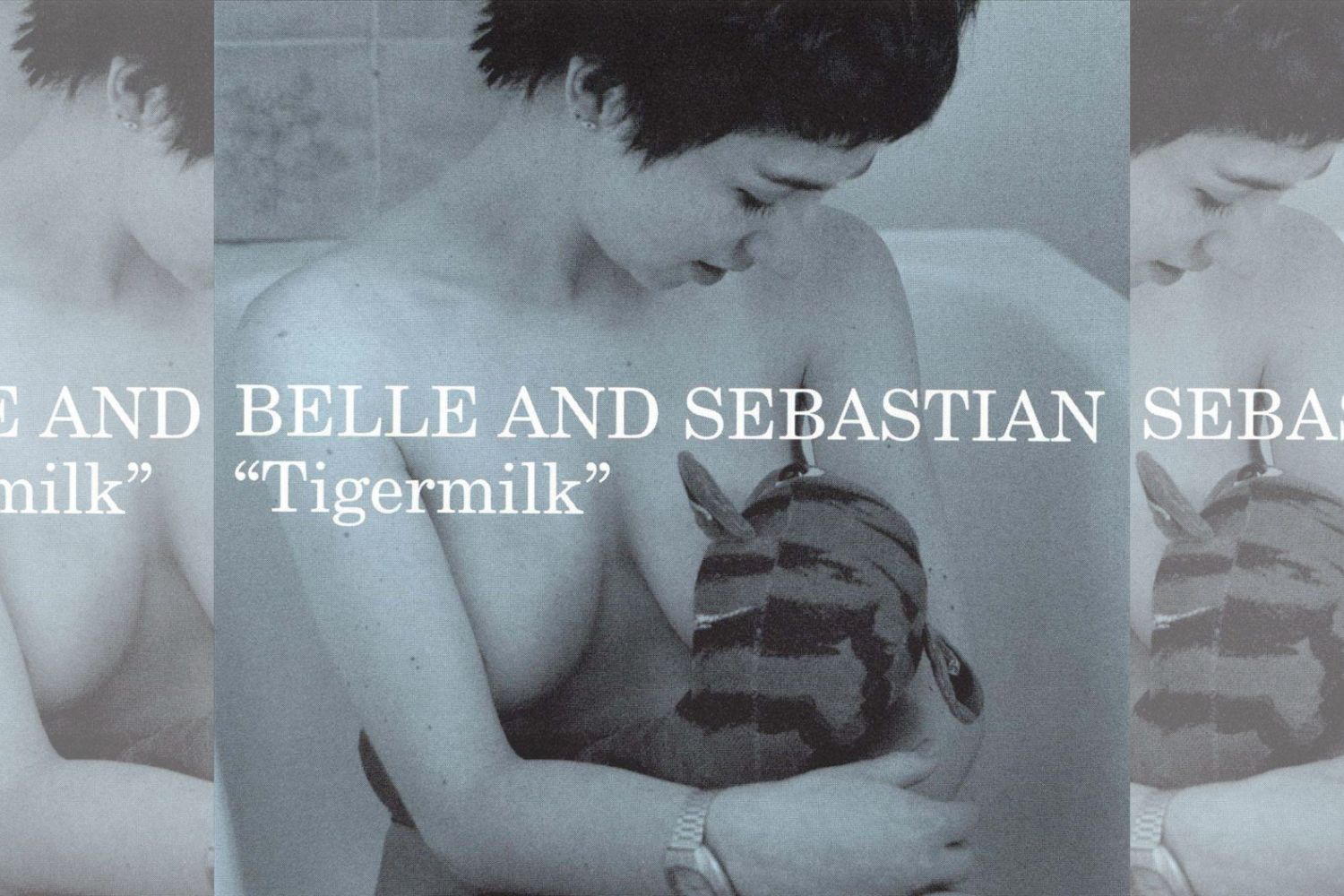
The recording sessions for the album, which took place over three days, were the first time that all band members had actually played together as a group. This state of affairs was a product of the fluid and uncertain journey that the Glasgow group took toward its own inception. It originated as a solo project that singer, songwriter, and eventual frontman Stuart Murdoch never actually expected to be able to transform into a fully-fledged band; Murdoch admits that “the idea of the group … was in flux” before, during, and, to some extent even after their debut had been recorded (a fact which led to Murdoch’s decision to use a photo of his then-girlfriend Joanne Kenney as the album cover, rather than a picture of the band themselves).
As a result of this somewhat cobbled-together collaboration, many of the arrangements across Tigermilk were written on the fly during the recording process, and though I don’t want to overstate my case, I don’t think it’s hard to see that more than just a thread of the folk tradition can be seen weaving its way through this notion of a group of loose-knit musicians playing together for the first time, ad-libbing and embellishing the songs as they go, and crafting an entire record of 10 tunes as part of a collective, semi-improvised, community process.
The case is helped, of course, by the fact that the entire album sounds blissfully, effortlessly beautiful. One need only listen to the gorgeous, bittersweet extended jamming that closes off “My Wandering Days Are Over,” for example—or the steady, euphoric crescendo that concludes “I Could Be Dreaming”—to get a sense that, despite being relatively unfamiliar with each other, the performers who made up the first incarnation of Belle and Sebastian could boast some scorching hot musical chemistry. It’s evident throughout every song, where a basic foundation—usually consisting of a blithe bassline that hops and bounces around an heartfelt, twinkling, indie-style guitar—is met with finely-tuned cascade of instrumentation, be it the twee jostling of tambourines, the low thrumming of a cello or the triumphant strike of a trumpet. The sounds build up together in spectacular fashion, feeling utterly busy, even thrilling, and yet never harsh, chaotic, or redundant; on the contrary, the album rarely sounds far from angelic, and indeed, to be so pretty and gentle—yet so thoroughly bursting with life—is one of Tigermilk’s most incredible achievements. It is sustained by an obvious musical camaraderie that makes the record feel wonderfully personal and intimate—and yet Murdoch’s lyricism and delivery always feels far too casual, clever, and grounded for the songs to ever become sickly sweet or sentimental.
That’s something else that feels earnestly folksy about Tigermilk. Belle and Sebastian love a good story, and the album is packed full of them. Murdoch’s vocals, overflowing with brightness and melody, are tightly interwoven with an endless tumble of all sorts of people and their turbulent tales. On this record, Murdoch explains how he “got married in a rush / To save a kid from being deported,” tells us of a moment when he was “so touched / I was moved to kick the crutches from my crippled friend,” and warns us that “Now I’m feeling dangerous / Riding on city buses for a hobby.” That this cavalcade of bizarre events all occur within the very first song, “The State I Am In,” should tell you all you need to know about the rest of the album, which is replete with immersive, slice-of-life trials and tribulations faced by a seemingly limitless cast of characters. The second song, “Expectations,” tells the story of a troubled schoolgirl harassed and belittled by her peers and her teachers alike, while “My Wandering Days Are Over” tells us how “The disenchanted pony / Left the town with the circus boy.”
Manyof the lyrics have a strong nostalgic quality, with some songs—like “Expectations,” “We Rule The School,” and “You’re Just A Baby”—mentioning school, and are sung to, or are implied to be from the perspective of, school-age characters. But this is hardly done with the intention of letting the listener get all hazy and letting rose-tinted goggles do all the heavy lifting. Rather, it’s because school, and adolescence generally, can be such an emotionally vivid, tumultuous time, and Murdoch makes the most of this fact for full storytelling advantage. There is certainly very little to make you feel warm and fuzzy about the events described in “Expectations” or “She’s Losing It,” for example, but it’s exactly that willingness to engage with people and stories in such candid detail that gives every line of Tigermilk such a powerful sense of depth, richness, and tender authenticity.
It might sound odd to say that an album that so thoroughly devotes itself to exploring the nitty-gritty—sometimes banal, sometimes intense—of other people’s lives is also capable of just getting you. But it’s precisely because of Murdoch’s knack for digging deeper that gives the strange sense that he might be able to dissect you, the listener, just as easily as any of the subjects of a Belle and Sebastian song. What’s more, by the end of the record, it’ll seem like a genuinely inviting prospect. Tigermilk’s great strength isn’t just that it can tell an interesting story; it’s that it can make every moment of those stories positively tingle with beauty, whether they be joyful, melancholic, or some fractal shade in between.
Treble is supported by its patrons. Become a member of our Patreon, get access to subscriber benefits, and help an independent media outlet continue delivering articles like these.
