
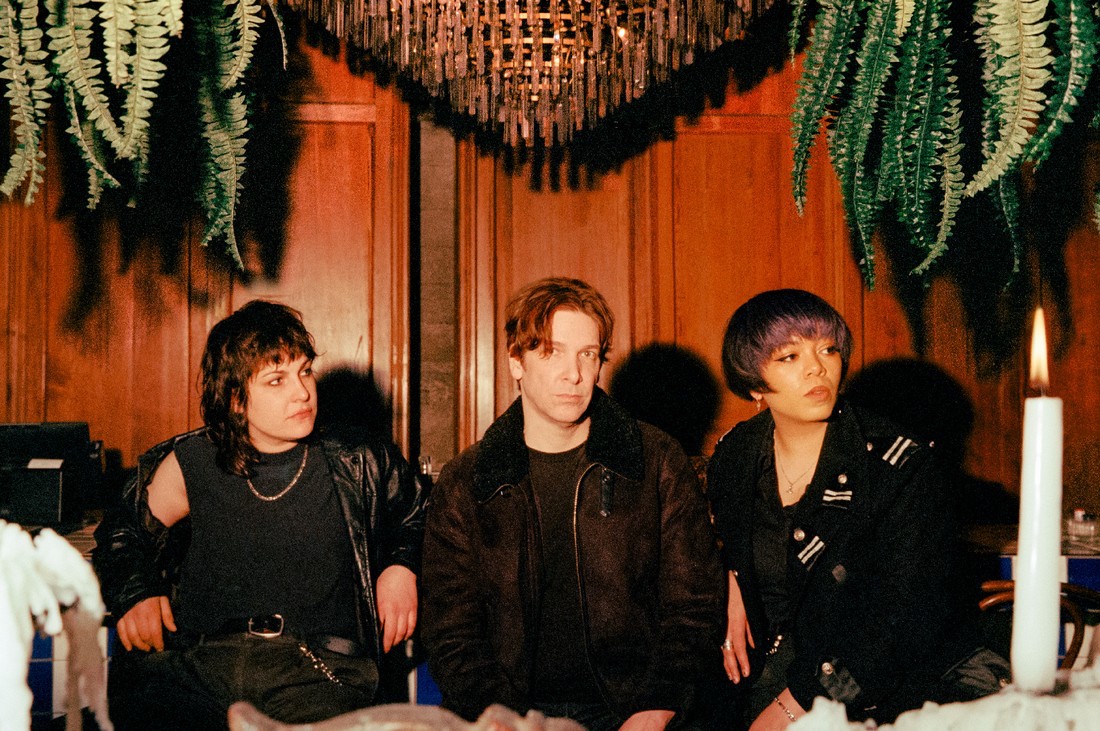
When everyone on the planet was stuck in place, Ganser released an album of jittery and agitated songs, hypercharged and explosive. For those who needed to feel a jolt of energy, 2020’s Just Look at That Sky provided a necessary shot in the arm, but it arrived at precisely the wrong time for the band to take the album on the road. So the members of the Chicago post-punk group made the best of it and started working on the next one, Animal Hospital, which arrives this month via felte, just slightly over five years since their previous LP.
Ganser aren’t the same band they were back in 2020. That’s true in a literal sense; co-founder, keyboardist and vocalist Nadia Garofalo left the band at the end of 2022, and afterward, guitarist Charlie Landsman likewise took a break from playing music. But founding members Alicia Gaines and Brian Cundiff are also joined by a new member, guitarist and vocalist Sophie Sputnik. In addition to the shift in personnel, however, Ganser have likewise expanded their musical palette on Animal Hospital, which was recorded with producer Angus Andrew of Liars. Much of the album harnesses the furious drive the band is known for, like the driving opener “Black Sand.” But the group open their sound into unexpected places as well, like with the spacey electronics of “Dig Until I Reach the Moon,” or the droning cosmic groove of “Grounding Exercises.”
“I want to be able to live in a lot of different moods,” Gaines said via a Zoom call from her home in Chicago. “And I think that’s something we pursue in soundtracking emotions, feelings, situations in that way. I think about my favorite records when I was 12, 13 years old, like Björk’s Homogenic, it’s like diving into a really deep ocean.
“There was a certain sense of experimentation before everything became so streaming driven,” she continues. “I love an album. I’ll still fight for the album format.”
Gaines spoke to us about the journey the band undertook over the past five years, Animal Hospital, the changing shape of the band and more.
Treble: It’s been five years since the release of Just Look at That Sky, which arrived right as pandemic was in full swing. How did that affect the direction of the band at the time?
Alicia Gaines: I mean, nothing was normal. So it felt very strange, but of course, a record we recorded in 2019 was resonating with people in 2020, so for us it felt like a bit of a time warp, because it was a snapshot of things before they went crazy, but that’s when everybody heard it. It was a time when we were connecting with people online and meeting new folks, whether it was other artists or writers, but it reflected a time we had already passed through. So when we started writing the new record, it was literally in quarantine, me and Brian writing music that felt very free in a way, because we had no expectation of anything happening. We started diving into what we call our sandbox, and just really indulging whatever we felt like writing without even a thought of whether it would come out. It was an interesting place to start. The world had kinda stopped and we were seeing everyone being squeezed through the eye of the same needle. It’s really rare for everyone to go through it at the same time and in the same way. It’s hard to gauge where everyone’s coming from, and their values, and how they react to the same emergency. It was really clarifying for folks. I don’t think we’ll ever see that again, unless something else terrible happens. (Laughs)
Treble: Knock on wood! (Laughs) So how far back did the work on Animal Hospital begin.
AG: Really, back in 2020. I can think about certain songs like “Lounger” getting written in a basement during 2020 and 2021, so I think now we’re doing the same thing where we’re metabolizing the feelings from that time but also moving out of that time, because it was the first time we got to play a record on the road, and really road test songs. So a lot of songs evolved a lot. We went on the road with Mclusky and with Idles, and we got to see how those songs worked in practice. “Lounger” is a good example, we did a version of that at Electrical Audio with Angus, before the primary recording sessions, and then changed it a bit. So there’s an iterative process with these songs, but that’s what happens. The first record we recorded in five days and it was like ripping off a band-aid. Now this one we’ve worked on for years and road tested, and record it in 17 days. So it’s like a deeper version of what we’ve done full-time.
Treble: The lineup of the band has changed a little bit as well. How did those comings and goings change the shape of the record?
AG: The band’s always been an overlap of everyone’s sensibilities and tastes and just a passing back and forth of ideas and lyrics and smashing things together. The reason that I don’t make music by myself is the surprise of working with other people. And obviously,. Going through the pandemic, people’s priorities change in terms of what they want to focus on and what they have the time and energy for, and that happened at different stages of this album, with the core being me and Brian, working through quarantine. And then continuing to write it with Charlie, and then Charlie wanted to take a break from music, which was completely amicable, so he recorded half the guitar, and then we brought in Dove (Hollis), whose an amazing guitarist and has a unique touch and widened our scale. And also with Sophie, we used to be co-workers, so I’ve known her for a bit, so she’s really brought in new tools as well, sos suddenly we have an alto and a soprano in the band. That’s always been how we approached things. It’s kind of like, whatever tool makes sense for the song, and I think the songs really lead the way in terms of who is doing what, who’s singing. But it really helps because it makes it less personal in a way, not that we avoid being personal, but we’re kind of soundtracking different feelings and emotions.
Treble: What are some of the feelings you wanted to capture on Animal Hospital?
AG: I think there’s a certain amount of remove, a certain amount of distance, you have songs like “Dig Until I Reach the Moon” that are about hiding away, and that’s something over the past few years, I think everyone’s had to do a little bit of hibernating and refocusing their energy. Then there are those white hot flashes—we have a song called “Creature Habits,” where the whole focus is “oh shit I’m late” and it’s kind of that white hot panic. So that’s kind of fun. I like exploring more mercurial things, but also having some really nice immediate punk songs, because we still love that. We played a DIY show recently in a pit in a skate park situation happening behind us, and that’s still very much something we’re a part of.
Treble: It feels like there’s a lot more experimentation with different sounds on this record.
AG: Yeah, part of it was the nature of writing at home. When shows weren’t possible, suddenly, every sound feels more valid to bring into the mix because there are no constraints. And working with Angus, that’s someone who’s been an inspiration for me personally for a long time because [Liars have] evolved their sound a lot over a long time. And he would push us a lot, like… “Can we just sit in this groove for a while?” He would push us out of what a band of guitar, bass, vocal keyboards and drums would do in a room versus what you can stretch that to, and the fun part is how we can do that live. So we’ve been featuring out how we can bring that live, like adding vocal effects and things like that.
Treble: You brought up how streaming has changed how music and albums are released or made. You’ll often see artists re-releasing an album with one or two bonus tracks just to keep it in front of people. Do you find yourself thinking about how to keep up with the machine?
AG: I guess not, because this is our first record in five years. (Laughs) We did put out an EP, but eh, I don’t know, it’d be like releasing one shot instead of releasing a movie. They all bring meaning to each other, all the different songs, and that sticky duality is inherent, especially int his record where we talk bout those themes, like what the title is all about. But Brian and I were just talking about Oasis and having love for that maxi-single format, and I wish it still existed a little more. With bands like Oasis or Radiohead, sometimes the tracks on the back half of the maxi-single are the faves. There’s always a fiery single that has to lead the charge, but that doesn’t always cut to what a band is doing.
Treble: With Ganser having been a band for a decade, what’s changed the most for you in that time?
AG: That’s a good question. The biggest change, personally, is that this is the only band I’ve ever been in so there’s a lot of learning on the front end. In terms of how to put together a song, how to go into the studio and record. I thought of everything as a graphic designer, so I knew how to put together art projects, but in terms of bringing together something sonically which has the added time element, instead of static images, that’s the thing that’s changed the most. So we’ve really honed in on things like sequencing a record, but also pushing songs past first-thought best-thought. There’s games we like to play, like if someone asks what does our music sound like, I think of the bass and guitar in double dutch, like the syncopation off of each other, especially in the early work, but even some of the stuff in the new record. But from there it’s been a process of deepening and broadening especially in production. In the studio, Angus was saying to us, “I’ve never seen a band with spreadsheets.” I felt a little called out, because we keep track of every demo recording going into the studio, and a lot of the time we keep the demo stuff. Sometimes you keep the vocal take you did at 2 o’clock in the morning where you’re just riffing words that aren’t even words yet, and sometimes it’s good to hold on to that, so you keep it from getting too polished. So maybe that’s something we’ve honed. Like, what can we keep from the demos when it was a sketch? I keep going back to drawing terminology because that’s where I come from: What parts do we want to really build out into a painting?
Treble is supported by its patrons. Become a member of our Patreon, get access to subscriber benefits, and help an independent media outlet continue delivering articles like these.