

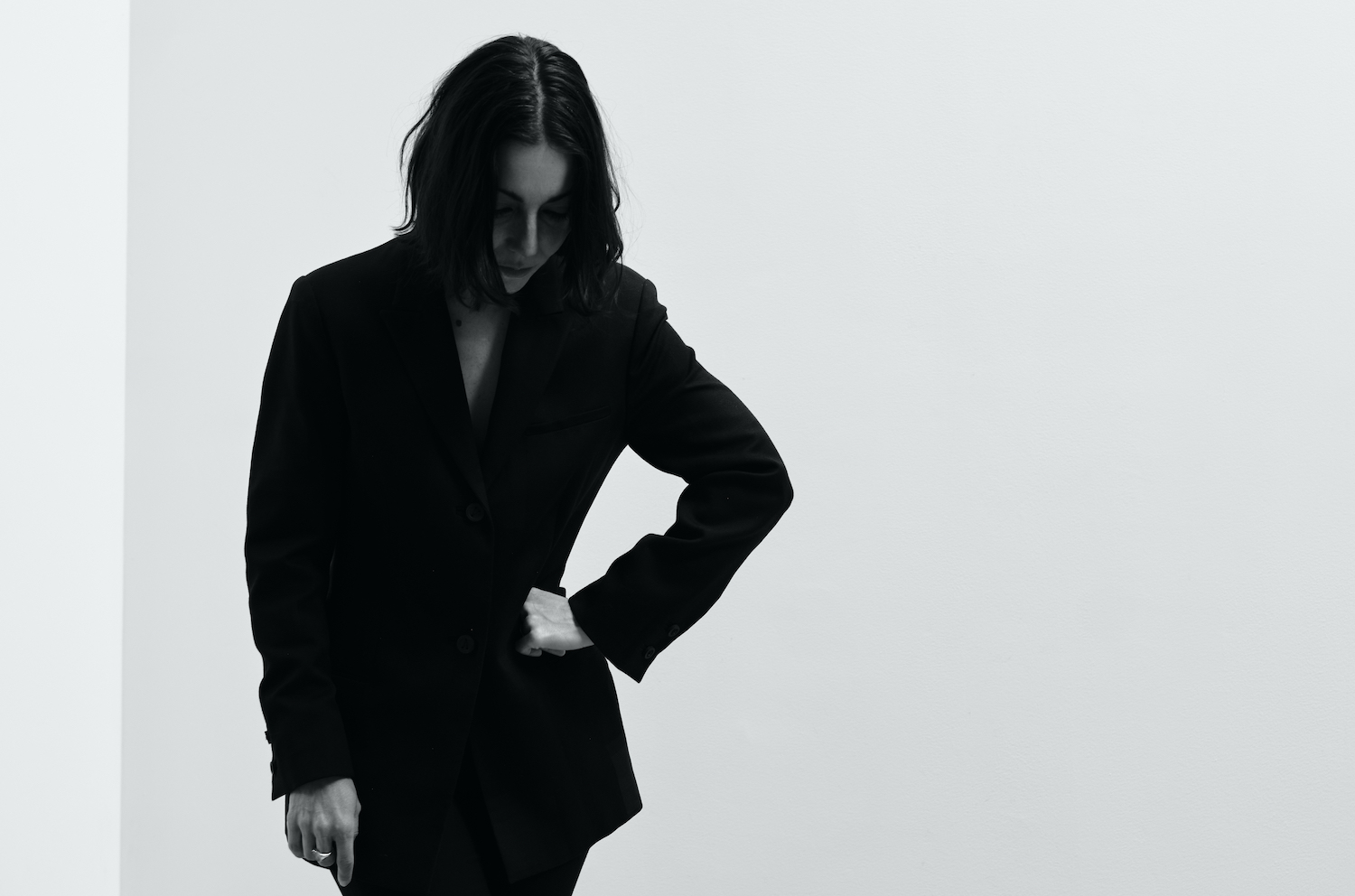
Lucrecia Dalt has a unique talent for drawing listeners into a curious and compelling unseen world through her songwriting. On her 2022 album ¡Ay!, the Colombian-born singer/songwriter crafted a loose science fiction narrative of an extraterrestrial visitor who is able to travel through time, confronting new ideas of emotions and physicality as they visit earth. And in doing so, she channeled her own feelings of familiarity and nostalgia in its musical compositions, incorporating musical styles like bolero that she grew up hearing, even as the narrative itself defied gravity.
With follow-up A Danger to Ourselves, however, Dalt spun a thread from a much more grounded and intimate source, writing songs that spoke to and were in part inspired by the throes of a romantic relationship. And yet once again she put an unusual musical spin on this concept, juxtaposing moments of vulnerable stillness against a kind of thrilling adrenaline rush of sound fit for a dynamic movie scene. For Dalt, this represented a new challenge, one that required overcoming some hesitancy in putting something so deeply personal into her songwriting.
“I’ve been slightly afraid, and I say afraid because I recognize it as a fear to expose the personal in music,” she says. “I’ve always been somewhat reluctant to do it so it felt more comfortable to invent a whole story that I could talk about so I could detach emotionally and create something based on that. But in this one it felt for the first time, very naturally like I wanted to work from the process of pretty raw sincerity.”
A Danger to Ourselves, arriving in September via RVNG Intl, came together in different stages; Dalt dedicated a six-month period to realizing the songs, working with percussionist and collaborator Alex Lázaro in building a rhythmic foundation for its songs, while a cast of collaborators—including David Sylvian, Juana Molina and Camille Mandoki—lent their voices to the project. But the project began with pieces of text and poetry that came together while Dalt was touring behind her previous album, ¡Ay!, catching sparks of inspiration in the quiet intervals offstage.
“You have all these frozen moments where you’re allowed to think and just drift,” she says.
Dalt spoke to us via her southwestern U.S. home via Zoom to discuss A Danger to Ourselves, musical intimacy, and crafting something that feels cinematic.
Treble: Was the writing and the making of A Danger to Ourselves in any way similar to how you approached ¡Ay!?
Lucrecia Dalt: No, the previous album, the impulse was to create atmospheres that reminded me of certain musics that I listened to as I was growing up in Colombia, so it was derived from and around the idea of bolero, which is a very spread out genre all over Latin America. For this one I wasn’t aiming to look for any reference specifically or for the album to sound any specific way. It was more like wanted to create something that felt like it was supporting the ideas I was already exploring in text. There were some intuitions already explored, because once you start performing you start to discover things about yourself that maybe you don’t discover when you’re making an album, because performing exposes you to so much. Present time, about singing about the power of percussion which I’ve started to explore with Alex Lázaro, so in that sense, I kind of knew I wanted it to be an album that explore rhythm in more complexity. More polyrhythms, weirder, more ways to work with the drums. And I knew that I wanted to have more stripped down melodic content, and I wanted the voice to be more up front.
Treble: There seems to be a musical intimacy and vulnerability to the album in much the same way that you described the lyrical themes. Were you looking to bring the sound of the record into that space as well?
LD: You try to create what’s right for what you already have written, it’s almost like—the joys you start to discover as you work more and more on music is like clarity in what you enjoy in sound, what you want to explore, what you don’t. For me it’s important to make a record that has sounds I don’t hear anywhere else. I have nothing against traditional music or traditional instruments, I love when someone can play a guitar gracefully and I admire that. But I feel my brain is more attuned to those little nuances and details and space, I think about, yeah, spaciousness, and I felt in a way the songs are trying to embed the elements that need to kind of honor those words. Sometimes it’s like that, sometimes it’s like the lyrics go this way, the music goes another way, but in the end they’re married.
Treble: What was the first song you wrote for A Danger to Ourselves?
LD: I think “cosa rara” was one of the first ones. It was the exercise of working along a loop that Alex sent me, which I like a lot. I just arrived here, I was driving through landscapes that are very desert-like and I think it was a time that, maybe I’m wrong, but maybe because I was reading a book that talks about John von Neumann that was the person that ultimately helped Oppenheimer. And I went to White Sands, and all those thoughts combined into a road story, and “cosa rara” with the rhythm that Alex had, combined into that. It was something that felt a little more dub, and obviously I’m not working within the rules of having all these knobs that you can bring up and down and process along the way, but more like the sensation of dub does to you.
Treble: Do you set aside specific time to write or work on music, or do you strike when the inspiration hits?
LD: I think I’m both. On other occasions I could set up a time in my calendar where I’d say, OK August, I’ll work on this, but I can also work on other things or tour. But for this record, I really wanted to have the six months at least of complete dedication to this and nothing else. And now I’ve realized how important that is to me, and I’ve realized that I want this to become my way of working. Over time I’ve realized that being in the same space where I work and where I rest is very important, because I will only find out about the rhythm that I want to have with the record while I’m working on the record. With this one I’d wake up at 4 a.m. and that was the time I’d be more productive because of maybe the brain state you’re in at that time—everything’s dark out and it’s quiet, and I loved working during that time. But I just like to get obsessed when I’m working on something, just allow myself to almost get sick of everything that’s going to realize this thing. I believe a lot in just practice. Sometimes you can get a block, but if you insist, sometimes you pass through the block and maybe create something else. And sometimes you just don’t do anything today, and that’s fine too. I’ve just accepted that. I’ve set the rules more or less when I know I will be able to work on a record, but I try to keep them kind of consistent. For me I find that when I know of artists making an album while they’re doing so many things and they’re going back and forth and then stop for a month, I have no idea how they do that. The continuity of thought and creativity is important for me.
Treble: I read that you had sought to make music that has a cinematic quality with this album, and you’ve also done work in film and TV scoring. How much of an influence does film play on your music?
LD: Oh, 100 percent. It’s the biggest influence for me. Books influence me and sentences to me sometimes can stay for a long time. “Acéphale” is something that I kenw about for a long time and only now used that concept. But in terms of film, it’s the most inspiring form of art. I find it very brave that someone can have a vision and with so many possibilities of failure it comes through. So yeah, I admire Claire Denis, I admire Jim Jarmusch, and David Lynch, and someone like (Bertrand) Bonello. I was watching his films when I was finishing this record and the ideas of time he presents in The Beast and the tension of love in different times, it’s very beautiful to me. There was one I was remembering today that I had forgotten. Or like Sleeping Beauty, Julia Leigh, is kind of a reference for me for “Agüita con Sal.” In the case of the movie it’s very perverse and very used in a different way, but if I used the subjectivity of that person that is just lying down that just wants to be left alone and doesn’t care that she’s objectified in this way, as long as she has these things. So I create a lot of images that derive from movies and I complete them. Or it can be like how “cosa rara” was imagined as a kind of road song that can be kind of, in a way, a Wild at Heart kind of vibe, but they get to experience what ever we saw in episode 8 of Twin Peaks for example. Those anomalies, I find it’s one of the most beautiful pieces David Lynch has ever made, I felt the tension of terror and the music and the personality and all the references there I found so appealing. I use my canvas to imagine things along the way in a parallel world.
Treble is supported by its patrons. Become a member of our Patreon, get access to subscriber benefits, and help an independent media outlet continue delivering articles like these.