



Way before Janet Jackson‘s declaration of a third album, Control, was released in February of 1986, she made a couple of changes in her life. First, she fired her father, Joe Jackson, as her manager. And then, at the age of 19, traveled to Minneapolis with a friend to record a new project with Jimmy Jam and Terry Lewis in the summer/fall of ’85. Those previous two albums? Sub-mid saccharine vanity schemes cooked up by the fired Dad, who never let Janet have input on the records bearing her name, but insisted he, not any particular record producer, could make her as big as Michael. That’s Joe, creator of the ill-fated JoCola, who had his sons working in strip clubs when they were kids. Always keeping one eye on the check before the plan. Jam, Lewis, and Janet all agreed she needed to leave California and get a taste of the Minneapolis lifestyle. There was never, ever, ever, any centrifugal force moving the daughter Jackson to pique the interest of older studio wizards such as MJ’s braintrust of Quincy Jones and session musicians. As quietly spoken people, MJ and Janet, brother and sister, within a musical household, stayed politely competitive as peak Yankees vs. Red Sox rivalry, when it came to music.
Janet was introduced to Jam and Lewis by A&M Records’ top brass, John McClain, a family friend of the Jackson family. The former members of the Prince satellite group, The Time, fronted by the gregarious Morris Day, were curating this nouveau-type sleek Black pop that was the futuristic cousin of Disco, a keyboard and drum machine-driven hybrid.
Their production credit for Captain Rapp’s “Bad Times (I Can’t Stand It)” was a street hit, a staple at the Black roller rinks around the country. Somehow, Jam and Lewis put together proto-Detroit techno mojo with early wave hip-hop attitude and sprinkled in diva vocals. While this amalgamation was never a top 40 radio hit, you could poll black folks, urban listeners (use whatever label you want) who taped songs off the radio late on the weekends far left of the dial on terrestrial radio, and you can bet this Captain Rapp cut, the vocal or the extra funky instrumental, was on said cassette tape. Maybe even twice.
From that street cred, Jam and Lewis made hits for Alexander O’Neal’s long suit Casanova persona, churned out the Vanity-6 adjacent “I Didn’t Mean to Turn You On” for Cherelle and burbled up the late-night mantra for Friday night friskyness in the 80s, “Just Be Good to Me” by the SOS Band, which was the song that got them fired by Prince due to the recording session, causing them to miss a tour date due to a freak blizzard in Atlanta. Some would say that’s an opportunity by snowflake. In any event, Jam and Lewis had that credibility, that lurked and influenced pop music from the edges. But a successful collaboration with Janet? That’s Dick Clark and Soul Train recognition all in one. Career-defining legitimacy over and underground.
As much as all three did not want to sound, and never did, like Michael, they were all cognizant of the possibilities. If this project were flexed properly, it would give Janet’s brand that Midwest retouch—think Art of Noise with jazzier melodies accommodating those thunderous beat systems.
Done the correct way, Jam and Lewis’ being fired by Prince would become a mere asterisk; from Janet onward, their songwriting career would eventually rival the results of elite duos and individuals such as Lennon and McCartney, Gamble and Huff, and Holland-Dozier-Holland. With affiliations and production credits that include Sounds of Blackness, Human League, New Edition, Ralph Tresvant—all of that legacy begins with Control.
Janet became a new funkateer and collaborated with musicians associated with Prince, MJ’s rival in the ’80s. So, as Control began to take an unforeseen stranglehold on pop music in 1986, with Janet calling out drummer Jellybean in a very Morris Day-like manner on record and in Grammy performances, A&M only funded a three-week promotional tour across the United States in 13 cities following the album’s release. Two different interpretations of her work started to emerge, signaling the polarities with which America viewed what MJ’s little sister could do.
On the Dutch music television show Countdown, hosted by a pre-MTV fame Adam Curry in 1986, Janet Jackson is inundated with questions about Michael’s oxygen chamber, which of her brothers calls psychic hotlines before they board airplanes, as if she were a spokesperson for the family gossip, and not an artist. In retrospect, that, along with all the Jackson headline coverage aimed directly through Janet’s press tour before Control became the cultural pivot-point it is today, began a passing-trains-in-the-night relationship between Janet’s musical domination through modernity, and Michael’s musical trajectory going in the opposite direction.
Where Rolling Stone’s Rob Hoerburger, on April 24, 1986, jammed two reviews, Janet’s Control and Jermaine Jackson’s Precious Moments, into a 400-plus-word examination of “what are those” other Jacksons doing, meaning Rolling Stone didn’t even give Janet the dignity of a solo album review, even when she had Prince associates and ex-members of The Time producing the project. What an oversight. However, one thing he did get right: The aim.
“Janet’s Control is already a hit, but she sounds more concerned with identity than with playlists,” stated Hoerburger. It seems malls and MTV were not the goal here.
“We wanted to do an album that would be in every black home in America,” Jam later told Rolling Stone. “We were going for the black album of all time.”
Writer, producer, and director Nelson George, who had a column in Billboard at the time and also wrote for The Village Voice, stated that Control was “1986’s first great album” and might have been the first to do so. Melody Maker would chime in later with “one bastard of a dance record,” which can be observed as an original way to praise something.
But there is a scarcity of overwhelming, non-backsliding praise for Janet or Control, besides George’s declaration. And that’s OK, because as Jam laid out the plan, it did take effect.
Control, with its empowerment lyrics, signalling to Black women, “you don’t have to take shit from anybody,” was not just a massive commercial breakthrough that scored multiple—seven—hits, and sold over 14 million copies worldwide. We can spaz out over the figures, but the album served as brain food for the Missy Elliotts, and the Jessy Lanzas of the world.
As I said earlier, nobody was expecting or checking for these numbers, but they for sure indeed happen. Control reached No. 1 on the Billboard 200 albums chart on July 5, 1986, and stayed there for two weeks. Five singles from the album landed in the top five of the Billboard Hot 100, a first for a female artist from one album. “When I Think of You” became her first No. 1 Hot 100 hit, with other top 5 singles including “What Have You Done for Me Lately” (No. 4), “Nasty” (No. 3), “Control” (No. 5), and “Let’s Wait Awhile” (No. 2). All Control singles topped the R&B chart except “When I Think of You.” “The Pleasure Principle” also reached No. 1 on the Hot Dance Club Play and Hot R&B/Hip-Hop Songs charts. The album remained on the Billboard 200 for over two years. Okay, so that is the financial chart impact. Now, let’s talk cultural.
The extreme rhythm jacket that Jam and Lewis rebuilt the Janet brand with elevated that version of Black music; keyboard-driven, slick, synth-heavy electro-funk became the new template.
These trends had been building for a while on Black radio, where Parliament’s “Flash Light” got that party and trend moving, and new funksters Ready For The World’s “Oh Sheila” put the synth-pop into higher BPMs in 1985. But Jam and Lewis, with input from Janet, seized the moment in the musical zeitgeist by creating these calamitous drum machinations with attitudinal thwack; it was New Jack Swing off meds. One minute you’re getting militaristic drum timbre worked over with reverb, and Jackson’s vocals instructing everyone, “No, my first name ain’t baby, it’s Janet, Miss Jackson if you’re nasty.”
And then next on the glorious, proto-electronic Deeeetroit sounding “The Pleasure Principle,” which shares a name with the Gary Numan new wave, synth-pop classic of an album, we have that soft Janet soprano voice guiding and riding with us in a Maserati-type engine of a production. Produced by Monte Moir, the keyboardist of The Time, it is eerily a faster-moving, punched-up arrangement you can easily hear and see The Time just flowing, doing their “floppy dance” as Pauline Kael once described their stage presence, in an alternative Purple Rain universe. But instead, we get a Janet anthem, where, again, those faint but fearless soprano vocals accompany an iconic music video that inspired a who’s who of future female vocalists from Mýa, Ciara and Tinashe to Normani, Britney Spears and Jenifer Lopez.
Wearing those Black Guess jeans and a black, possibly Jean Paul Gaultier T-shirt, while she performs alone in a warehouse with a chair and a mic stand? It’s her Motown 25 Moonwalking moment, which made Madonna and Whitney sweat and work a lot harder.
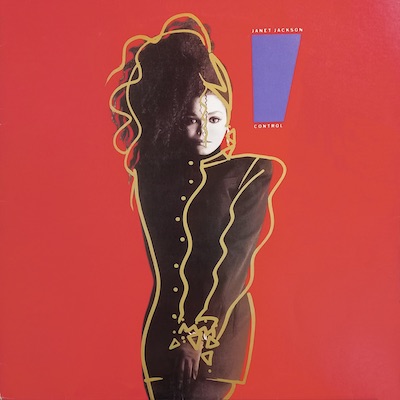
Janet Jackson : Control
Note: When you buy something through our affiliate links, Treble receives a commission. All albums we cover are chosen by our editors and contributors.
Treble is supported by its patrons. Become a member of our Patreon, get access to subscriber benefits, and help an independent media outlet continue delivering articles like these.

