


There’s this constant struggle among circles of music critics and fans over some of their subjects’ creative output. Which is “better,” either objectively or subjectively: the artist whose sounds reflect ongoing reinvention, or the artist who finds a stylistic sweet spot and repeatedly churns out work from it for an adoring public? For the former, bands as big as The Beatles and The Rolling Stones each transformed multiple times over time—from mod skiffle popsters covering blues and early rock to weird troubadour romantics, psychedelic trailblazers, elevated crypto-bluesmen themselves, and studio obsessives.
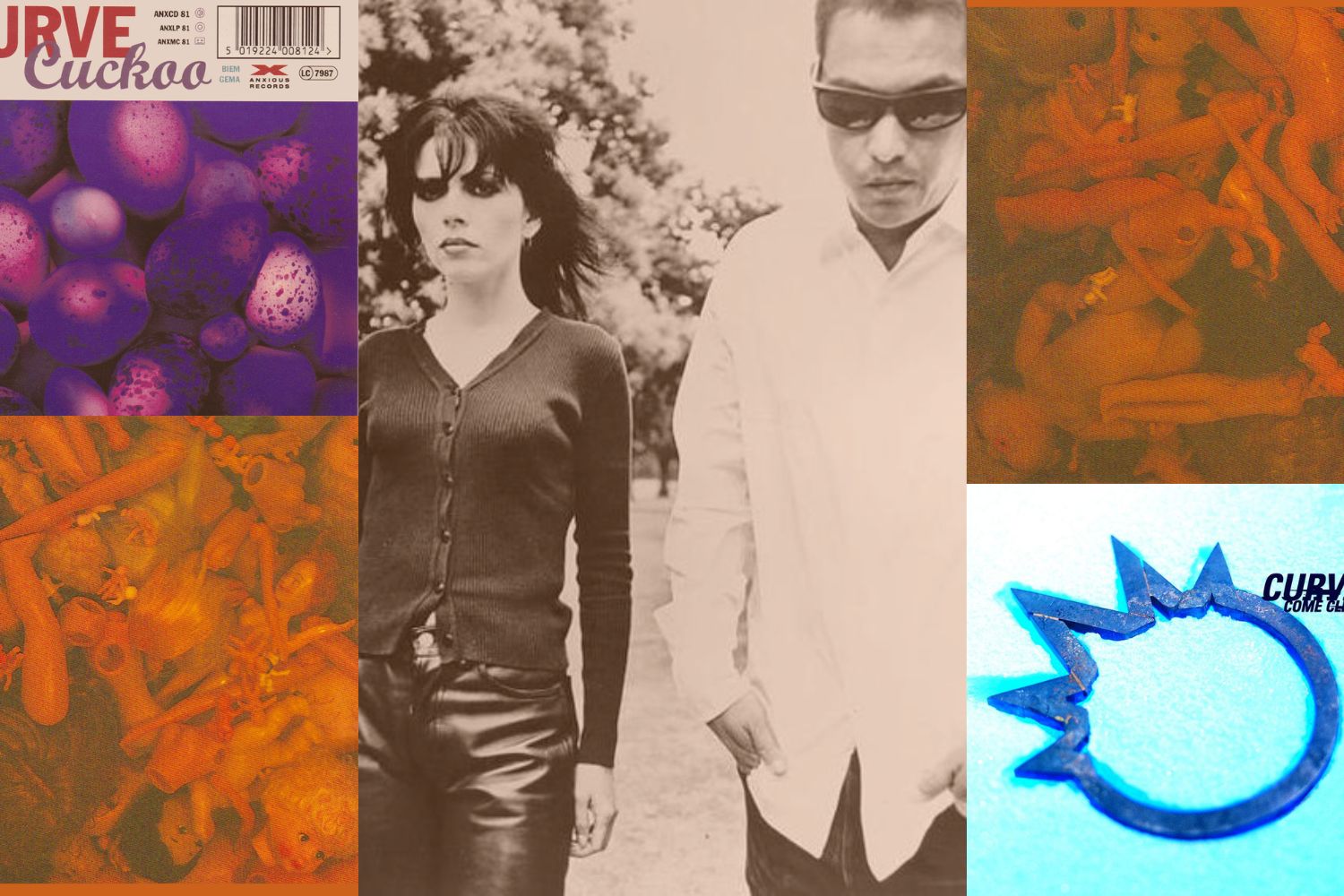
The latter category might hold Jimmy Buffett’s infinite chill and Nine Inch Nails’ complete lack of it. There’s Phish’s decades of gnarled musical mapmaking. The digitized malaise of Depeche Mode has grown more lush only as the advancement of bits and channels has allowed it. Current and smaller artists build oeuvres all their own, all the time. The London band Curve, centered around the duo of vocalist Toni Halliday and multi-instrumentalist Dean Garcia, clearly tumbled into a specific groove and never left.
I don’t remember which of their releases really did it for me—Doppelganger, the EPs collected on Pubic Fruit, or even a deep cut included on an edition of the British CD magazine Volume, imported by the music store at the college across the street from mine. But I know Curve’s origins coincided with certain musical sounds starting to blend and breed curious offshoots at the start of the 1990s, especially in the UK.
Post-punk was morphing into early “college” and “alternative” rock, including the shimmering reverberations of shoegaze and dream-pop. All of these were also folding back in new wave’s synths and digitized percussion that had taken off-ramps to an array of other club sounds like industrial, rap, and house music. The largely electronic rave movement then extended out from that branch of music’s family tree, as would its intertwined Madchester scene that often relied on more traditional band structures. Acidic keyboards, wiggly earworms, hypnotic grooves, and remixes were everywhere, with Curve deftly navigating these paths as they converged and diverged.
Besides Halliday and Garcia themselves, the world has four people to thank for bringing Curve into existence. The first is Dave Stewart of Eurythmics, who introduced the band’s live and session bassist Garcia to Halliday, a friend of Stewart’s who was then a solo artist on his Anxious Records label. This pair’s first work together in the band State of Play was skillful but relatively unsuccessful. The quartet’s highly polished sound contained elements of new wave, sophisti-pop, even freestyle, a kind of car crash between Howard Jones and T’Pau. Halliday then made Hearts and Handshakes, a 1989 solo album that also went nowhere.
She and Garcia decided to try working together again, this time as a duo under a new name. Enter the remaining three important people in the band’s life: Curve’s longtime studio hands, all royalty in the field of digitized and distorted pop music. There was Steve Osborne, best known for his time popularizing the tenets of house and techno in the Perfecto team with Paul Oakenfold. And then there were Alan Moulder and Mark “Flood” Ellis, the bright binary star of production in the perpetual night of dark, moody musics coming out of post-punk and new wave.
Osbourne and Moulder helped produce the band’s seminal first three EPs for Anxious: 1991’s Frozen, Blindfold, and Cherry, anthologized on Pubic Fruit the following year. Moulder and Flood would handle Curve’s first LP Doppelganger in 1992, and then engineer, mix, or perform on almost everything Garcia and Halliday released as a duo over the next two decades. So pervasive was Moulder’s presence in particular that he ended up marrying Halliday.
Halliday’s coos and wails through these vital releases formed connective tissue between Siouxsie Sioux in the 1980s and Kim Gordon in successive decades. Meanwhile, Garcia and the band’s wrecking crew of producers took the highfalutin pop constructs of State of Play and wrapped them in the same rough sonic cloth as My Bloody Valentine, as if those contemporaries’ song “Soon” could be stretched out to a full genre. In reviewing Curve’s discography they sound all the better for it, branded as one of those great Rock Acts You Can Dance To.
The appeal of the band’s early catalog (stretching to at least 1993’s sophomore LP Cuckoo) stemmed primarily from playing and production that leaned into the sounds of goth, industrial, and shoegaze, their instrumentals and vocals swirling around like dust devils. With a female singer in the spotlight, historians and critics have long defined Curve as the proto-Garbage. It could be argued that Curve’s consistent synthesis of technology with analog and electrified instruments, along with Halliday’s emoting that worked as both purr and yell, comprised an unheralded precursor to Linkin Park as well.
The singles and B-sides that started to appear from Doppelganger forward showed Curve were comfortable dipping into percussion-heavy and dissonant experimentation. They also managed to create effortless techno synth lines that might have pleased Osborne even beyond his early presence at the duo’s sessions.
The “Horror Head” B-side “Falling Free,” for example, started off as a drum-pattern-powered workout but infamously got converted to hissing, burping IDM in a later Aphex Twin remix. The duo’s small roster of covers included Siouxsie and the Banshees and Tubeway Army, but their version of Donna Summer’s “I Feel Love” on an NME charity compilation found their takes on Giorgio Moroder’s classic melody and rhythm fighting through their distinctive fog of echo. The “Superblaster” single also gave us “Low and Behold,” with a spare, bassy keyboard up front in the mix to reinforce its sinister nature—”How we gloat/At others’ misfortune/A nation of reptiles/Given to nothing.” If I’m being honest, as I type this, I’m reminded it’s likely this cut’s inclusion on a Volume volume that first sent me down the Curve rabbit hole.
Curve’s sounds, influences, and partners predicted and participated in the work of genre development through the back half of the 1990s. The band’s Blackerthreetrackertwo EP was a specific if subtle milestone, with Cuckoo songs manipulated by a cross-section of artists rising up from the electronic underground: The Drum Club, Future Sound of London, and Nine Inch Nails’ Trent Reznor. Dance music in this moment was splintering into hard rhythms and transcendental escapism, among other things and feelings. These would simultaneously inform and be informed by rock’s largesse to start to turn into the big beat movement.
Against that backdrop, Curve received high praise for 1996’s Pink Girl with the Blues EP and then arguably earned their broadest mainstream exposure with the lead single from their third album, Come Clean. Released in 1997, ”Chinese Burn” in its original form and remixed by the likes of Lunatic Calm criss-crossed IP universes from Marvel to Buffy the Vampire Slayer. The song’s smashing breakbeats and klaxon-like guitars from Garcia, paired with Halliday’s fuzzed-out vocals, all struck while The Prodigy and Chemical Brothers were hot. This was followed up by the midtempo “Coming Up Roses,” a ballad that stood out from the period’s aggressive focus on club floors and festival crowds.
Curve then found themselves negotiating the music industry with some difficulty, and the internet age with some ease, as the 21st century dawned. Locked in a contract dispute with Universal Music Group after the release of Come Clean, Halliday and Garcia would independently post songs to the World Wide Web that would later be gathered on the self-released Open Day at the Hate Fest in May of 2001. The public response to it convinced UMG to shortly thereafter release Gift, an already complete album at the heart of the company’s issues with Curve—probably because it used less of the sonic sustain and decay heard in their discography up to this point.
Their electronic-inflected rock, especially the slick version of industrial embraced in songs like “Hell Above Water,” could still meet the challenges of modern rock radio of the time. But with Halliday’s singing largely unobscured here, Curve maybe starts to sound a little more conventional—or maybe it’s that newer bands caught up to the thought leader of the pack? More and louder voices were crowding the stylistic spaces they’d long called home. Linkin Park’s massive first LP Hybrid Theory came out the year before, while up-and-comers like The Knife and Ladytron would debut alongside Gift. Radiohead’s digital diptych of Kid A and Amnesiac surrounded Curve in this moment, and The Rapture’s “House of Jealous Lovers” would relaunch many of these sounds as indie-dance in March of 2002.
And so, the following June, The New Adventures of Curve would tie a bow on Garcia and Halliday’s formal partnership. Initially available only on Curve’s own website, New Adventures maintained the duo’s gothy come-hither image to the bitter end. Short on tracks but long on time, it hypnotized listeners for 5 to 7 synth-and-patch-filled minutes at a clip with reverberating sheet-metal percussion (“Nice and Easy”), introspective and methodical riffing (“Star”), jittery EBM (“Answers”), and even Deepsky’s progressive breaks mixed into “Cold Comfort.” It was the encore for the duo’s concert of a career together, referencing and recasting their strengths, influences, and planted seeds.
Halliday has only sporadically re-entered the spotlight since then. She’s been a guest vocalist here and there, sang lead for Chatelaine and their 2010 album Take a Line for a Walk, and released the solo Roll the Dice EP in 2020. The Chatelaine music seems just a bit more satisfying overall as a curious slice of gothic chamber pop, while her vocals outpace the shiny synthpop production on her own release.
Garcia’s been far busier with production roles and as a player in multiple projects. His biggest name recognition might have come in KGC alongside members of KMFDM, while his longest-running concern has been SPC ECO, teaming with his daughter Rose Berlin to play loose and fast with shoegaze and various electronica subgenres. All of Garcia and Halliday’s newer outlets absolutely have wildly creative moments; none feel as purposefully in the pocket as Curve did.
What might carry on Curve’s legacy best and brightest is the pair’s well-maintained Bandcamp page, sequestered from the rights and permissions issues of many streaming services. It holds just about every officially available song, rarities that appeared on special-edition physical and digital releases, studio mixes shelved by the band and their regular producers, unreleased remixes by the like of J.G. Thirlwell (Foetus) and Talvin Singh (Cornershop), and live performances from the US and UK. It’s a fascinating archive to click through to see and hear not just the creative process but the breathtaking consistency of what resulted from it.
So yes, I believe that largely sticking to one particular aesthetic throughout a musical career can be viable, and depending on the artist I might even prefer it to growth as seen in sonic variety. March 2026 marks 35 years since Curve debuted with their Blindfold EP—considering my extant ownership of their albums and how my own tastes arc toward the rhythmic, when it comes to Toni Halliday and Dean Garcia my answer’s a fait accompli.
Treble is supported by its patrons. Become a member of our Patreon, get access to subscriber benefits, and help an independent media outlet continue delivering articles like these.