


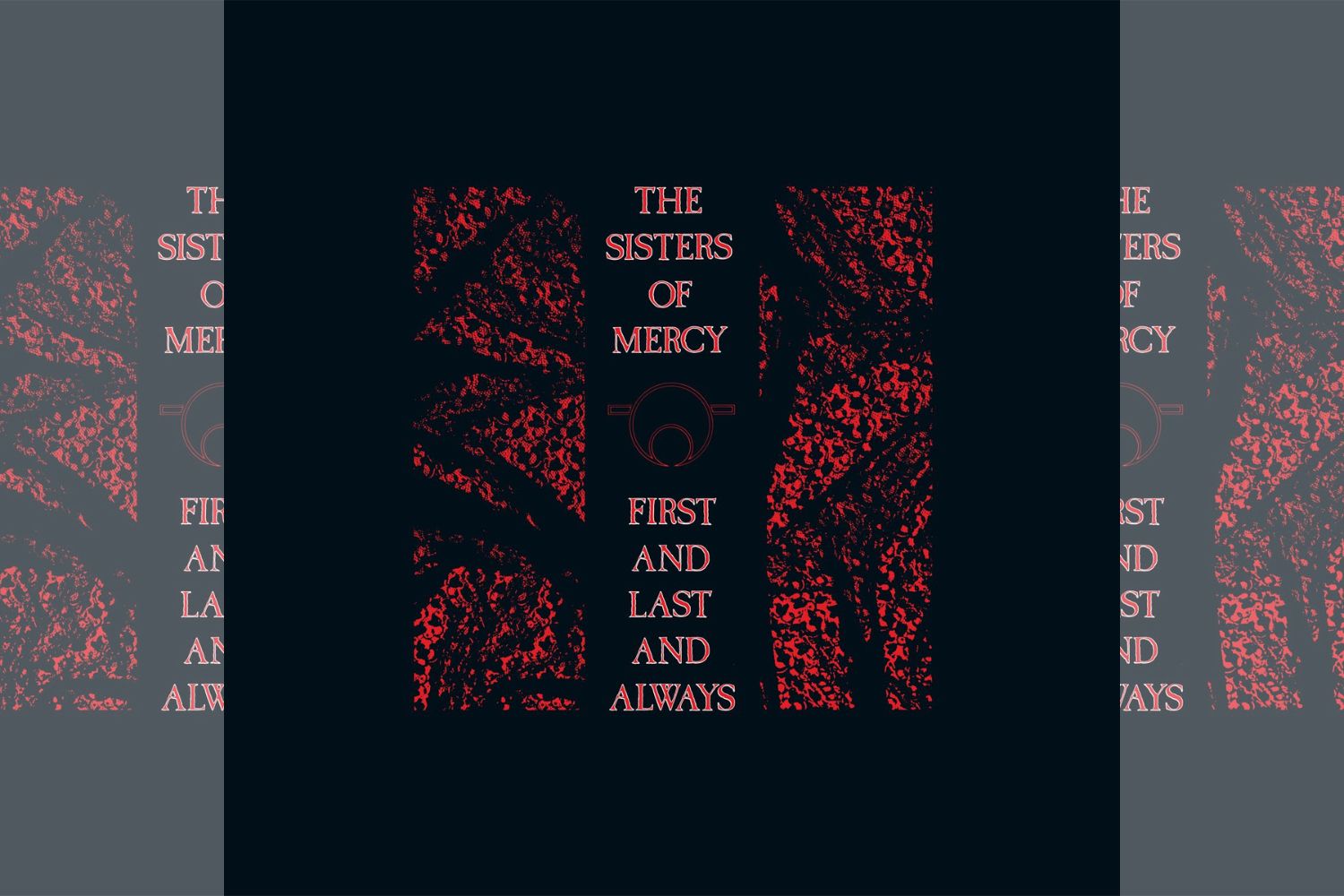
There’s something critically tantalizing about a group like The Sisters of Mercy. They never had anything resembling a stable lineup, with vocalist Andrew Eldritch being the sole consistent figure across the band’s three albums and numerous EPs and standalone singles. It also means that tracking the evolution of the group’s earlier material and the further development after First and Last and Always, their monumental debut, becomes much more fractured and filled with branching paths of divergent evolutionary histories. There is no Sisters of Mercy, really; there are only brief constellations of players in the midst of their own stellar journeys, arriving from and departing to other groups with their own unique sonic templates.
Perhaps thats why the three studio albums of the Sisters are so radically different. Working backward, 1990’s VIsion Thing is a clattering mish-mash of sonic ideas, from the post-Cult hard rockisms of its opening track “Vision Thing” to the Jim Steinman-cowritten longform piece “More” which marries the drone-oriented material of the band’s early days with the typically grandiloquent high-drama approach of the co-writer of such songs as “Total Eclipse of the Heart” and “It’s All Coming Back To Me Now.” Floodland meanwhile embraced the startling, polychromatic maximalism of the more psychedelic and progressive wing of gothic music, full of color and lush textures and effulgence. In comparison, First and Last and Always seems positively spartan, barren and simple. Synthesizers emerge to fill spaces, but it is so often one or two guitars, a bass, and the drum machine in these skeletal arrangements.
And yet the other way round, the album seems like the apex of their development up to that point. The band began its life with a series of singles, following the punk mold at the time of packing each 7-inch with entirely new music. Their debut record “The Damage Done” is a stripped down, half-manic punk tune and its two B-sides “Watch” and “Home of the Hit-Men” underscore that. These days, we might call it post-punk, but even so it was very much on the end most aligned with punk and its post-Sex Pistols hysterics. The next single “The Body Electric” with its B-side “Adrenochrome” tilted the band toward the skeletal and repetitive, albeit it still with that rough edge. So it would go with their final single of that narrow era “Anaconda,” which led directly into their debut EP Alice.
Alice kicked off a three-EP and one-single run that are the defining documents of this early era, all written and recorded within a one-year span arcing from March of 83 to March of 84. Alice is the first moment the band appears gothic, landing just on the other side of Joy Division’s debut which in so many ways is the dividing line of what is goth versus mere post-punk. The Reptile House dives deeper into the morose atmosphere and repetition, being an album of drones and repeating lines which they would hold on to for the next couple of years of the group’s development. The end of this arc saw the “Temple of Love” single with its B-sides “Heartland” and Rolling Stones cover “Gimme Shelter” and the concluding EP of the triptych Body and Soul. It was on these recordings that they began to involve the dance music elements that would concretize their sound. If “Temple of Love” was the first recording they began to feel like the Sisters of Mercy we know now, then Body and Soul and First and Last and Always were its developing completion. Of them, the latter LP sounds almost boundless in its vision and lushness, combining the bleak conceptualism and repetition-fueled miserablism of The Reptile House to their burgeoning use of synthesizers for spaciousness and more emphatic drum beats from Doktor Avalanche, their drum machine.
This is not incidental. It was only in the midst of “Temple of Love” that the band achieved any kind of lasting stability. Wayne Hussey, formerly of Dead or Alive, joined as a second guitarist in late 83, bringing with him an ear for the psychedelic that the band had apparently always been looking for. Hussey and Gary Marx share writing credits for the lion’s share of the band’s material once they began playing together, with both of them listed as songwriters for every track on the debut with only two songs, “No Time to Cry” and “Possession”, featuring co-writing credits from other band members. The band seemed to refuse to go overboard with the development of their sound like many of the early goth rock pioneers did near-immediately. The relationship between gothic music and progressive music has always been the focal point of psychedelia, with each of those post-psychedelic wings interested in the broader soundscaping and song-structuring possibilities afforded by it even if they disagreed on fine-grain particulars like odd times and macro-scale composition. Hussey’s era of Sisters songwriting however was marked by a conservative approach to the psychedelic, seemingly focused on what could be produced by the band themselves without relying overly on studio trickery.
Absurdly, the band and especially Eldritch have insisted that they never were a goth band or even a post-punk band but instead an inheritor of psychedelic music and the classic rock of the late ’60s. Ignoring briefly that it is precisely that era that much of punk draws from, as well as surf music, rockabilly, Motown and early rock ‘n’ roll, it becomes challenging on close analysis not to see their point, even if it’s hard to agree fully. Their cover of “Gimme Shelter” acts as a decoder ring of sorts. The Stones only briefly dabbled with out-and-out psychedelia but they quickly found career-long resonance in the bad trip darkness that emerged from the bubbling underground of the genre, especially on tracks like “Shelter” or “Paint It, Black.” You don’t need to rewrite that material to arrive at First and Last and Always; just add chorus and reverb and swap Charlie Watts’ eminently human drumming with the coldness of a machine.
Psychedelia after all did already contain so much abyssal darkness. You have Syd Barrett, who became as much a figure of punk and goth worship as psych pop, with the tale of his madness reframing the gleeful mania of his material from the early days of Pink Floyd into something morose and terrifying, signaling the end. Black Sabbath did not envision themselves as a heavy metal band until the ’70s, initially seeing themselves as a psych band that just wanted to touch on the other psychedelic expanses beyond the common flower power; this deeper connection to psych rock only begins to be firmly shaken around the time of Master of Reality and even then the doominess of their material underscores a naturally psychedelic component to doom metal that has remained. Similarly, Coven, a band that famously included a recording of a “real” black mass as the B-side of their debut LP, were only reframed as a proto-metal band beating Sabbath to the punch after the genre had been established. At the time, they were, like all great experimenters of that era, an underground psych band.
Add in the overwhelming influence of David Bowie on Eldritch’s vocals, which are far more the archetype of goth vocalism than someone like Robert Smith. Eldritch is one of the key figures that established the recontextualization of Bowie into the bleakness of psychedelia, building off of the more morose and austere aspect of Bowie’s work that emerged on Station to Station and only deepened over the remaining years of the ’70s, applying a career-defining darkness that also marked him as far more individual as an artist than his sometimes more acclaimed ’60s and early ’70s material. Still, while this vocal affect is now synonymous with the gothic sound, it’s not hard to see how Eldritch himself might have imagined it closer to being a willful inheritor to early music.
We cannot arrive at goth rock without the gothic, and that latter element is far more spiritual than material, easier to feel than to concretize and define. It can be both austere and resplendent, romantic and predatory, frightened and frightening, driven to celibacy by contemplation of death and driven to deep eroticism in the throes of mad life. Eros et Thanatos, with each extreme acceptable so long as its relatively extreme. First and Last and Always is a fascinating example of the anxiety of influence; by not seeking the gothic and instead pursuing the psychedelic, the melodramatic, the cold and repeating, they discovered it naturally in a way that bands willfully copying the style often rarely achieve. Regardless of the band’s desire, First and Last and Always is a foundational text of the genre, with the elements they themselves considered out of the bounds of the genre at the time having now become definitional elements.
Still, it’s hard to imagine they could have penned a song like “Marian” with its very Poe-derived ode to a woman who appears perhaps to be dead and not have gotten a whiff of grave dust and fresh corpses, “Some Kind of Stranger,” the album’s closer, appeals to both a broad sense of alienation common in the Beats, a major influence on gothic aestheticism, as well as the existential via Camus, with those nervy contemplations as well being defining intellectual components of the contemporary gothic. “Black Planet” with its lyrics more spat out than sang play out like an inverted hymnal, “Possession” describes a kind of vampiric love and “No Time to Cry” fixation on denial and the coldness of a spirit refusing the emotional indulges in a melodrama that only the resolutely unemotional can obtain. But this may be because the gothic as a spirit and not a musicological construction emerges via contemplation of darkness, passion, death, the grave, madness, the way all good things begin inverting themselves if you intensify them far enough.
The band splinter following the release of First and Last and Always. Eldritch and the other members would form two separate camps while a fight over rights to the group ensued given their remaining recording contract. We get a snapshot of where what came from in that narrow window following the dissolution of the band. The remainder of the players, headed by Hussey who by then had taken up the role of vocalist as well, formed The Mission, who pursued a brighter band-driven psychedelic sound closer to the richness of Siouxsie and the Banshees than the prototypical coldwave that Sister seemed to hint at. Eldritch meanwhile would quickly form a group to record an album under the name the Sisterhood, being the apex of the sounds early coldwave gothic sound, with lengthy pieces composed of drumbeats and cold synth pads predicting techno before its properly development, set against the most morose vocals and lyrics Eldritch ever set to paper. The awareness of this album reframes First and Last and Always less as the tomblike statement that Closer was for Joy Division and closer to their Unknown Pleasures, haunted by the dark but not yet fully surrendered to it in a fatalistic suicidal way.
That neither band would approach that kind of darkness again after is likewise surprising. While on Always, the sound feels primordial and brimming with a power that so many other bands over the next forty years would draw from and develop upon, both Sisters of Mercy and the Mission seemed to abandon its hybrid of the skeletal and lush following the coldest reaches shown on the sole album by the Sisterhood. Perhaps they each saw the uselessness of following that path with nothing more to deepen it. The Mission’s early numbered EPs saw them pursuing the kind of gothic music that the Cure or the Alarm were better known for while Floodland, the proper second Sisters album, would see Eldritch adopt a sense of dullness and drama closer to Echo and the Bunnymen.
That First and Last and Always seems to dissolve to the touch as you interrogate and situate it feels maybe the most fittingly gothic aspect of it of all. Though its follow-up is more acclaimed, it also has a sense of being a beautiful enough garden that it produces less of the vertigo and disgust of its colder, bleaker forebear. That Always is neither their most punk, their coldest, their most drawn-out or their most morose doesn’t undercut it; it just gestures back once more to that modernist sense of alienation, of placelessness, of the stranger lingering too long and departing at random. Its name feels in retrospect a fitting eponym describing its position, as a fundament, as a completion, as a burbling well, always turning away from itself, always turned away from even or especially by its composers. If it were more solid, permanent and definable, it would only be less gothic.
Treble is supported by its patrons. Become a member of our Patreon, get access to subscriber benefits, and help an independent media outlet continue delivering articles like these.

