

“We have witnessed a lot of shit lately,” Lane Shi Otayonii tells me over a video call. We talk about genocide and horrific crimes happening around the world. We both agree that there’s a lot of awful shit happening. Otayonii refuses to cave into despair, however. She believes in the power of art, community, hope—in finding love among the shit.
Love is in the Shit, out now via Pelagic Records, is the title of Otayonii’s new album as Otay:onii. On Love is in the Shit, she alchemizes noise, trip-hop, harsh industrial tones, serene ambiance and more to present an eclectic sonic journey. Whether in her previous band Elizabeth Colour Wheel, in Dent, or through her solo work, her music demonstrates an emotional and technical quality that defies simple classification. This extends to her performance art, where emotion, music, and improvisation combine to convey captivating works of cathartic power. Earlier this year, Otayonii brought her performance art to the stage of the Roadburn; 2026 marks the second year of her three-year long residency with the festival.
Love is in the Shit is a call to find hope where possible. There’s a permeating atmosphere of grief in the world right now, and Otayonii is acutely aware of this pain. Through her art, she strives to send out energy to inspire hope. With Love is in the Shit, she wants to remind us that, whether it’s through making art or taking part in a hobby, you can transform negative feelings into something lighter.
In a conversation with Treble, Otayonii and I discuss her new record, her approach to improvisation, her performance at this year’s Roadburn festival, and more.
Treble: I want to start with the record’s title, Love is in the Shit. What’s the meaning behind that?
Lane Shi Otayonii: Human beings have gone through a lot of shit. We have witnessed a lot of shit lately—from each other, from far away. The genocide, the wars, the horrific crimes that people are committing. We feel really helpless seeing [all of it], and do the best we can to help, but still, we cannot stop it entirely. And then, not to say that from a personal note, we’re still experiencing all kinds of troubles, difficulties, obstacles, to a point that it’s soul crushing.
Love is in the Shit, it’s the kind of beauty and love I still have at the end of the day, after all these troubles, despair, depression, and the loss of hope. I think that love—whether it’s love from me to the world, or love for another person around me, love for a friend, and vice versa—I see it as a very precious thing that’s happening in my life. This album is dedicated to that kind of love that’s still surrounding us, and did not fade away regardless, despite of all the bullshit.
Treble: That’s a powerful reminder. Even when despair feels all-consuming, we can still find some light in our lives.
LO: Yeah, absolutely. And to be honest, this is very necessary for us. Because if we don’t start to realize the skills of transforming our energy into something that we can possibly push for a better end, then there’s nothing to be hoping for. So, this is also an encouragement for all those people to try to find this ability, try to find this ability to transform everything. Whether using a joke or whatever, try once, try twice, try with your friends. Like, playing a fucking video game, try again, you know?
Treble: Your songs feature incredible range in sound and structure, and I’m curious how much improvisation plays into your process. Are you mostly working with improvisation when it comes to what’s coming to you emotionally and translating that through instrumentation? How much of your process is planned?
LO: Yeah, definitely a lot of improv. Especially the last song, “Tears Won’t Tell”. A lot of improv in the vocal [performance] as well. I think, because I travel so much—usually I get a date—you need to be here on this date, here’s your flight ticket. I [find something] relatable in music. You need to get back to this structure at this time: four bars later, you need to get back here. But the space between now and that destination, you’re free to explore and get on your own journey and go as far as possible.
For me, that’s very meaningful because I like the gaps. I like to see the in-between-ness. I think it’s the in-between-ness that really tells the color because, destination and starting point, they’re out of our control in many senses. The in-between-ness is where you can have a little bit of your thoughts, your attitude, your words, your own heart in it. In terms of structure, there’s definitely an end point.
Treble: In the press release, there’s mention of the record reflecting your “trialing conscious states.” Could you explain what that means?
LO: I can talk about language. When I write in English, Mandarin, and when I write in dialect, they all reflect direct mental consciousness in the situation in which I speak those languages.
[…] If you see the lyrics, it actually reflects my mental state. However, because I have a passion for this language, I’m still me, in a way that the core is there to reconstruct the language. It’s mentally reconstructed in a way that probably is so wrong and so silly in grammar. But for me, it makes sense. For example, the song, “Have You Ever,” there’s a little section where I was composing using my native dialect. It’s called Tuhua. My mind falls back to this subconsciousness, like dream state subconsciousness. If I really think about why I always have this subconsciousness and dream-like state […] it’s often related to my childhood.That is because I left China when I was 16 to the U.S. and never really came back to live in China again for a long time. And of course, Mandarin is another thing. It’s often fun and witty because that’s how I build my memories with my friends in China. We always speak Mandarin. So, it’s interesting. Now I live in Europe. I really experience that different language manifests its social consciousness as a whole.
Treble: Does your passion and sometimes discomfort of language translate into your physical performance art? If so, how?
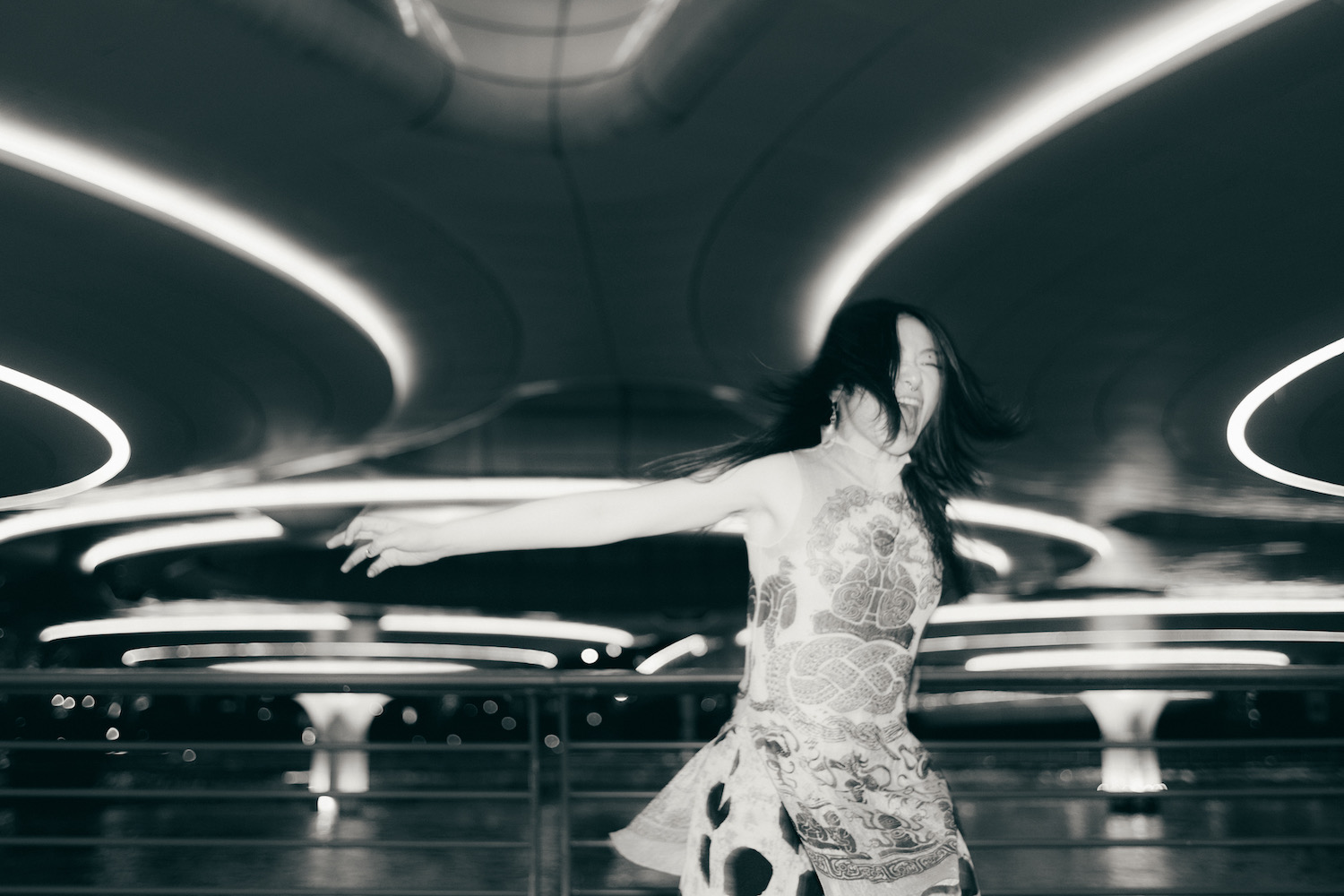
LO: I would say yes. Sometimes it’s because I really can’t understand the language very much and I compose in it.I try to connect with it using my body, using another mechanism that’s most close to me to kind of move away those moments of embarrassment and reconstruct again. You know, in many senses, once I feel like I’m in a situation where I feel a bit misfitted, or don’t understand, I usually use this mechanism to try to ease up my body, my tension, my mind a little bit. That comes into my performance a lot.
Because I perform solo, and there are a lot of faces from the audience, I need to ease. I need to engage with my own feelings. Once again, if I have to be honest on stage, I cannot perform without a real feeling in me. Oftentimes, that is very intense. I usually use my body to ease it up. The second thing is I use my body to compose. Because there’s a rhythm, or there’s no rhythm. But we all hear rhythm everywhere, even in water.
Once you hear that, your body starts to move and sway and react to it. That’s a call and response to the sound that is constantly doing some stuff. Sometimes playing my guitar is interesting, because I don’t necessarily move my body quite a lot when I play. That is because I feel like my finger is inheriting every inch of my energy. My fingertips are moving like my whole soul is going. So, the rest of my body is stagnant and almost functions like a listener and observer. I fall into this state of trance and just have my finger moving around. I quite enjoy that.
But sometimes I just don’t give a fuck. [I’ll] play a bunch of wrong notes and sway my body as I want to fly. Stuff like that. With this new album, I have a little shit device where—it’s literally a potentiometer, using Timsy board to connect to my session in the computer—when I twist it around, it changes the whole sound of my session. In that sense, that goes to the alchemy side of everything. [In] how I turn what’s going wrong into something that I can dance to. I can do another dismantling reconstruction.
Treble: How was performing at Roadburn this year?
LO: Why I make this [solo] work is because, I think after I moved to Berlin for work, I started to think about what I really want to do, right? Because I have a history back in the U.S. always playing with my ex-band and always in this heavy community. In a setting of bands and I love it.
I love it because this is where my passion was. But then when I’m alone, [I ask myself] what do I need to do? It’s a real question and it left me really speechless because I had never thought about it for myself ever before. So, I thought about my childhood, and I see that because I left China at 16, it’s such a distinctive period, you know?
So, [for the premise behind my Roadburn performance] I chose six Chinese lullabies that [I’ve heard throughout my childhood at] primary school and home. I wanted to change these songs and really imagine them sonically and performance-wise. I wanted to bring [the performance] to a stage where a lot of people can listen to these songs with a similar mind. The second part is that I collaborated with a costume designer. She made four costumes as the four auspicious beasts that protect the four corners of the world. I’m Turtle from the north; there’s Dragon from the east, White Tiger from the west, and Vermilion Bird from the south. These four beasts are the beasts that will protect the energy of the good and try to protect the beings on Earth. They’re hovering [in] our sky.
[Also], I was touching [upon] the subject of children, genocide and wars. Not to be talking slightly close to what they’re feeling, but because I was born in the ‘90s where one-child policy was executed during the generation—I am the only child, and my parents were not allowed to have a second child—oftentimes I feel very lonely. Now I’ve reconciled it with all kinds of friends, non-blood related friends that are my siblings all over the world. They’re no different than blood-related [family] whatsoever. But I was often wondering how these children are thinking and feeling right now. Some of them without possibly the only people that ever cared about them in this world; without a lot of medical help, maybe without a whole set of means too. How are they coping in this world, and feeling so desperate and helpless? I wanted to use this set of songs and these four auspicious beasts to send out good synergy and frequency to these children.I do believe that if you really wish for something, you need to think about it and send out your wishes and do it with all your energy as possible. That’s why I started this project of Sugar Moon. Sugar drawing was a huge part of my childhood. […] I draw a moon [using sugar], and then I use Osmanthus flower petals as the decoration, but also [as] the smell of the childhood that I was so familiar with. I never really smell Osmanthus flowers in the environment that I’m living in right now. So, I use that as a symbolization of unity. Because in China, when we miss our family, we often look up to the moon… and send our wishes to the moon too. So, [in the performance] I grab the moon down and I crack it into pieces, and I distribute it as much as I can to the audience. It was a magical moment.
Treble: Love is in the Shit is a powerful argument against doomerism—that even when life feels at its most difficult, we can take negative energy and transform it into something beautiful. Reflecting on your artistic journey, how did making art get you out of your own shit, and how has your relationship with art evolved since?
LO: I remember my first time making art. I think I was 13 years old, and I was reading all of these soap opera books, love books, novels from this Korean writer. There’s a book she wrote called Outsider. I finished the book, and I saw that she’s calling for theme songs. A little detail: I practiced piano since I was seven and never really loved it. It was a pain in the ass in my childhood because it’s so boring and so much work. But that was the first time where I felt like, I can do something with my piano. So, I wrote a song.
That’s the first time I made something. How it evolved, that’s the sad part. I think it evolved, more so, [with a focus of] tapping into an industry. You know what I mean? I have to figure out the putting out of my music. That’s a sad part. The business part is quite draining, I have to say. All the noise.
Why do we like noise music? Because maybe if we put noise in our head, we might be getting out of the noise of others. Like how they tell you what band [to like] and a lot of selling info. You don’t have to know about that. The only thing that artists or creators or whatever should care about is the things that you’re so passionate about working on and let it guide you. The more I’m deep in the shit, figuring out my financial side, the more I know if you do not make a piece of good work, just forget about putting it out there or whatever. Because you will connect to the wrong people. If I want to so urgently put out [something] on a big platform or whatever—the business side—then I will connect with the wrong people because the energy is not right. As simple as that.
I’ve learned it in a way that now I’m fine with just doing [my art] with whatever connects and listen to my intuition a little bit more every time around. When people want to talk to you, always talk to them. Unless there’s a harmful note, you know, then you tap back and be like, hey, bye bye. But the thing is, I also think that because I made the things that I made, it has led me to a lot of people that truly appreciate life, even more so. That is something that I will never take for granted.
Treble is supported by its patrons. Become a member of our Patreon, get access to subscriber benefits, and help an independent media outlet continue delivering articles like these.