


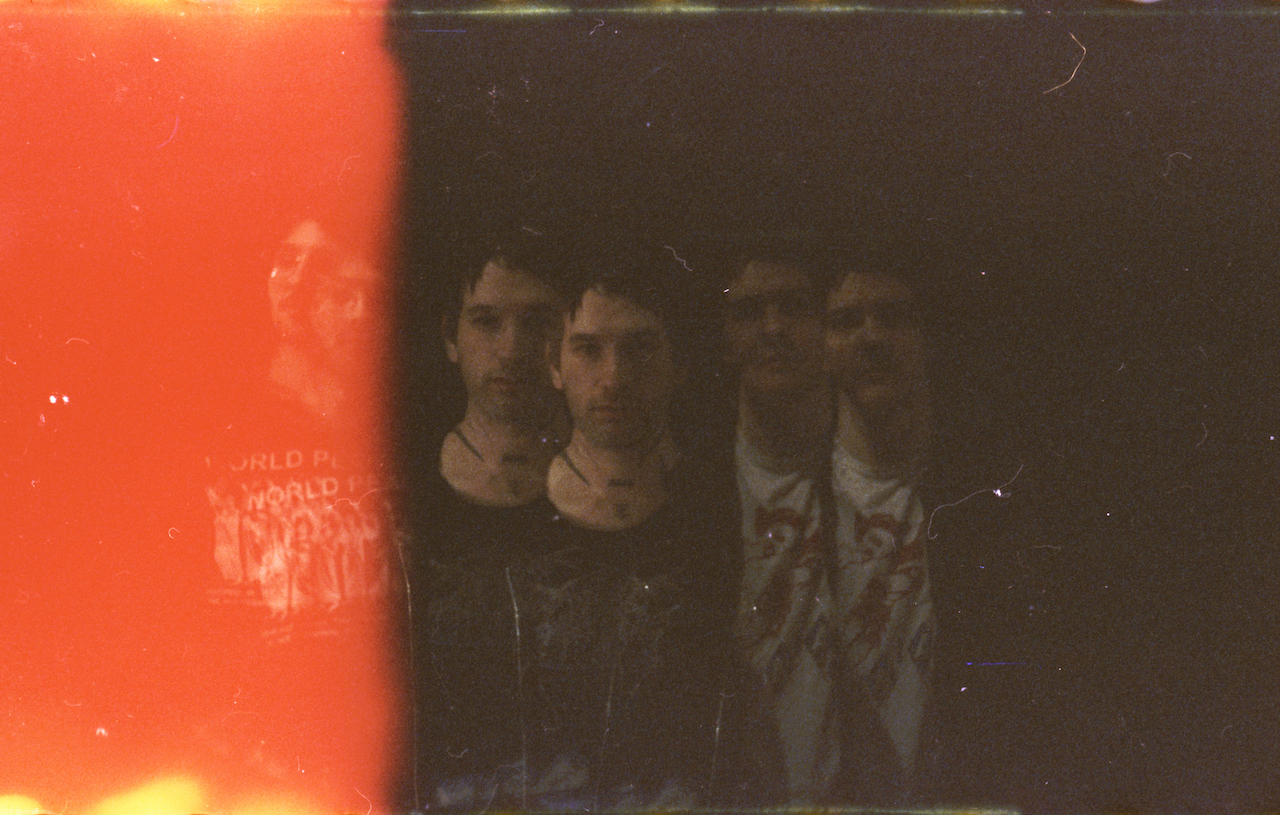
On their new album …Beginning of the End, Portrayal of Guilt present an apocalypse. Vocalist Matt King speaks of humanity’s self-destruction through his lyrics—how we harm each other and the planet. He speaks of a God that’s disgusted and plans on punishing us. The future is a pitch-black hell.
…Beginning of the End, out this month via Run for Cover, marks another intense entry in the Austin, Texas trio’s discography. Though the band’s roots are in screamo and grindcore, Portrayal of Guilt has evolved into more eclectic and overwhelming entity. Along with weaving in death and black metal, industrial and hardcore, the trio integrate styles from outside the rock-metal adjacent world. Take 2023’s Devil Music and 2024’s Christfucker II for example: the former features a B-side of chamber music interpretations of their work, while the latter features EDM remixes of 2021’s Christfucker.
While …Beginning of the End features variation in styles—including hip-hop and electronic sounds—Portrayal of Guilt set out to embrace something unexpected: pop. The band didn’t sacrifice their signature, harrowing tone—the atmosphere on Beginning of the End is steeped in feelings of disgust, dread, horror. What King, bassist Alex Stanfield and drummer James Beveridge set out to do was elevate their grotesque heaviness into a melodically crushing delivery, experimenting to see how far they could push their sound.
I spoke to King about the band’s desire to use this approach to further elevate awareness of Portrayal of Guilt. We discuss …Beginning of the End, his approach to lyric writing, his and the band’s approach to genre, and the feelings he strives to create through their arrangements.
Treble: Portrayal of Guilt has done some killer experimentation when it comes to blending genres. Where does that experimental drive come from, and how does it work its way into the band’s writing?
Matt King: I think that’s just mainly because we’re not really looking to write something specific. Especially with this record. Our drummer [James Beveridge] lives in New York, and he used to live here, so we would practice together all the time. We had a lot more music coming out. Whenever we all practice together, that’s when our heaviest stuff kind of happens. I think with this record, specifically, it sounds a little bit different because I’ve had the opportunity to write a lot of these songs on my computer, just alone in my room.
As far as genre blending, I feel like it’s just natural because, again, we’re not looking to try to write something specific. I listen to a ton of music—the way a song could potentially sound could have something to do with what I’m listening to that day. If I’m listening to rap or grind this day, it all kind of comes out. There are times I’ll listen back to some stuff we’ve done, and I’ll be like, I must’ve been listening to Converge.
Treble: Would it be fair to say inspiration is more impressionistic for you?
MK: I mean yeah, definitely. A lot of shit will be inspiring, spark new ideas. It just depends on what I’m into that day or week. It’s hard to say now what I was possibly listening to [while making …Beginning of the End], but there are a few things within the record that I’ve been wanting to do for a while that we haven’t been able to do. Specifically, with the rapping, I’ve always wanted to produce beats; I used to produce beats when I was younger. Not for anybody in particular. I always thought it would be cool to mix rap and punk/hardcore together, so I felt this was a good time to do that.
Treble: In making The Beginning of the End, did your previous work on Christfucker II and Devil Music provide a certain direction with the album? Particularly, did those records prove to you that Portrayal of Guilt could go further with experimentation?
MK: I can definitely say that. Each release that we do is its own kind of thing. With Devil Music, the whole plan there was—Christfucker had come out, we were writing some songs, and at that period of time I was listening to Celtic Frost. Celtic Frost has a lot of songs where the band is playing the song, and [then] there are classical instruments, and they’re basically different versions of the song. From that alone I was like, what if we did an A-side/B-side kind of thing, a heaven-and-hell version of a record. So, that was the inspiration behind that. With Christfucker II, I love electronic music. I basically started, not too long after the first one came out, started looking for specific people to do remixes.
With this new record, we could’ve gotten weird with it, as far as classical instruments or more electronics—which I think there are a few little things here and there that are somewhat electronic. But for the most part, with this record, the main thing was I had always wanted to do more verse-chorus style pop structure songs. Not to say the end goal for the band, but it would be very interesting if the band was writing pop style songs, what if there was an [easy-listening] version of Portrayal of Guilt. How far can we take this sound? Say if we turn into something like The Strokes, or some shit like that. On that level. If you had a band like that that has this specific sound. I feel like we started one way, and it worked its way into what we became. I feel like Christfucker is where we found our sound. I feel like we can write any song and have it sound like us. With the next record, who knows what’s gonna happen.
Treble: It’s a whole conversation about how much further metal has gotten into the mainstream today. An example that always stands out to me is Slipknot—at the start of their career they had much more of a death metal, industrial sound, and they got radio play. So, it’s not impossible for a band like Portrayal of Guilt to reach a similar level of cultural appeal.
MK: Yeah, definitely. At the same time, it’s like, how many times can a band write the same album? That’s something we’re trying to get away from, I guess. It just comes with the times that we’re in, as far as what kind of record we’re working on.
Treble: In terms of lyric writing, with each record, how has your writing voice developed? What came first for you, writing or music?
MK: Music for sure. That’s the main thing for me; that’s always what speaks to me first and foremost with any music I listen to. As far as writing and lyrics, I’m not gonna lie, I hate writing lyrics. It’s definitely the worst and it comes last. For pretty much every album, but with this album specifically, we did all the music first and then I spent a little while writing the lyrics to the songs. But [writing lyrics is] like pulling teeth. That’s mainly, I think, has something to do with school; I went to school until about 10 th grade and then just dropped out. I just hated it so much. It just takes me back to having to write a paper. So, I’m like, yeah I really don’t want to [write lyrics], but at the same time I have to.
Treble: That trips me up to hear because I think your lyric writing is great. I enjoy reading horror, and your lyrics are gripping.
MK: Thank you, I really appreciate it. I used to not write like that. But I feel confident with this record. The last few [records] I have felt very confident about, lyrically.
Treble: The obvious follow up then is where does this type of horror writing come from for you? Or perhaps it’s not even about genre for you.
MK: It’s definitely not genre related. I wish I really knew exactly where it comes from. Usually the way I write lyrics, I’ll usually listen to our music, and I’ll write sentences and words that come to mind. It always goes there. From there, I’m essentially structuring everything; I’m not just writing down in order, I’m piecing things together as I go and telling a story from there. It’s all straight from my mind; I very rarely look things up. I’ll only look things up for help when I start speaking about certain subjects, to make sure they’re accurate.
Treble: What inspires your lyric writing, or your approach to lyrics in general?
MK: With lyrics, it’s weird but I actually don’t [have a lot of specific influences]. I feel a lot of the stuff that I’m writing down, if you read it, you can picture it. That’s where I think it comes from—I picture it and then I write it down. I wish I could describe how it happens. I’m in just a weird headspace as I’m working on stuff like that. The only way I can describe it is picture to words, words to pictures. [Regarding inspiration], things that I’ve read; maybe not even horror movies specifically, even though that definitely has something to do with it. In a way some of it is low-key edgy, but I’m not trying so hard to be edgy. It’s the same thing that I get out of listening to a true crime podcast, something like that. I’m always interested in the details. I think that could have something to do with it.
Treble: It sounds like you’re describing morbid curiosity. I have noticed—not to reduce all your lyrics—references to religion and suicide. What is it about these themes that call to you?
MK: For the most part, as far as religion goes, back when I was younger, I was forced to go to church every week. Getting involved in that, Sunday school, and I have zero interest in that stuff. And the kind of person that I am I think—I don’t want to look at it as straight-up nihilistic. I’m more just facts based in my mind. I don’t believe in it, no offense to anybody who does. I have zero interest in religion, I don’t believe that it’s real. I think it’s more a joke, if anything, like that.
So, a lot of times I’ll bring that [into the lyrics writing]. I’ll use it whether I’m serious or not, such as in songs on the new record, writing about how humans are essentially ruining this world and God is gonna come back and kill everybody because of how terrible it is.
Treble: A quality I like in your lyric writing is that it straddles a line between realistic horror and fantastical horror. Is there any intention in your lyrics that you hope gets communicated to listeners?
MK: For the most part, I would say as far as my writing goes—I’ve been asked what does this mean. [Songs have] meaning, but at the same time, I almost prefer whoever is listening to it takes it the way they want to take it. Not to say there’s no meaning behind it, because there’s definitely a meaning behind it. But as far as music and lyrics, I always would prefer if the listener has their own opinion on it. That seems a lot cooler to me.
Treble: Then on a similar note, what about Portrayal of Guilt’s instrumentation? I read a quote where you described Christfucker as wanting to make an album that “sounded like it came straight from hell.” What does that mean emotionally though? What is it that you’d like for the band’s sound to convey? If that matters to you.
MK: It definitely does. It’s usually sounds that are most intriguing to me. I don’t even know how to describe the sounds that I’m thinking of—just weird, dissonant tones. I’ve been using this as a reference all day because it’s my favorite band, but Korn. The music specifically; the guitar players in Korn, and Wes Borland of Limp Bizkit, just these crazy guitar players, and stuff like that. Those kinds of sounds are most interesting to me.
As far as atmosphere goes, that has shifted since we started. Because we were writing for a different reason back then. We started off as one kind of band and just had fun with it from there and became what we are now. As far as Christfucker goes, trying to make you feel uncomfortable and anxiety ridden, if that’s even possible through sound. A lot of movies don’t scare me; horror movies don’t scare me anymore, but there have been some movies that have freaked me out and I think, more or less, it’s the sounds. A simple jump scare: that scares you, you can scare anybody by just hitting something next to them and that freaks you out. Using that and things like that are definitely a part of what we’re sort of trying to go for, but again, it fluctuates. Time and place, kinds of songs. Each album is different.
Treble is supported by its patrons. Become a member of our Patreon, get access to subscriber benefits, and help an independent media outlet continue delivering articles like these.