
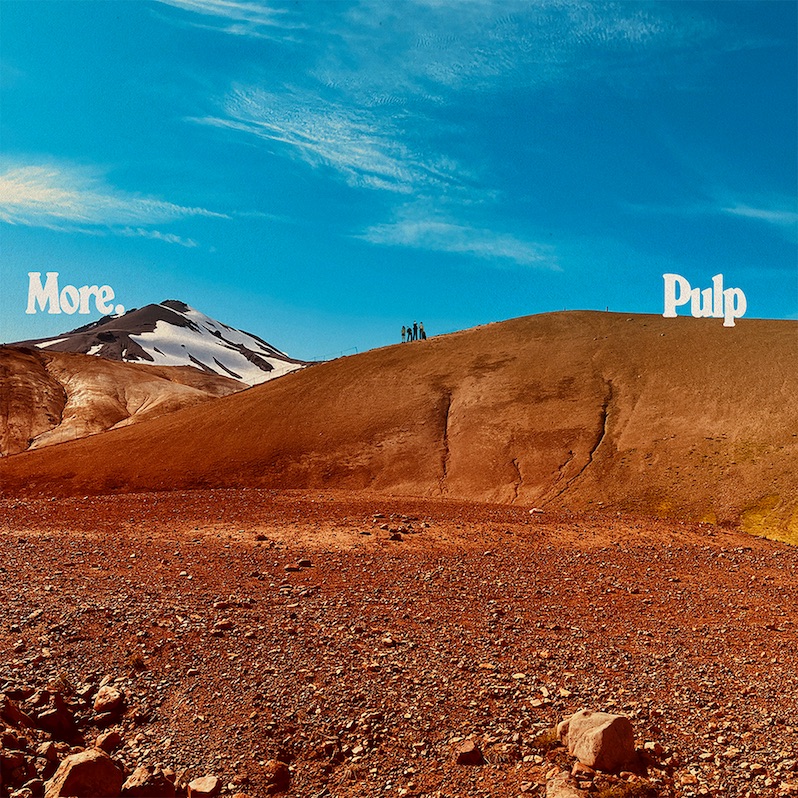
Pulp : More

A confession: I never have been big on Britpop. When it comes time to decide all-timers or ballots, I’m the one talking down on Blur, razzing the movement for delivering the bloated egos of Oasis who never seemed to justify the hype to me (even if they have a number of records that are admittedly pretty good) and seemed mostly beneficial for handing us Radiohead, an absolute greatest-of-all-time level group even if their politics as of late have proven less up-to-date on left-wing positions than they had been around the turn of the millennium. So why choose to review this record? It’s simple: I never, um, actually sat down with Pulp before this. I’d heard interesting things, how they skewed more toward the arthouse and the progressive than their peers, had a great level of sophistication to their playing and compositions. I didn’t necessarily disbelieve people. I just never had the cause to verify before now.
They were, of course, correct. Not only on the back catalog (This Is Hardcore absolutely god damn floored me, as I was told it would!), but also on this record, one that eschews all the typical expectations of a comeback record decades after their last studio document for something more restrained, or at least more restrained than how some might skew. Pulp’s approach here feels closer to what Tears for Fears did with their superb comeback, trusting in their vast and seemingly endless capacities as songwriters and performers, dramatists wielding the pen on staff paper as much as the lyric book. What a wise gambit. Frontman Jarvis Cocker is not only so effortlessly full of guile and intrigue in his delivery but has a wickedly sharp pen, erring away from the hysterically purple overwritten lyrics of some touted greats and keeping an ear toward those lines that catch you like little barbs in your jacket, brambles you bring back home.
But the keyturn moment for me, which came part of the way through track two on my first pass just as I was turning to my wife to mention not really getting the record, was this sudden epiphany. Where had I heard that sly-devil patter against that kind of rumbling arthouse British rock, part glam and part the rough-and-tumble of figures like Nick Cave with their brooding drama? I could practically see Geordie Greep before me. Strip away the more overtly mathematical and proggy flourishes of groups like black midi and Black Country, New Road and you see the long tail Pulp’s obvious influence carried on that scene. And it’s an obvious punch-up too; stretch the lengths of the pieces, let the tracks play out with the same slow billowing theater that Pulp themselves did on This Is Hardcore but with some extra muso flash and pizzazz. This might sound like a knock to Pulp, openly stating that they lack the same kind of flourish that I find myself consistently drawn to. But the thing is: Pulp doesn’t need it. There’s a real magic to picking the right chords, the right notes. Sure, Yes may play a whirlwind of notes that feels perfect for them, but this doesn’t mean the organ-hum gospel simplicity of U2 becomes incorrect.
This epiphany didn’t just carry me through the rest of More, which from that point on felt akin to the same kind of masterclass in songwriting and constraint that everyone from Paul Simon on the underrated Seven Psalms to Peter Gabriel on the arguably gainless victory lap of i/o, but also back through their previous catalog. The ambition laid itself bare to me, one that had much more in common with Radiohead than Oasis, this urge to internalize all these myriad voices into their work, all these ways to approach chords and inversions in pursuit of drama and something rustic and real. Opening my ears, I could hear Sparks colliding with Tom Waits, swapping parts between those two pillars to create something half-rustic and half-camp, with enough nimbleness in the guitar parts or inventive turns in the bass or keyboard accompaniment turning chords on their heads to indicate they’d also spent time in the woodshed. A lot of times, talk about great songwriting strike me as lazy copouts to refuse to talk about the song as recorded, seeing a piece as potentiality rather than specificity, a skill important in the musical world but not strictly always relevant on the critical end. More, meanwhile, felt like a delight, a 24-year delayed punch just to reaffirm they really were as great as everyone said they were. Take it from me: I wasn’t taken in by the hype until this record. That says something meaningful.
Label: Rough Trade
Year: 2025
Similar Albums: