


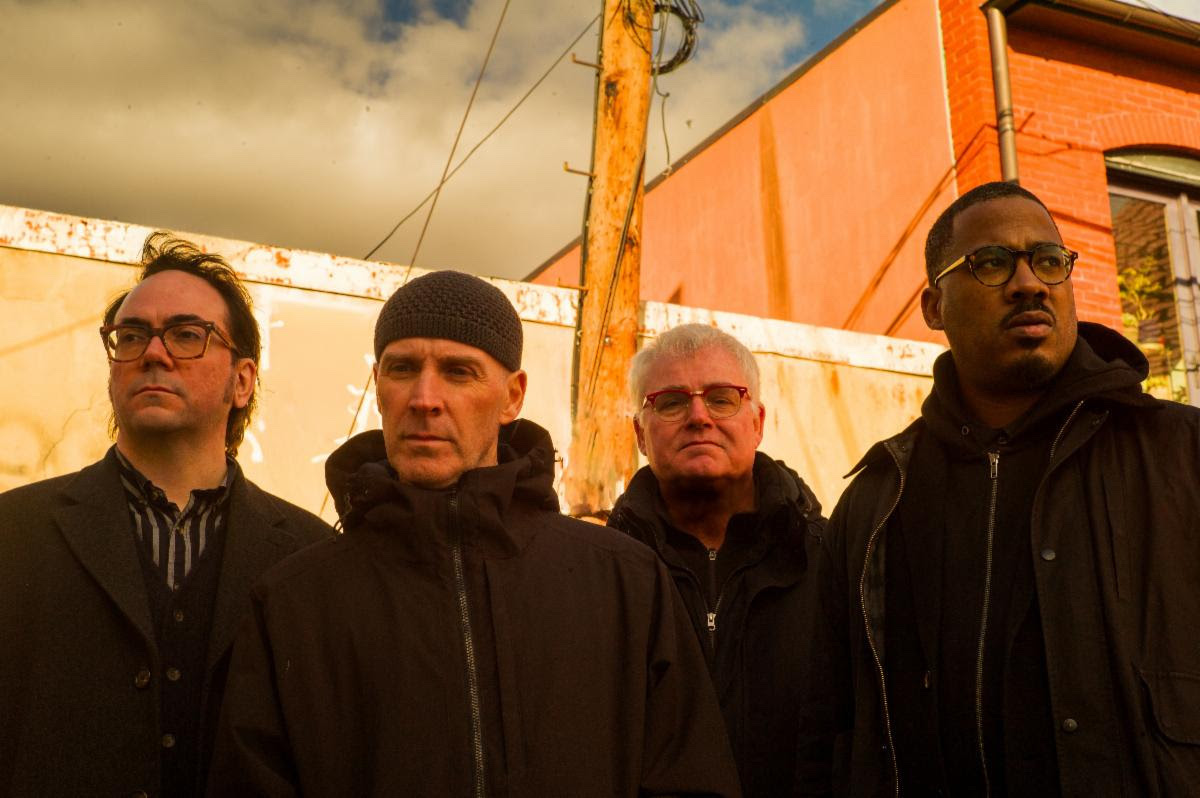
The essence of jazz is to push boundaries while embracing an expansive vision, the intersection of which is at the core of The Messthetics’ ongoing collaboration with composer and saxophonist James Brandon Lewis. The Messthetics comprises the former Fugazi rhythm section of bassist Joe Lally and drummer Brendan Canty with guitarist Anthony Pirog, and the addition of Lewis’ talents has seen their unique artistry elevated to a new level. Their new album Deface The Currency, which came out on February 20 via Impulse! Records, showcases an urgent energy on highlights such as “Gestations,” “Rules of the Game,” and “Clutch.” It exhibits a substantial progression with the introduction of more experimental elements being heightened through the abstract and free-flowing nature of the music.
I recently had a talk with Lally, Lewis and Pirog about the making of their new full-length, how performing together throughout the past year or so has fine-tuned their approach, and what they hope people take from the album while giving it a listen.
Treble: For the making of Deface The Currency, what was the experience like? Was there any carryover in terms of vision or approach from your first collaborative album that came out in 2024, or were you all looking to start from a clean slate?
James Brandon Lewis: This is a document of us from playing a lot of shows. We’ve had a lot more shows under our belt this go-around for this record versus the last record, so that’s one of the main differences.
Joe Lally: Yeah, that makes it like a clean slate, and at the same time, there’s carryover of what we had written, even before we were playing with James, that got introduced to him over that time on the road. There’s also a continuity that’s involved.
Anthony Pirog: It’s also a documentation of the evolution of the group vocabulary over the many shows we’ve done together. There’s also the difference of having the option to rehearse songs in front of people and have them develop in front of people, which is something different from the first record.
Treble: When it comes to the songwriting for this album, how would you describe this particular evolution with you performing together as a unit? Do certain ideas and parts fall into place more seamlessly and is the communication pretty streamlined these days?
JL: Three of us are all in the D.C. area, so The Messthetics can get together and work out ideas and talk about things. We then introduced James to them, and when we were out on the road, we could use the soundchecks to actually experiment with these ideas. James also brought a song into it with “Clutch,” so it worked the other way around too, but mostly, it’s something that is a slow process. It’s introducing the melodies to get songs going, which I think a lot of things come from, right?
AP: Yeah, we get together as a trio to compose stuff, but I think the process is pretty intuitive. No one is really trying to tell anyone what to do, and when James joins us, not much has to be said because there’s a real trust between everyone. The goal is to support the music and each other on stage, so there are lots of interactions that might sound like they’re planned out in advance, but we probably didn’t talk about them. For instance, at the end of “Rules of The Game,” we all start deconstructing the idea and the riff. I don’t know what James is doing, but he’s just filling in all the holes where my lines allow him to and we never discuss that as interactions.
Joe and Brendan are doing the same types of things, so we just kind of let it happen. We’re very lucky in that regard.
JBL: I think that just over time, having essentially worked with Anthony since 2014, he and I have a natural chemistry. Working with Brendan and Joe, at a certain point when you collaborate, it really has a lot to do with serving the music, less about ego, and more about fitting in where you can fit in. At least in this ensemble, we all have a natural flow at this point, and we’ve always had a flow, actually, even when I sat in with The Messthetics in 2019. It always kept revving up with the vibe, the energy, and the connectivity every time we would get together. We would always sync up ways that came out quantifiable.
Treble: The music video for the title track has these layered visuals of each of you playing your respective instruments in lighting that has a contrasting resolution of shadows and bright spots. Who had the idea to make the video in this fashion and was it filmed in a studio space or was it filmed in a more peculiar location?
AP: We’ve done music videos as a trio since we started and we also have some live footage that we’ve released, but we’ve never done a performance where we’re kind of playing along to the tracks. That idea was something we hadn’t done, and I’ve done some videos with the guitarist Henry Kizer where we have a green screen, which he sent me to take part in some of his videos. He does a monthly or quarterly guitar program on YouTube, so we shot the music video in front of a green screen in Joe’s basement where we rehearse, and then James met up with our friend in Brooklyn, Robin Bell, who added those lighting and filter features, but Brendan shot it and edited it.
JL: Brendan’s part was actually shot separately too, right?
AP: Yes.
JL: It’s so weird in a way.
JBL: I also think a part of the background, the scenery, that’s from us being on tour together.
JL: Yeah, Brendan made it all happen.
JBL: Exactly, we just showed up.
Treble: Both the title track and the name of the album come from a quote from the Ancient Greek philosopher Diogenes, so how did this come about where it felt like Deface The Currency was the right fit for a title?
JL: I think the sentiment was in the air with how we kind of look at what we’re doing, being a band, and what we’re doing with the music that we can present and how we’re going to present it. To not worry about things like genres and how it’s going to be perceived, so it made sense, and it’s certainly the right phrase, but I can’t say that I had anything to do with where it came from.
AP: I was reading, I came across the line, and like Joe said, it has a lot to do with what we talk about. It might not relate directly to the original quote, but we constantly talk about just trying to play music like our authentic selves in an authentic way and how that’s the real power of this band. It’s the meeting of different personalities that are all there to engage in the same activity.
JBL: Obviously, it’s the four of us just being on the road, hanging out together, living life, experiencing life together, and there’s an energy. I can say confidently that with the four of us, if you’re expecting us to sound the same, then we’re going to go against that. We’re going to deface that and we’re going to redo whatever the notion is of what we should be doing, just kind of like bucking the system. That’s what I think of when I think about the title of this record and the energy of this record, and while it relates to the first record in instrumentation, it’s a totally different vibe. It has a “now” energy to it without being overtly one way or another, we know what’s going on in the world, so we don’t even have to say it, it’s in the music.
Treble: When people give the new album a listen, what do you want them to take from it? Going along with what James said about the “now” energy, is that something you want the listener to connect and identify with?
JL: I just want to say that anything you put out there is expressing your take on the moment and what you can put together as your piece of art that you hope will land with people. Really, what I ask of people is I’m just hoping we can get their attention to sit with it, be there in the music, and see what they can find in it. I always think it’s different to people and their interpretation of something whether it’s lyrical music or instrumental music. The main thing is hoping that the attention we’ve brought to it is met with the attention of the people listening and they can find something in it.
JBL: I hope people just feel our honesty, that’s what I always hope with playing music and releasing music. Our people get bathed in sound, go into listening to the music with an open mind and an open heart where it’s less referential and more accepting of what’s being presented. This is the way in which we are sonically viewing the world, so we want people to get immersed in that while submitting to what’s being offered.
Treble is supported by its patrons. Become a member of our Patreon, get access to subscriber benefits, and help an independent media outlet continue delivering articles like these.
