


We live in an age of unidentified drone swarms and outsourced prison megacomplexes. It’s a time of declassified JFK document dumps, AI-generated porn, and celebrity space tours. The guy who, until recently, was the president’s “first buddy” literally owns a company developing brain chips, while the guy in charge of national health once shared his own brain with a worm.
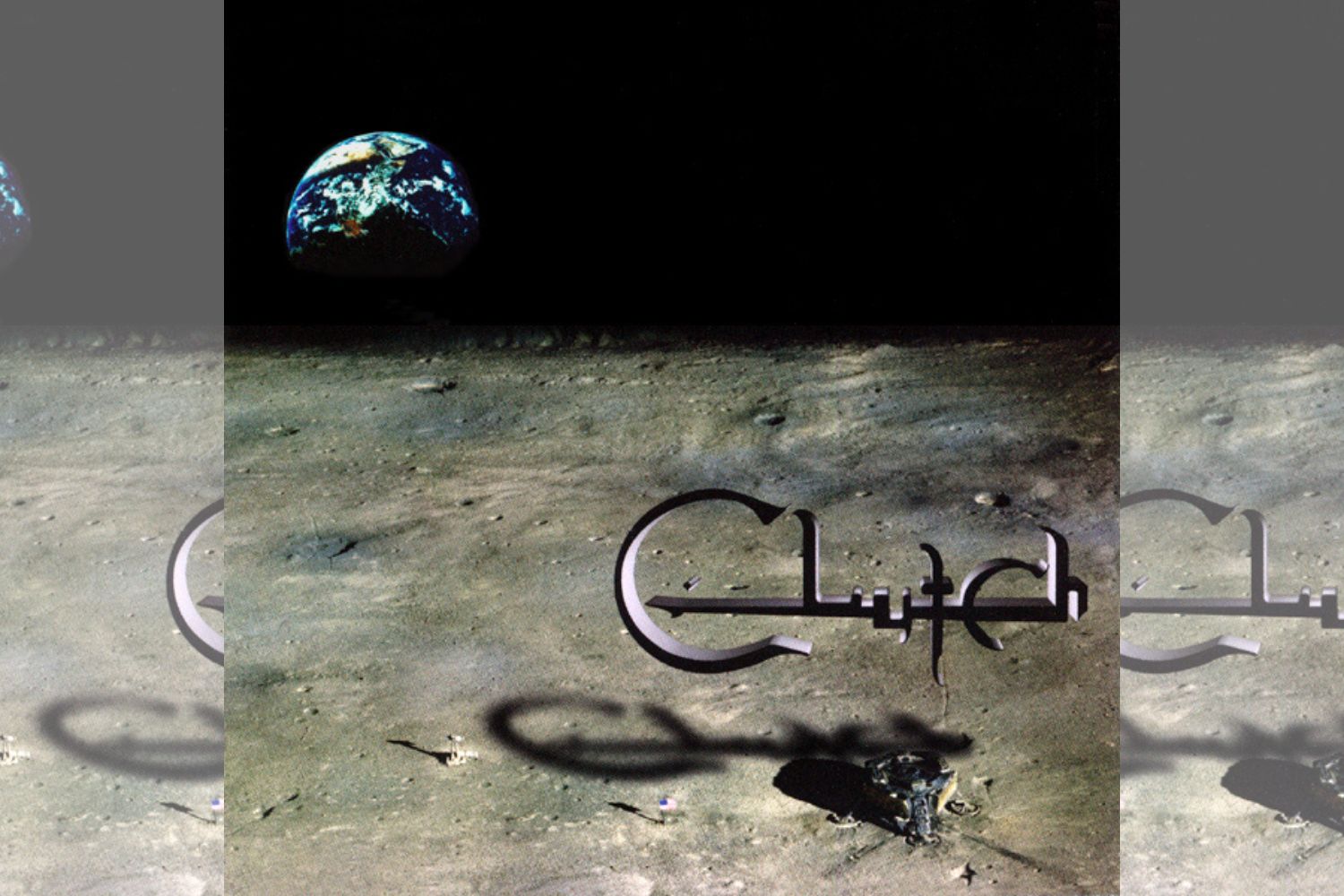
We live in the no-longer-fantasy world of Clutch’s self-titled second album, which recently turned 30 years old. It’s a lyrical album of groovy—yes, groovy—metal that, if anything, holds up a little too well. The album revels in conspiracy culture, which was a lot more fun when conspiracy culture wasn’t the mainstream reality.
Now, for some listeners, Clutch’s 1995 album is what will earn the band a plinth in the ’90s wing of the Royal Museum of Stoner Rock, should a brick-and-mortar facility be built (an AI dehydrated a small rainforest to confirm no such place exists, though there once was a website for one). And fair enough: the primary radio single was a slow-burning psychedelic track called “Spacegrass” in which singer Neil Fallon roar-bellows about smoking some spacegrass and watching the universe expand.
But “Spacegrass,” with its slowly sinister bassline, menacing chorus and explosive bridge, is also about picking up a hitchhiker and driving around the solar system in a 1973 Dodge Dart Swinger, with a little Jesus figurine bouncing around on the dashboard.
And that is the heart of the album: outer space and the weirdness of the American open road.
The album wasn’t recorded for couch-locked kush bliss. The self-title says it all: this is an album for shifting into gear, squeezing the throttle, and knocking back whatever stay-awake shot was available at the truckstop just past Ganymede. You don’t hold the steering wheel at 10 and 2 while listening to this record; you’ve got your right hand at midnight and your left hand out the window tasting the wind like a rattlesnake’s tongue. It’s what Barf would rock out to in the back of the Eagle 5 Winnebago.
Clutch is the groove metal embodiment of what was once Coast to Coast with Art Bell on AM radio. It is a soundtrack for highways that are empty except for the crackle of a CB radio and a billboard every 10 miles that reads “The Thing? What is it?” It should be in the jukebox of every backroad biker bar where what connects one soul to the next is sharing the strangest thing they’ve ever seen.
The album kicks off with a double track, “Big News/Big News II”—a fusion of funk, metal and pirate shanties that evokes Jabba’s sail barge in its heyday (“We got Greedo, Solo to the rear/they know the deal/Sacks packed with pieces of eight/a Sailor’s life for me/Live free or die, never look a bounty hunter in the eye.”). And like many good album openings, it gives the listener a clear preview: if you like it, venture onward, because it’s a theme that will repeat. If it’s not your cup of grog, turn it off and go find yourself some Dave Matthews.
This is followed by the twangy “Rock n Roll Outlaw,” an anthem that in a just universe would be up there next to Joan Jett and Kiss (“Where rock is criminal, criminals rock!”), and “Texan Book of the Dead,” Clutch’s heavy riffed bastardization of the 1958 novelty hit, “Witch Doctor,” and various children’s songs.
Clutch hits its stride with its talky “Escape from the Prison Planet,” and I’ll shank anyone who doesn’t recognize it as a masterpiece of musical story-telling, encapsulating the entirety of late 20th century paranoia in just under five minutes. It’s starts mid-thought from the perspective of a John Carpenter-style protagonist (think Roddy Piper in They Live or Kurt Russell in Big Trouble Little China) who has seen through the curtain of normie society:
Then against my better judgement I went walking out that door
I smiled at one person, then I nodded to three more
One man asked me for a dollar, I asked him, “What’s it for?”
He said, “I have seen them.” I said, “O.K., it’s yours”
What was behind the door? Who are them? It’s an opening as irresistible as any mid-20th century pulpy paperback, and it only gets more intriguing in the second verse:
And to the tune of a billion dollars, I supplied to the D.O.E.
Some tasty little nuggets of alien technology
And as one might expect, I’ve been harassed for years
The Men in Black have been bending my ear
As a matter of fact, they were just here today
But I escaped them through a secret passageway
Once I lived there for one thousand days
After “Spacegrass,” the album continues on with tracks like “Animal Farm,” which reads like a metal version of The Twilight Zone’s “To Serve Man,” and a string of songs invoking doomsday truck stop preachers, before closing out with a double-track return to the opening theme.
The album engages and electrifies the same brain synapses that led to two major cult genres of the time. The X-Files, Fire in the Sky, Alien Autopsy: Fact or Fiction, and the Men in Black franchise were bringing UFO abductions into pop culture. Meanwhile, America’s romance with the open road (thanks in no small part to Oliver Stone’s ascension) was turning dark and apocalyptic with Kalifornia, U-Turn, Natural Born Killers, Thelma and Louise, Six String Samurai, Lost Highway and Fear and Loathing in Las Vegas.
Listening to contemporary Clutch doesn’t scratch the same itch (Full disclosure: I stopped listening after The Elephant Riders). But just as Deep Purple’s Machine Head, which opens with “Highway Star, ends with “Space Truckin’,” may be Clutch‘s closest ancestor, the Viagra Boys’ fourth (almost self-titled) album, Viagr Aboys, may be its heir. While there may be no direct line between the two bands, their records have similarities akin to the creepy non-twin lookalikes who go viral every few months. Clutch’s “I Have the Body of John Wilkes Booth” and Viagra Boys’ “The Bog Body” are both raucous odes to corpses pulled from mud. On Viagra Boys’ “Store Policy,” singer Sebastian Murphy employs similar vocalization to Fallon on “The House That Peterbilt.” In “Medicine for Horses,” Murphy, despite being Stockholm-based, croons longingly about “the great plains of North America” (albeit because his character is fixated on assisted suicide by horse-hoof to the head). And where Clutch is engrossed in Area 51-esque conspiracy theories, Viagra Boys explores the surreality or new age self-care and scammy pharmaceutical regimes. Or maybe it’s just that I’ve been binging both records during the same month and, like every tinfoil milliner, seeing the kinds of connections that only emerge when you stare at a murder board too long.
Nevertheless, Clutch’s self-titled album is very clearly the product of its time—and that time was before Alex Jones and Qanon became household names, when driving was a near-universal American pleasure and not something to be outsourced to gig workers or autonomous software. That’s why it’s also an uncomfortable listen. The themes have lost some of their charm: like watching the season premiere of The Lone Gunman after Sept 11, 2001 (IYKYK, and if not, look it up) or reading Isaac Asimov after #MeToo. But if you can separate yourself from the hellscape created over the last decade (an Orwellian feat of doublethink for many), the album remains both a remarkable work of metal innovation and a satisfying specimen of mid-’90s science fiction.
Treble is supported by its patrons. Become a member of our Patreon, get access to subscriber benefits, and help an independent media outlet continue delivering articles like these.
