


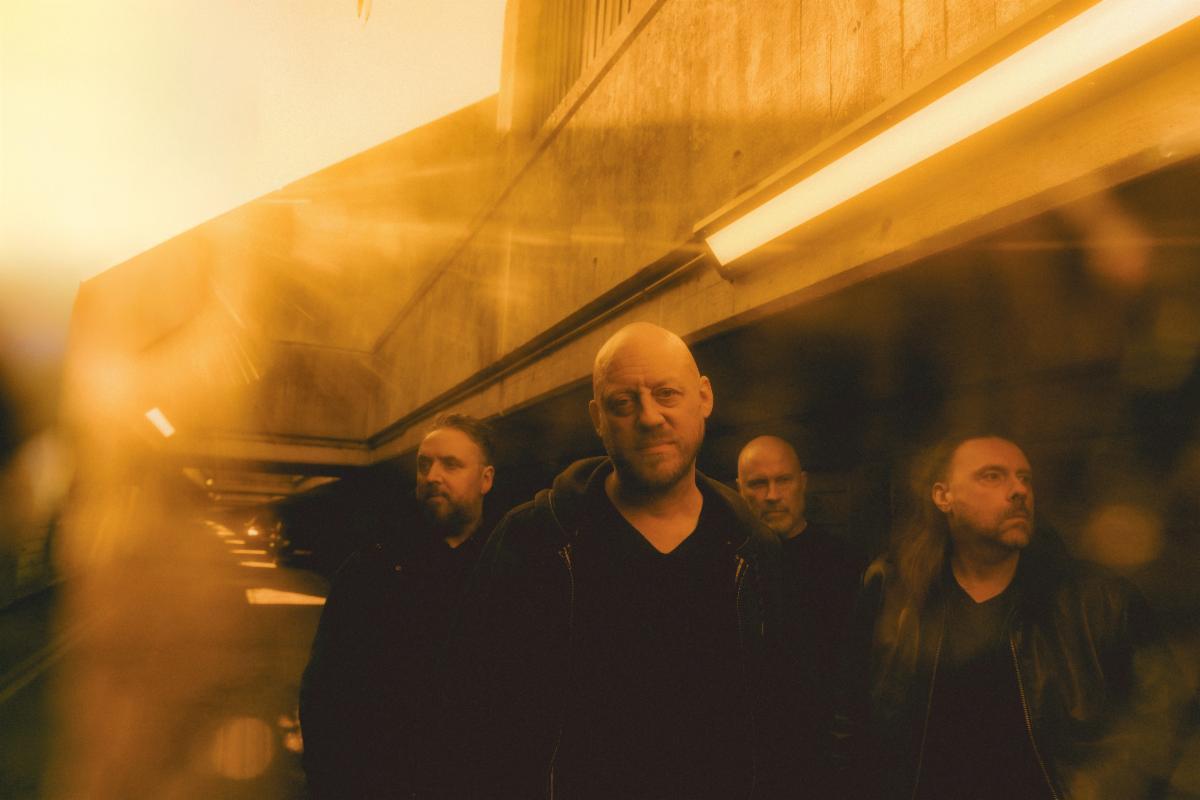
I’m in the basement of Reggie’s Rock Club in Chicago talking to Patrick Walker. Later tonight I’ll get to see him perform a solo acoustic act as 40 Watt Sun—but for now, we’re talking about Warning.
If you’re a fan of doom metal, there’s little doubt in my mind you know about Warning. The English band cemented themselves in metal history with their 2006 sophomore record, Watching From a Distance. While Warning embrace the low-end riffs and gloomy drones that are staples of the genre, Watching From a Distance sets itself apart from other doom records in Walker’s embrace of melody, along with intensely personal lyrics that reveal only as much as they need to.
Watching From a Distance has received critical acclaim and fan adoration in the 20 years since it was released, but Walker opted to leave Warning aside in the years that followed—that is, until now. Although the band has reunited for live performances prior to this year, they’re releasing their first new album in 20 years, Rituals of Shame, out this month via Relapse.
Rituals of Shame is a moving experience; while Warning’s instrumental performance stirs with evocative blends of heart-wrenching melody, Walker’s lyrics are the heart of the record. The guitarist and vocalist has shared that the music that eventually became Rituals of Shame arose from a profound experience in his life. Walker has a reputation for keeping the explicit meaning behind his lyrics close to the chest; the point of my conversation with him is not to probe these lyrics, but to better understand the emotional state and practices that form his work.
In my conversation with Walker, we discuss the craft that went into Rituals of Shame. We talk about his thoughtful writing practices, the decision to bring Warning back after all these years, the legacy of Watching From a Distance, and why he finds labeling music as cathartic “cringey.”
Treble: The press release for Rituals of Shame, it’s said that a transformative experience in your life shaped these songs. With the band being shelved for so long, what made you realize that Warning was the appropriate vehicle for…
Patrick Walker: No, it didn’t. I can answer that before you finish asking your question. All I knew was that, at the end of 2024, I wanted to make a new record. It’s the same as feeling hungry and wanting to eat; I can’t explain it better than that; I knew I wanted to write a new record. The only thing I knew ahead of having written any music was that I wanted to make a heavy record. I knew how it was going to sound. As soon as I knew that I then had the decision: Do I make this as the new 40 Watt Sun record—which would be perfectly legit—or do I make a new Warning album?
The previous year I had already decided I would likely play some 20th anniversary shows for Watching From a Distance. So, I knew I would be playing with the same band again. I figured let’s release this as a new Warning album, it makes all the sense. I thought it would be a significant thing to do, on the 20th anniversary. That’s easy to be cynical about it and say, well, that’s very convenient. But that’s really how it happened. It’s the record I would have made now anyway; I didn’t make this record because it was going to be a Warning album.
Treble: When you say it made the most sense to release this album under Warning, are you talking about a sonic difference?
PW: No, because it’s the record I would have made anyway. I was going to make a heavy record; I could have put Warning’s name on it, I could have put 40 Watt Sun’s [name on it]. I considered forming a new band with entirely new band members. […] Without wanting to sound cynical about anything, it made my life easier. I wanted to get label support so I could make the record I wanted to make, and putting Warning’s name to it helped in a small way.
Treble: Was there ever a desire to return to making a new Warning record prior to creating Rituals of Shame?
PW: No, because I never had any compulsion or need to make another record of that kind of weight—I mean sonic weight. Because Warning terminated at a certain point originally, it’s going to be synonymous with a certain sound. Whereas 40 Watt Sun has always been—I mean everything I’ve done has always been part of the same continuum, I think. But 40 Watt Sun doesn’t have a defined sound; I mean, it’s defined in other ways, most notably through my songwriting.
Warning was frozen in a moment in time, which was 2006, or 2009 when we played the last show. So, it was easy to, essentially, pick up where we left off, in that regard.
Treble: Was your decision to drop Warning from a place of feeling the sonics of that band, being so heavy, might limit your artistic expression?
PW: No. As soon as I felt I painted myself into a corner, so to speak, in a band, I would get away from that or start a new band. I never wanted to make records to fit a band name or expectation; to me, that’s not a truthful way of creating art. I started a band when I was 16 years old, and after I made Watching From a Distance I knew what I wanted to do next. I already had a lot of the songs from the first 40 Watt Sun album written. I just thought it was time to move on now. Warning is defined by this record I made, I guess; I just wanted to carry on with a different band name. But similarly, the first 40 Watt Sun is the next record I would have made, regardless.
Treble: Considering this year marks Watching From a Distance’s 20th anniversary, how has that record sat with you after all this time? You’re someone who channels their personal struggles and stories into art, and then puts that into the world. In doing so, that gives people the chance to embrace your art, but also make it their own, try to probe for more details…
PW: Or misinterpret it, which seems to be the case.
Treble: With that in mind then, and considering the cult following that has come with Watching From a Distance, how does that record sit with you now, with so many people picking at it? Does it still carry the same emotional weight now as it did back in 2006?
PW: No, because when I wrote that record, I was 27 years old. I was a different person. It was almost half my life ago. I still circle around the same few obsessions, concerns and whatnot [through art]. In some ways, I haven’t ventured very far. If I listen back to that record now—I should say I don’t listen to it, but if I did—it would pain me because I’d see it as something extremely imperfect.
On the other hand, the most that anyone making a record can ask for is it’s well received. Better than that is if people listen to it in five years time. If people listening to your record 20 years later—by this literally whole new generation of people that are getting into that record now, who weren’t born when it was made—I can’t be ungrateful for that. I wouldn’t be making this record today if I hadn’t made that record.
Another part of me is—and I’m being defensive about the music I love, particularly the music that informed Watching From a Distance—I don’t see Watching From a Distance as anything unique. Because I know where it came from. There was a whole host of bands in the early ‘90s that were on Hellhound Records; a lot of east coast metal bands, European bands, and half a dozen UK bands, that were hugely important to me and really informed the 16-year-old me that went on to make Watching From a Distance. I love those bands […] in that sense I don’t think Watching From a Distance is unique. I think it had the fortune, probably, of emerging at the advent of the internet. […] Had it emerged five years earlier I don’t think people would be listening to it.
Treble: You play it close to the chest when it comes to not divulging explicit details about your life. As someone who makes art about his life, what are the mental hurdles or worries you’ve navigated, and how did you get over them? People have opinions on everything, so when it comes to creating a piece of art based on something so personal, say, Rituals of Shame—is there ever a moment in your mind where you’re like, “I don’t know if I actually want to put this out into the world?”
PW: You know, no. I do my best to cover my tracks, I think. I don’t want to be too explicit or make anyone else uncomfortable; I wouldn’t want to hurt anyone’s feelings. Whatever reputation my songs have gotten, I like to think I’m quite discreet. Like I said earlier, I think Watching From a Distance has been hugely misinterpreted; or certainly a lot of it has.
My other answer to that would be: my responsibility is to be as truthful and as honest as I can. I don’t know how else to do it; there’s nothing else that compels me to make music or inspires me to want to sing than my emotional concerns or my inner life. I’m very careful about what I say. I mean that in interviews or in songs. There’s nothing I’ve never sung about, I’m just probably been more careful about how I express it.
Treble: I’d like to ask about catharsis…
PW: I’ll cut you off because that always makes me cringe. When people say, oh it must be cathartic or I find this cathartic, I cringe at that. That’s something I try to not think about. The thought of music as being a catharsis or something –
Treble: In general?
PW: I think so, yeah.
Treble: You mind sharing why?
PW: There’s just something about it I find—a bit cringey. I don’t know. [Pauses]. I think I just shrink from anything that’ll try to run away from anything that makes the act of making music seem, that glorifies it or makes it seem too self-important, or precious. They’re just songs. I want to sing. If there’s anything cathartic—I tell you what, it’s not cathartic. Because it implies it’s a sort of, like the proverbial hall of pain, or whatever. I work fucking hard writing songs; I don’t work harder at anything. I’ve spent years writing a single song before. The making of this record, although I did it in a comparatively short period of time, I worked at it nonstop for three months, and that’s not catharsis.
It’s hard work, and it’s craft. I’d rather be recognized for that than something—the idea of being an act of catharsis makes it sound like we got into rehearsal and plugged in, and it’s like playing loud and screaming and that shit. I don’t really see how that applies to what I do. You might say, if I was speaking about something else, they’re exorcising some personal demons or whatever through that. But even that, I don’t feel comfortable with that idea. I can’t really be exorcising anything because I’ve been singing about the same shit for 20 years. And it hasn’t gone very far, has it?
Treble: I get where you’re coming from: we carry our pain throughout life. It doesn’t entirely disappear.
PW: Do you think that I suffer less than someone that doesn’t make cathartic music? Or whatever you want to call it. A lot of bullshit is said about music and a lot of people talking about their own. I’m very wary, I don’t want to say anything, I would rather be known for the craft and the very talent I have rather than… the idea of music being an act of catharsis. Even if you asked about some old Delta blues men or something like that—was that catharsis? Even then I’m not sure I’d feel comfortable about that; it undermines the problem there in the first place. So yeah, I don’t think so.
Treble: This reminds me of another conversation I had recently. There’s a lot one could dive into about the idea of a piece of art being mythologized and being placed on a pedestal. I don’t know if this is resonating—what I’m trying to articulate and ask is if you believe this idea of mythologizing art can be taken too far?
PW: I do. I think it happens all the time. I think the immediacy of the art is compromised by that and the humanity of it. I believe you’re in danger of [pauses] of romanticizing or glorifying whatever very real [pauses again]. Sorry, I’m not articulating myself very well here. Well, I’ll cut myself off there then. I’d need more time to think about that.
Treble: Totally fair. I don’t want to probe into your lyrics, but I would like to ask at least how you found the record’s title.
PW: I went to Italy to write the lyrics. Firstly because I had done two very long tours, and I needed to go on holiday by myself and relax. But I also had to do this work. The thought of going back to the house that I live in—by myself, back home and unpacking my heart—to do that job, I couldn’t think of anything less. I thought, well, I’ll go away somewhere by myself, somewhere peaceful and remote and comfortable, and do it there. I was away for three weeks; I read a lot, wrote every day.
I mean the title of the album derives from a lyric in the title track, “pulling me into the shame of the most base rituals of humiliation.” That was it. And although I wasn’t writing an album built around a theme, there was something in that that seemed to thread through all the songs on the record. It seemed appropriate to me.
Treble: I was surprised when I read about your writing practice in creating this album—seven days a week for three months. Why was the process that intense, and what’s writing for you like outside of making an album?
PW: I don’t write when I’m not making a record.
Treble: At all?
PW: No.
Treble: How about a journal?
PW: Well, that’s one of the reasons I tend to—another thing that makes me wince—the term songwriting. Because it implies—I don’t write or read music. I always prefer saying making songs. Because it makes it sound more akin to carving a sculpture or making a painting. I don’t know, I think making songs is more appropriate. It seems more or less to describe what I do.
I write ideas down; you might hear someone say something passing on a bus, or might hear a line spoken in a film, and it just triggers an idea and I make a note of it. The blueprint for the way I worked on this record is how I made the last 40 Watt Sun album, Little Weight.
At the end of 2022, I want to say it was New Years Eve, I suddenly realized I would either have to make a new 40 Watt Sun record for this following year, or I’d have to get a proper job. One of those two options was unthinkable. The first thing I did, a few days into January, I called Chris Fullard [recording, mixing] and said I want to make another record. Chris made this Warning album as well. […] I booked a space for demoing with my drummer, and I spent three months writing songs. No where nearly as intensive as this.
It made me realize, I think the most important thing for a creative person, or for creativity, is not inspiration, it’s not personal trauma or anything like that: it’s a deadline. If you’ve got a deadline, then you’ll do the work. I did that with Warning as well.
I had nothing else to do, I got up every morning—I’m very lucky, I live in a beautiful remote part of the country—I made myself get up early every morning, had a shower, make coffee, and sat and worked. I didn’t start writing songs, I started making music, making ideas, and then they turned into songs. That was it. Originally, I said I’ll treat it like a full-time job, so I’ll work from nine until six o’clock. By and large, I didn’t stop; I didn’t read a book at all last year. Reading then helps me move on. I couldn’t listen to music; it feels like you’re whitewashing whatever is living inside your head. Usually after dinner, I would just sit in silence or carry on working on songs.
Treble: That sounds beautiful.
PW: It wasn’t beautiful [chuckles].
Treble: It sounds peaceful. But I understand doing that same thing for months on end might be a lot.
PW: The thing is it doesn’t afford you a moment’s peace because you always have the music or the songs living in your head. And you can’t get rid of them; you’re frightened to get rid of them. I would have loved to put on a record or something, but then you lose what’s living. You just have the same refrains, or a bit of song structure, knocking around your head for days or weeks. In many respects that’s why it’s the hardest thing that I’ve ever done, or that I could have applied myself to, I think. That’s why I’m not very prolific because I couldn’t do that every year.
Treble: Where did this ethic of deadlines and deciding to not listen to music while making music come from?
PW: That’s not a decision though. That’s a fear of losing what’s in my head. If you’re writing a melody or you’re developing a song in your head and building it, if I was to then put on a record, I tell you what I’d pay attention to. Everything I’ve got living up here is going to vanish. There’s even a danger if you walk into a supermarket and there’s music playing in there, it’s really difficult to not let it start rubbing out or interfering with what’s existing.
The deadlines thing—the record I made before Little Weight was Perfect Light. I had a song on there, “Behind My Eyes,” that took me three years to write that song. That isn’t meant to sound self-aggrandizing or anything. I lived with the songs on that record for years. I worked on them for years with a whole host of different musicians. I never wanted to make a record like that afterwards. I wanted to make records with great care, but I wanted to capture something of the urgency or the impulse that compelled me to want to make the songs in the first place.
Treble: Reflecting on Watching From a Distance and thinking of where you are now with Rituals of Shame, what’s something you’re proud of with how your writing voice has evolved?
PW: Economy. I’m learning how to make songs better. That could mean shorter songs; very often it does, but it doesn’t necessarily mean shorter songs. I think the title track off the new record is economical, with no compromise to its length. I’m very proud of that, I think every moment counts on that song.
Treble is supported by its patrons. Become a member of our Patreon, get access to subscriber benefits, and help an independent media outlet continue delivering articles like these.