


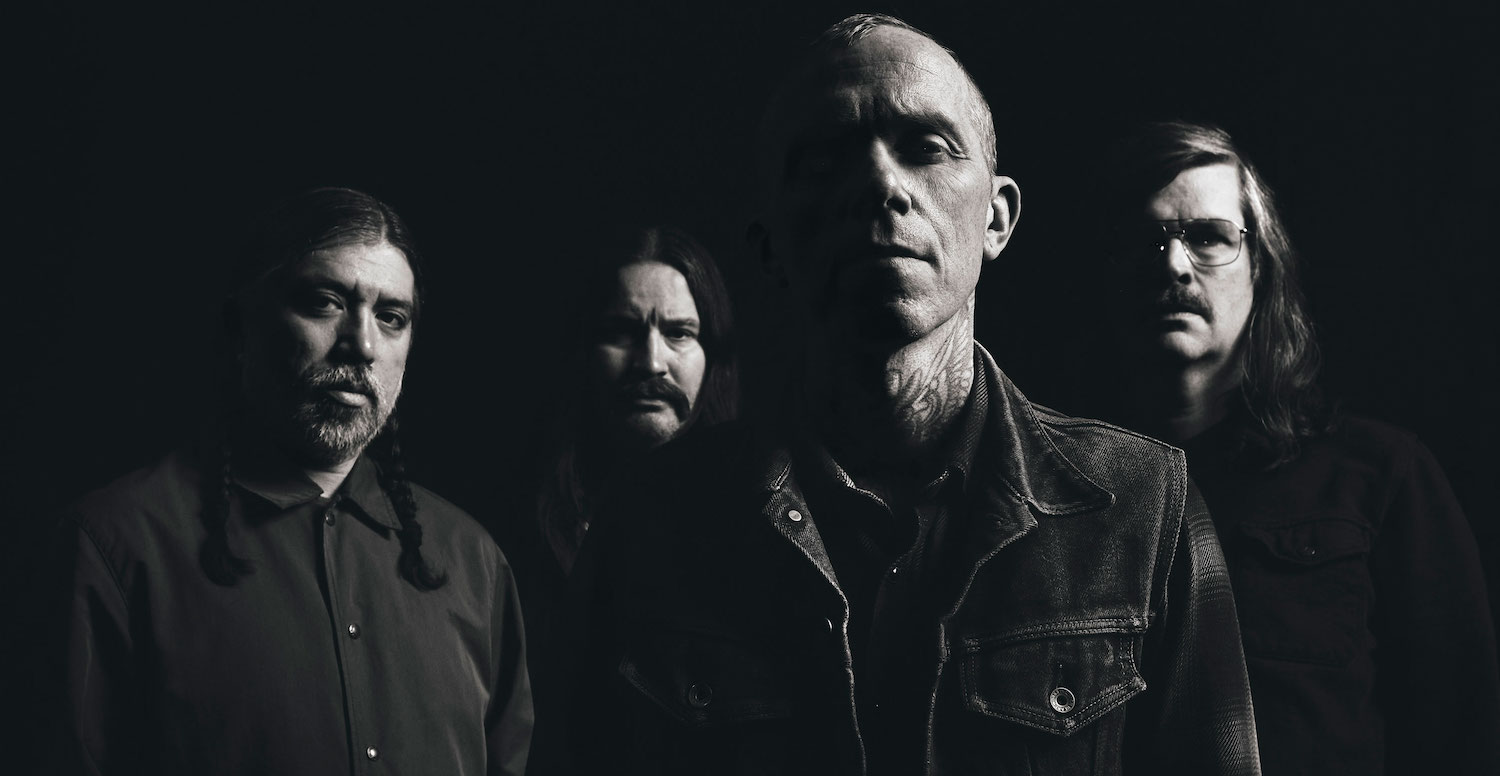
“Our band is real, this isn’t decoration. These are adults working through some fucking hard things in their lives.”
Jacob Bannon has never been shy about baring his wounds to listeners. For 35 years, as the vocalist of metallic hardcore veterans Converge, Bannon has delved deep into personal and societal pains in his searing primal screams. He’s keenly aware of the work it takes to navigate a world plagued by struggles, an empathy that allows for a more earnest and sincere connection among fans.
This poetic ferocity is felt all throughout Love Is Not Enough, the band’s 11th studio album and follow-up to 2021’s Bloodmoon: I, their collaborative album with Chelsea Wolfe and Stephen Brodsky. It arrives in a time where the weight of hardship feels unbearably crushing—matched with a sound that’s suitably intense and incendiary.
Acknowledging this societal wound, Bannon says, “There’s always obstacles in the world. Personal, professional, economical, whatever. But I feel like we’re in a pressure cooker somewhere on our evolutionary line.”
On Love Is Not Enough, Bannon aims his lyrics outward, addressing the damage done by systems and institutions while still reflecting a more personal outlook. “Distract and Divide” looks at the capitalist systems in place that profit off us fighting with one another, whereas “Make Me Forget you” explores the loss of relationships over time and losing the opportunity to say the things you wanted to.
Bannon’s lyrics convey sympathy for what it means to traverse a difficult world. And while it may take more than nice words to survive this world’s horrors, he reaffirms that it’s important to not lose hope.
I spoke with Bannon about Love Is Not Enough, the thematic scope of his lyrics, the duality of misanthropic music, his growth as an artist, and more.
Treble: “Love Is Not Enough” seems like it can be interpreted numerous ways. For me, it reads: to survive the struggles of the world, it’ll take more than sentimentality. If you want to make change in the world or your relationships, there needs to be showing up, action. Does this notion resonate? How did this phrasing come to you?
Jacob Bannon: I like the power of the statement just on its own, because it does all the things which you just basically laid out. The people who do resonate with heavy music, or just attracted to the gravity of it, I think can take something from that message and apply it to their own lives in a way.
Here’s the thing: none of us are perfect, right? We all struggle with these things: showing up, being present when we need to be. Being focused when we need to be; being loving, compassionate, empathetic when the time calls. It takes effort and a lot of awareness to do that. It’s very easy for us as people in today’s society to get bogged down in the trials, tribulations, the minutiae of our own lives. Sometimes we forget to be kind; we forget to be all the things that can raise a society, a family, a friendship.
Treble: In the 2013 documentary Rungs in a Ladder, you said “I think that there’s a level of human responsibility that’s out there, just being a human being whose put on this Earth.” I think now, more so than ever, artists are leaned on heavily to weigh in on politics. When thinking about human responsibility, and the role of the artist in social issues, has your stance changed at all?
JB: Not necessarily, no. I don’t think it would need to either. I don’t think artists have any more of a responsibility than any other human being when it comes to being compassionate and empathetic individuals. I think, often times, there is a premium—and I would say this is an assumption—put on what is perceived as the power of an artist. There are many out there that are quite large that have the ability to effect change on a scale that can alter things. I don’t necessarily know that punk rock, hardcore, aggressive music has the numbers to do that. But what we do have is a shared awareness of the dysfunction, negativity, and darkness in the world.
All of that helps us find heavy music, it brings us to the dance. I think the audience is more acutely aware of societal, political, and psychological issues, more so than other sample sizes of the world. I very much have the same feeling. I feel that we all have a responsibility, but I just don’t know how much change I can affect. It doesn’t mean that I’ll ever stop making art or music or trying to change my life in a positive way through the process. But I’m also aware of the limitations built into place; [social media algorithms are] not a free sort of platform for communication.
I’m sure it’s going to have darkness, elements that are antisocial, but I don’t want to perpetuate that. I want to celebrate all the other things that come with that with the community as well.
Treble: Something I admire about your writing is that, while you don’t shy from dark topics, you don’t lean into apathy. I feel some bands lean into marketing themselves in how misanthropic their music can be. I used to have a complicated relationship with depressing/misanthropic music—as if darkness is something to aspire to. So, when I’m thinking of artist’s responsibility in what they put out into the world…
JB: I agree with you to a degree with that. That’s also a struggle too. I’m compelled to write usually when I’m feeling down. If I’m having some sort of moment that, for whatever reason, I can’t keep everything contained within me, there’s some sort of spillover starting to happen. I try to give myself to art and expression at that time. It’s often triggered from a place of darkness or frustration, or a myriad of challenges. But I still try to find the light in it someway, and that’s my process.
That doesn’t mean I don’t feel misanthropic like others do. I do feel like destroying everything around me sometimes because of the pressures that I have. Internally and externally, it’s a very real thing. I try to ensure that, through the artistic process, I’m not perpetuating darkness, because I don’t see a need for that. I see a need for a platform for expression, to get things out of me and talk about heavy subjects. To just better myself and the world around me in that process, not wholly dismantle it. That’s not to say that art that is made from that place isn’t valid, it just occupies a different place. I think about that from a listener’s standpoint. I’ve been involved and a fan of aggressive music since I was a little kid. I found that music, and the gravity pulled me into that orbit, because I had those feelings, and I was struggling with a lot of personal issues and emotions, family strife and dynamics, trying to just find something that resonated with me. At the foundational level, heavy music checked a lot of those boxes for me.
For example, one of my favorite bands is Slayer. People listen to Slayer and say they are inherently negative, with songs about Dr. Mengele and this and that. And absolutely, there are super dark things, but that’s not what necessarily attracts me to it. What actually attracts me to it—sure there’s the intensity, musicianship, and a little bit of darkness and historical stuff—but there’s also a sense of community. Everybody who is a Slayer person will say Slayer, pretty much, above everything else, right? There’s a lot of people that think that way, and when you start to think about it, inadvertently, [Slayer] built a community of misanthropic folks that are surviving because of their art and music. There’s a positive byproduct; it’s not meant to create a Satanic war mob that takes over the world, it’s meant to make people see another day and not burn the world down around them. I think that’s a positive thing.
But I do think about these things, and in a very literal sense, misanthropic music can bring misanthropic ideas. So, I’m careful with that. Even in certain parts of hardcore, punk rock, and metal—particularly when you start getting into like black metal and hyper-aggressive hardcore—I want it to be human. I’m sure it’s going to have darkness, elements that are antisocial, but I don’t want to perpetuate that. I want to celebrate all the other things that come with that with the community as well.
Treble: On the topic of processing shared struggles, after all these years working together, how do you as a band navigate hardship? You, Kurt, Nate, and Ben have been friends for decades—what sort of process is there in processing each other’s pain? Especially when that pain is brought to the studio and becomes art.
JB: These are always uncomfortable subjects [Converge’s songs]. They’re especially uncomfortable subjects with all of us who are making these things. Because we all know what brings us to the dance. We know each other as four individuals; we know our life and family dynamics, and the things that are weighing on us personally.
So, when Kurt, Nate, Ben has a musical idea, and they play it, and I think about it—sometimes they’re just musical ideas—but more often than not, there’s motivation behind that. There’s something going on within your life that compels you to have to pick up an instrument and write something. I know that when I hear riff A or B in its primordial stages that’s the guys’ going through something and turning that into art and motivating them to play. When it comes to more literal things—we don’t talk about that. We never have. Because again, we know what brings us to the dance. It’s the world around us that makes us need to play aggressive music. With that said, it’s never an easy subject, so we don’t really talk about it. Our relationship is very much like siblings—we have shared experiences, we have such a shared awareness with each other, such a deep love and admiration for each other, as friends and artists and what we all bring to the table, that we just trust that process.
When I hear a riff, I don’t necessarily say, what compelled you to make that? I think the same goes for me. I think the guys know I’m working through things in my life, and what I bring to the table is that mirror. They know the complexities of that, in and out. They know that I’m fighting through it, it’s a process. There’s an understanding that’s there. There’s also part of it too—the world is so dark, and we know all the reasons that brought us there. We try to uplift each other a lot when we’re together. We don’t talk about too many serious things like that; we try to be a light in each other’s lives.
Treble: In one of your Substack posts, you share how, in writing lyrics, you’re “trying to find a way out of the dark that made me write them in the first place.” In writing Love Is Not Enough, what have you gleamed from the work?
JB: I don’t know. I don’t have that kind of closure or clarity in the process. Especially where I am in it now, because I’m still very much in it. Even though [at the time of this conversation] the album is made and it’s in manufacturing, it’s still very raw and really close. I say this sometimes, our music is like an exposed raw nerve. So, it’s very much there. I don’t know if I’ll ever have that perspective where I look at it as a finished thing and what it did for me emotionally or artistically or whatever. I just kind of move onto the next thing, I don’t know why that is. There’s probably some insecurity there. I’m so vulnerable in the art and music, that like, it’s kind of scary to let it out in the world. These songs are so real for me that I have a hard time emotionally separating myself from those things. If I do anything I just move to the next thing and keep going. Because that’s all that feels comfortable. You create something that’s emotional, that’s that raw, I can’t keep looking at that mirror.
That’s not to say the next mirror’s going to be any better, or any more positive in my life. It’s like, okay, I did that. I posed the questions I needed to pose, publicly and personally in my life, and now I’m going to move to the next thing. I don’t know if that’s necessarily healthy, but it’s just what happens. I think it just comes down to discomfort.
Treble: You seem pretty aware of your intention. It’s up to you if you want to focus on moving forward.
JB: Well, all of it’s a reflection, right? I never not think about it, I guess that’s the thing. When it’s your own life you’re writing about and not writing about fantastical songs like Vikings and barbarians, the perspective is really wild to navigate. I don’t have a really clear answer for that. Being an artist that puts out personal music, it’s a lot. It can be draining, for sure.
Treble: In the press release for Love Is Not Enough, you talk about being past middle age and looking at things on a deeper level. That comment, and the topics you bring up on the album, got me thinking about something else you said in Rungs in a Ladder: how making art and music makes you not feel alone, and how they’re about finding peace within yourself. However, you add that you aren’t ready to find that peace yet, but that you try. All these years later, how does that sentiment feel today? Do you feel ready to find that peace?
JB: I’m ready to find peace, to a degree. Just in life in general, but it doesn’t come. Part of making art and music, from a personal perspective, it’s self-exploratory. Sometimes you realize, in that, you’re culpable too. It’s not to say that you’re culpable for all the chaos and negativity in your life. But if there’s one common thread through all things which motivate me to make music, it’s me, right? It’s my reflections on it, interactions with people, it’s all those things. I think on that a lot. The storm is always there. Part of it is also coming to terms with that. I am a product of me, my environment, my upbringing and experiences, and that’s what’s happening, and… how can I deactivate the bomb? And take the ammunition out—when I say ammunition, I mean the things that are triggering for me in my life, from my upbringing—and trying not to give those things power and substance. That’s the positivity I’m trying to have within my life now. But it’s fucking hard. [It’s like] being in a room with people you care about and you want to feel great, and you can’t because you’re reflecting on other stuff that’s brought on by your depressive state.
It’s about decommissioning the bomb—that’s what I try to do with every day. I don’t know if I’m good at it, if I’m successful at it, but I’m still here at 49 years old. If there’s one metric that I can use to gauge that I’m fighting a good fight and I’m doing something substantive for me with the tools I have as a person, it’s that I’m still standing here, talking to it. That’s the only metric that matters.
Treble is supported by its patrons. Become a member of our Patreon, get access to subscriber benefits, and help an independent media outlet continue delivering articles like these.