


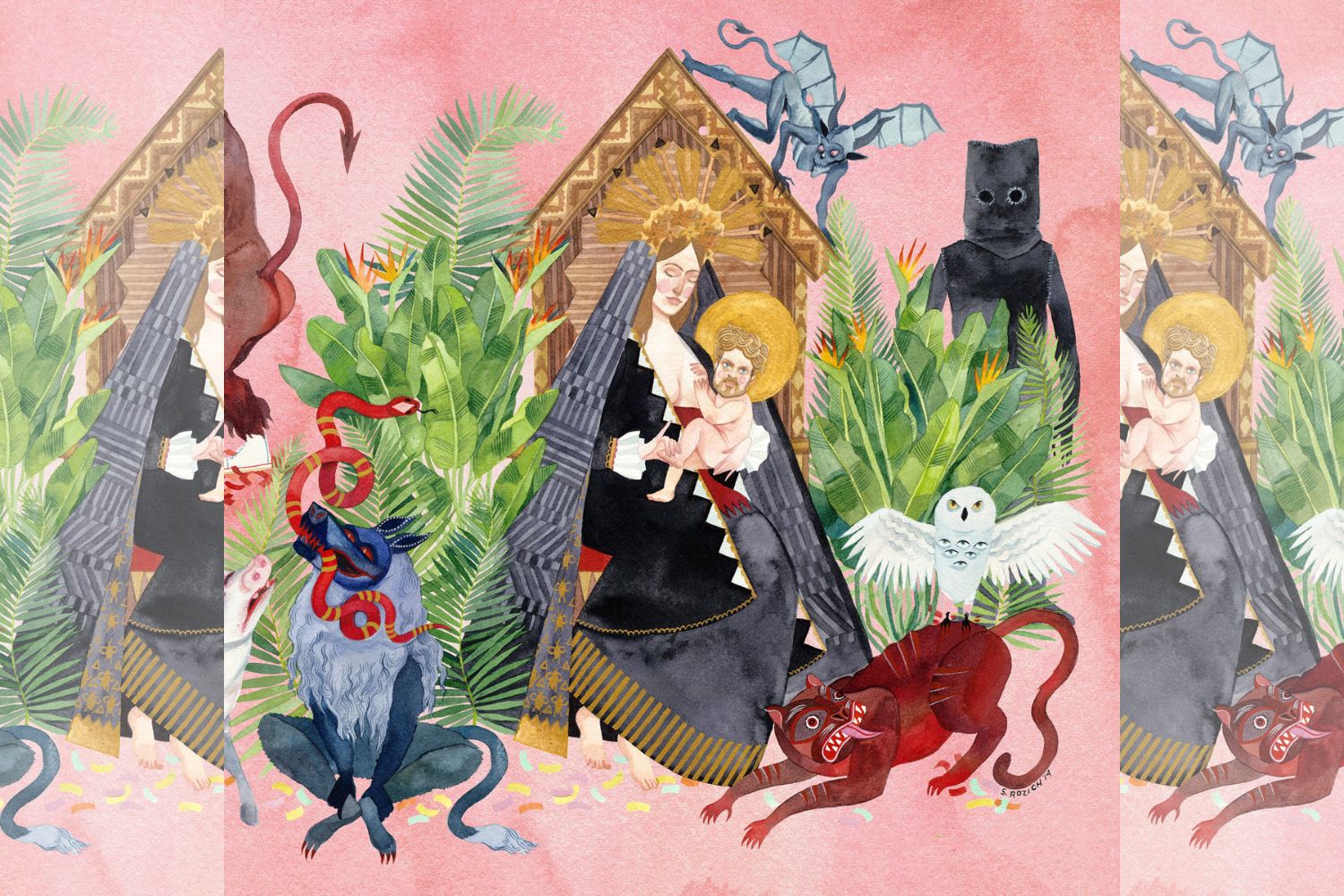
When I first heard Father John Misty’s God’s Favorite Customer, I was a little worried. Not because the album was bad—quite the contrary. In contrast to the prior year’s state-of-affairs omnibus concept work Pure Comedy, its 10 songs were more immediate, approachable, concise. But that directness harbored some thinly veiled, sometimes hilarious and occasionally devastating portraits of self-destruction. It’s a very good album that often feels very, very bad.
Father John Misty, née Josh Tillman, wrote the album while living in a hotel during a period he described as a “misadventure.” He said of the circumstances surrounding the album that, “well, my life blew up,” and in an evasion that speaks volumes, “to talk to me about what this album’s about, I’d have to bring other people into the picture who don’t want to be.” You can gather plenty of the details from the songs themselves, whether they come in the form of Jason Isbell expressing his concern to hotel staff about his wellbeing in “Mr. Tillman,” or the first-person account of his nights in a hotel on “The Palace,” which is sadder in its subtext than its inner monologue musings, which in characteristic wisecracking cynic fashion finds him proclaiming “Man, I must have been in the poem zone” and that he should adopt a pet and name it Jeff. (Good name.)
The most devastating moment on the album arrives on “The Songwriter,” wherein Tillman plays around with perspective and roles in a conversation with his wife Emma, singing during the chorus, “Goodbye, little songbird, now you’re free.”
I’ll confess that it hurt a little bit to hear that. Not for any dubious parasocial reasons—I’ve never met Father John Misty and I’m not a person who’s drawn to the drama of celebrities’ private lives. But just three years earlier, Tillman had released I Love You Honeybear, an irreverent and sweet album that captures a warts-and-all love story that, in spite of—or maybe even because of—the grandeur and sardonic humor, feels affecting and real. More than any other album in recent memory, it captures what it’s like to be so crazy about someone you’d follow them anywhere, even if neither of you knew where you were going, to find that someone you’d watch the ship go down with. I know that feeling; I, too, found that person.
Josh Tillman had undergone a strange and fascinating artistic and life transition before Honeybear. He’d released a number of albums as J. Tillman, a more earnest and anguished singer/songwriter with few of the hallmarks that’d make him both so beloved and bemusing to listeners today. He also played drums with Fleet Foxes around that same period, but it all came to an abrupt end at the dawn of the 2010s and his thirties when he pulled up stakes, left Seattle and hauled himself down to California, where he experimented with psychedelics and reinvented himself as a folk-rock singer in the form of a “shamanic drifter” as he once described it, and gave a name to his new persona: Father John Misty.
The Father John Misty of his 2012 debut Fear Fun doesn’t necessarily come across a believer in the power of love. He’s too cynical an outside observer for that, too sarcastic and acerbic. Yet what he lost in abandoning the open-veined balladry of J. Tillman, he gained in a flawed narrator prone to brilliantly obnoxious turns of phrase like “I’m writing a novel/Because it’s never been done before.” He lets some of his personal bio slip at the end of the album—”I never liked the name ‘Joshua’/And I got tired of ‘J’“—in a song auspiciously titled “Every Man Needs a Companion.” And then one day, on his way out of the Laurel Canyon Country Store in Los Angeles, he ran into a photographer he’d seen around and introduced himself.
The relationship that flourished from that chance encounter caught fire quickly—the two of them partying and spending all their time together—before it settled into a low simmer, Tillman and Emma Garr slowly building a more intimate life together. They got married in Big Sur, then moved to New Orleans where that intimacy could also grant them some anonymity, some quiet. Were they not still both active, practicing artists, you might call it “settling down.”
Emma became Tillman’s wife, and she became his muse. And as the two of them fell hopelessly in love, he wrote an album about it. Because it’s never been done before. Not like this anyway.
Love songs are sappy and cliche, they’re formulaic and insincere, but the songs on I Love You, Honeybear, Father John Misty’s second album, are none of these things. The wisecracking cynic of Fear Fun is still there, and we sometimes hear him at his worst, loathing both himself and the person he’s sleeping with on “The Night Josh Tillman Came to Our Apartment,” looking in the mirror and seeing someone who’s not worthy of the love he’s actually found on “The Ideal Husband.” But he’s softened a little, not above dosing the champagne or describing bedsheets in a way you might not repeat in polite company, perhaps, but honest and sincere in a way that most love-songs-by-committee never could be.
Technically, the album’s first single was “Bored in the U.S.A.”, the sturdiest bridge back to Fear Fun through its unglamorous and uncharitable look at domestic life (“Now, I’ve got a lifetime to consider all the ways/I grow more disappointing to you as my beauty warps and fades“), complete with the sounds of a laugh track. But the real first single, the one that fully immerses us into a love story unsullied by eyerolls and clever sound effects, is “Chateau Lobby #4 (In C for Two Virgins)”. The most direct distillation of their whirlwind romance into just under two minutes and four chords, “Chateau Lobby” makes Los Angeles a recognizable backdrop (Chateau Marmont! The sound of mariachi horns!) in a period of love, lust and new possibilities. And unlike anything on Fear Fun, it’s unapologetically sweet and sincere, in spite of how surreal its imagery might be: “Emma eats bread and butter, like the queen would have ostrich and cobra wine/We’ll have Satanic Christmas eve, and play piano in the Chateau Lobby.”
The slightest touch of a prickly edge is what makes it uniquely Tillman’s and, for that matter, cuts through any semblance of saccharine; in a press note released with the single upon its release, Tillman stated, “sentimentality brutalizes emotion.” Crossing that line was one of his greatest fears in writing the album, and when it was still fresh, he was nervous about playing these songs in front of people. But whatever nerves he felt at the time, I can say with confidence that “Chateau Lobby” captures what it feels like to fall in love better than any song I know of. My colleague L.D. Flowers aptly described Carly Rae Jepsen’s “Run Away With Me” as “what love sounds like,” and while I don’t disagree, “Chateau Lobby” is the one in which I could actually see myself, and my wife. When I actually told her that not long after we had both heard it for the first time, she confirmed our psychic link and said she had the same immediate reaction. That we’d already been married six years by the time the song had been released was a source of mutual regret.
To be clear, I don’t think I’m anything like Father John Misty, or for that matter Josh Tillman. I’ve never had a night like “The Night Josh Tillman Came to Our Apartment,” I’ve never detonated a past identity just to get lost in a new persona, and perhaps most importantly, I’m not a successful singer/songwriter. But I know what it’s like to be in love, and while I Love You, Honeybear is rife with both regrets and punchlines, it’s also an honest account not just of what the endorphin rush of a new relationship is, but where it goes next and, god willing, how it lasts. At one point during the writing of the album, Emma had told him, “You just can’t be afraid to let these songs be beautiful.” And why I also haven’t had this specific conversation, it’s more true to life than not, my own wife having told me more than once not to let my honest emotions become buried. I’m still working on that—consider this article good practice.
Honeybear is, it should be noted, quite beautiful. From the Tin Pan Alley piano and strings of the opening title track to the acoustic strums and horns of “Chateau Lobby” to the dreamlike synths of “True Affection,” a song written about awkward courtship via text messages, to the gentle folk storytelling of past, present and future on “I Went to the Store One Day.” The smart-ass is still here, too—sneering at aggressive women on “Nothing Good Ever Happens at the God-Damn Thirsty Crow” (“Why the long face, Blondie? I’m already taken, sorry“), a song he’s said grows more embarrassing to play live with each passing year. And the song he actually wrote on their wedding day is literally titled “Holy Shit,” but even that one lets slip a moment of beautiful clarity: “Maybe love is just an economy based on resource scarcity/What I fail to see is what’s that gotta do with you and me.”
It’s also not all entirely factual, for that matter—“Honeybear” is, apparently, not his actual nickname for her, or vice versa. But Tillman knows a thing or two about changing names, and in spite of that, Honeybear is still rife with the very real emotion he so feared drowning in cloying sentiment.
Honeybear resonates so deeply because it imagines love not as a novelty or a prize to be won, but as a living thing that grows and evolves, that changes and even improves with time. It’s open and eager to explore what that’s like, to still want to be there after the buzz wears off and a real life together takes over. Not many songs, let alone albums, succeed in getting past lust without tripping over into loathing. Father John Misty managed to do so without even being a little corny. Score one for the shamanic drifter, I suppose.
It’s here where I offer reassurance to both readers and myself: Tillmann and Garr got past that rough patch, and they now have a child together. And over time, Father John Misty’s music has provided solace in other ways, whether it saw us crying to “Goodbye Mr. Blue” at a live show after our own cat died or finding catharsis against the rapidly worsening hellscape of the United States to “Screamland.” We always listen to “Chateau Lobby” on (Satanic) Christmas eve, even though we’re very slowly inching toward the couple in the last verse of “I Went to the Store One Day.”
Father John Misty has also continued to mature as an artist and songwriter since then, never abandoning the irreverent humor and pessimism either, but finding more sophisticated and unexpected permutations of it, allowing his artistry to grow and not just his outsized persona. But I Love You, Honeybear is still the album that cuts the deepest, that strips away the veneer and puts it all out there, reflecting back something recognizable and relatable to those who’ve experienced it firsthand.
“For love to find us of all people/Who would have thought it’d be so simple.”
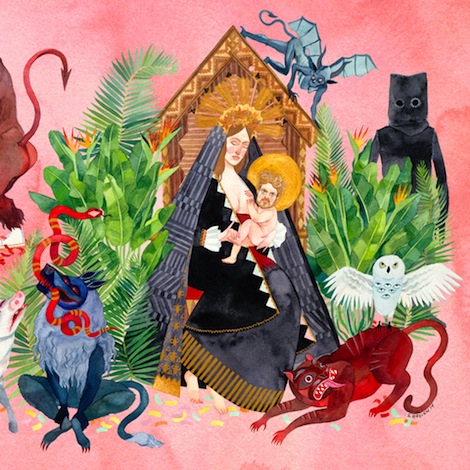
Father John Misty : I Love You, Honeybear
Note: When you buy something through our affiliate links, Treble receives a commission. All albums we cover are chosen by our editors and contributors.
Treble is supported by its patrons. Become a member of our Patreon, get access to subscriber benefits, and help an independent media outlet continue delivering articles like these.