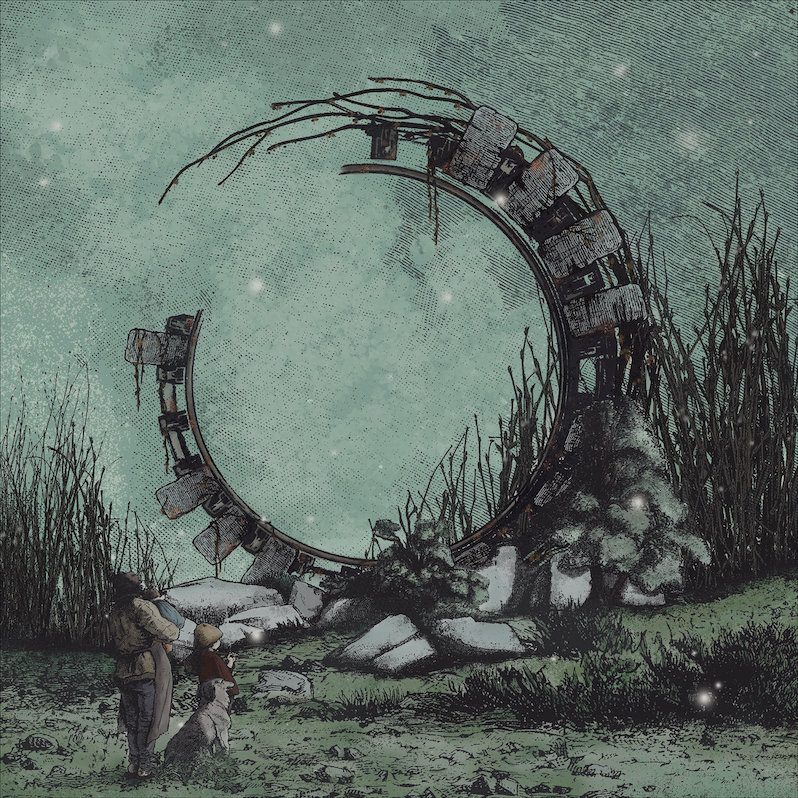

American Football : American Football (LP4)


Thirty years ago, it likely would have been scandalous to refer to American Football as a progressive band, let alone a proper prog one, but the sentiment wears well these days. Their mathy riffs have always had more than a fair bit of the scent on it but it was the scantness of the arrangements, the stripped down band-only approach, that gave things that punky final shape. As their sound has filled out over the past three LPs, their entire reunion era, the progressive-mindedness of the writing has become much more sharply apparent. Ignoring the comparisons to modern prog titans like Porcupine Tree, Airbag or Lunatic Soul, their music has slowly begun to resemble most specifically that of Yes. The delicate guitar that hides how tricksy those riffs are, the glorious atmospherics that feel like the latter day Beatles losing themselves in aquarium-worthy synthesized sound, and especially the vocal rhythms are shaped like that prog great, especially the material Yes turned in during the 90s and early 2000s like 1994’s Talk or 2001’s Magnification.
The emotional tenor is the major difference. Where Yes is meditative and ruminative, it is ultimately uplifting and warm music, turning toward the sun. American Football, here as always, is nocturnal, feeling more like reflective moments staring melancholically at the sea at night than anything resembling warmth or sunlight. The lyrical subject matter here tightens further from their previous LP, which saw the generalized angst of their debut winnowed down eventually to the stressors in frontman Mike Kinsella’s marriage. Now that the divorce is finalized, it is a thorough and scarred look at self-loathing and the failings of a man who ruins his own marriage from the inside. Some may balk at the directness of the subject matter, but that kind of complaint shows the often self-serving nature of the fan of emo compared to the artist’s behind it, with listeners and even critics finding themselves more desiring of lines they can superimpose their own lives over rather than real, delicate portraiture of a human life.
Songs like album opener “Man Overboard” and early single “Blood On My Blood” show elements of U2 and the Cure at their most lush, two bands that have drawn from the world of progressive music themselves to fill out their sounds over time. Meanwhile, “Desdemona” utilizes a minimalist vocal refrain against clarinet that feels borrowed straight from Music for 18 Musicians. “Bad Moons” feels like an outtake from the similarly Yes-adjacent Sigur Rós, particularly around the Takk… era when they were at their most grandiloquent and lush. The juxtaposition of these sophisticated and quite lively arrangements against the despair and desolation of the lyrical subject matter is a fascinating juxtaposition, feeling like a commentary on one of the grim brutalities of grief and shame: no matter how dark it is inside of you, there is sunlight and life and quiet moments always, everywhere, surrounding everything, even war crimes and genocides. This is an irreconcilable and often unbearable contradiction, that the world is so resistant to acknowledging out pain. But it too is the ultimate contextualizer, the force that unthreads even the deepest grief in time.
Most critiques of American Football once they dared sully their legacy by releasing new material amounts to nostalgia on the part of listeners, wanting something good to remain frozen in time to return to. But that’s not how life works either. If their seminal debut is a concept record about talented youths terribly unsure of themselves, the past three albums have been the response to that call explaining what happens when they grow up into fucked up complex adults. The answerlessness of this material, the poetic insight Kinsella can share against frankly ever-more-astouding compositions, is the point. As I age, I can attest to the remaining effervescent emotional truth of this record. You hope some great cathartic moment will come and everything will make sense, for better or worse. But this never comes. It is just more life, the knot in your heart changing shape as you age, trivializing your struggles before and making unknowable your struggles to come. The ultimate test of an emo record, can its beauty and savagery lay you low and bring you to complicated auto-critical tears, here remains as potent as ever.
Label: Polyvinyl
Year: 2026
Similar Albums: