

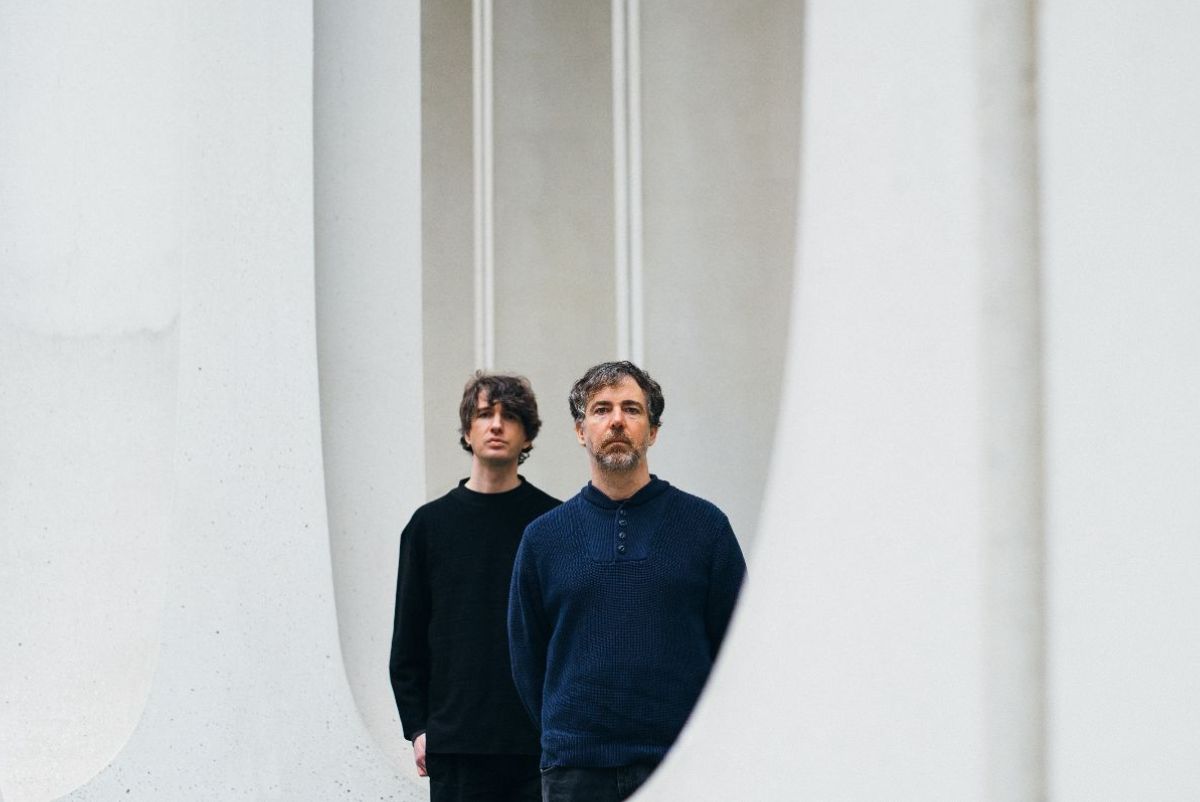
The sound of electronic duo Visible Cloaks is rife with contradictions. The music that Spencer Doran and Ryan Carlile make is ostensibly ambient, yet it’s always moving and shifting. It’s soothing yet disorienting, and blurs the lines between synthetic and organic—particularly on new album Paradessence, out this week via RVNG Intl. Its title a reference to a term coined by author Alex Shakar, combining “paradoxical” and “essence,” the first new album in nine years from Visible Cloaks explores virtual worlds bound by contradictions, gorgeously rendered and enhanced by the addition of guest musicians such as Félicia Atkinson and Motion Graphics, who both build on and become part of the beautifully bewildering landscape.
Nearly a decade has passed since the last Visible Cloaks album, Assemblages, yet in that time, Doran and Carlile have nonetheless remained active, having worked on sound installations, collaborative releases, a Playstation game and various other projects—as well as “life stuff,” as Doran put it. Because of changes in both personal and professional responsibilities, Doran says in a Zoom interview that the realities of how the group works has changed since they had the freedom of simply exploring sounds in an inexpensive Portland rehearsal room in the early 2010s. But he also concedes that having that additional pressure can also be a productive motivator.
“Having those constraints can be generative in their own sense, and not having all the time in the world, having a deadline is helpful,” Doran says. “Sometimes that pressure can be a constructive force.”
We spoke to Doran about the making of new album Paradessence, its conceptual threads, collaborations, and how to build a virtual space.
Treble: It’s been nine years since the release of Assemblage. And you’ve done other projects since then. But did you consistently find yourself being pulled in different directions during that time?
Spencer Doran: Yeah, we have a really slow process in making albums. We work on music a lot both separately and together, and we have this process of maybe casting a wide net. In making an album you’re sort of dragging all these things you pulled up and picking them up and looking at them and saying, “does this work?” I think a lot about this interview with [Iannis] Xenakis where he talks about composing as this hole you’re looking into, and things sort of pop up, and you either accept them or hit ‘em back with a stick. But the hole is actually, like, yourself, or things coming into your subconscious.
Our process is very iterative, taking ideas and letting them sort of be used as tools for collage, tools for assembling things in sort of different sequences, so it’s not the same process as going into the studio for a month or two weeks and saying, “we’re gonna come out of this as an album.” Like the standard way of thinking of rock bands going into the studio. Our process is very slow and, meticulous would probably be overstating it, but I have a hard time finishing things and considering them to be presentable to the rest of the world.
Also just life stuff happened too. Like starting a family and job, work kind of things, and I did this really long project where I worked on a Playstation game (SEASON: A letter to the future) and worked on all the audio direction and composing for it, which was about three and a half, four years. That was sort of my pandemic project. A lot of people are presenting their pandemic albums that they’ve sort of been tinkering with. So that space is kind of important in allowing things to arise in a more organic and natural formation.
Treble: Did the concept of “paradessence,” the idea of a “paradoxical essence,” inform the compositions themselves, or did that idea arise later in the process?
SD: That was more of an afterthought when I was thinking of a lens through which to view the pieces on the record. I think a lot about us being in this, kind of torn between two different modes of working on our own pieces, in that this very detail-oriented sort of sound as art, pure sonic investigation kind of process that you might more closely associate with like musique concrète, that sort of tradition. But also the horizontal, expansive environmental approach to thinking about music, and our own process being something that’s not like an attempt to arise as a synthesis between those two things. But more it’s something that those two elements coexisting makes it work. And the concept of “paradessence,” it’s kind of a made-up marketing term that the author made up in a book about cool hunting and the advertising industry, creating this mock idea that was, ironically, taken up by real advertisers. It’s also shown up in the art world a little bit too. But one of the core concepts of it is that something that has this internal schism at the core of it, and those things don’t arrive at some sort of unity, they stay in opposition, and that opposition at its core is what makes it so powerful. One example he uses is coffee. One of the reasons that makes coffee so desirable is it’s both relaxing and stimulating at the same time. These things that are in opposition become something other, the thing that makes it good is that conflict.
Treble: You can certainly hear those conflicts on Paradessence, particularly in the juxtaposition of organic and electronic sounds—and how it’s sometimes difficult to discern where the organic begins and the synthetic ends.
SD: That’s very much intentional—that very potent space between the virtual and the real and you can’t quite tell which is which. I think a lot about contemporary reality in the same terms, as there being a lot of possibility in this space where it’s hard to know what’s really happening.
Treble: On the note of virtual spaces, you mentioned that you had worked on SEASONS, the Playstation game, which is another good example of building a virtual world. What draws you to these kinds of projects and ideas?
SD: Yeah, working in that world is really interesting because you’re having to rebuild the sensorial experience of sound from the ground up. When you’re in an environment, and I didn’t think about this stuff until I started to work on this thing myself, there are a lot of really subtle details to make you feel like you’re in the space. Like room tone, or just like a background sound that makes you feel like you’re in the environment. If there’s nothing at all, it might feel really strange, but if there’s just a slight hum or an ambience in the background, you feel more of a sense of place. But when you’re doing game audio design in a 3D environment, you have to think about how sound, what makes it feel real is the sense of spatiality. Instead of it being just a moving background of a forest, you have hundreds of individual sounds coming from each leaf on each tree. When you’re moving in a 3D sphere, you have to think about where things are placed in relation to the human ear. A lot of it is not how I was used to doing field recording or capturing a physical recording with audio tools. You’re building the listening experience from the ground up, one piece at the time.
I think a lot about, I don’t know if you’re familiar with Steven Feld, he’s an ethnographer and field recorder and he wrote this kind of famous book about the Bosavi Rainforest. But he did this record (Voices of the Rainforest) released on Mickey Hart of the Grateful Dead’s label (the Mickey Hart Collection on Smithsonian Folkways), capturing the Bosavi Rainforest in sort of like a collage approach instead of going and just presenting actual field recordings, like putting a microphone in an environment and leaving it running, he recorded each element in the rainforest up close, and in a virtual soundstage put each of those different tracks on a different channel and created this hyperreal version of the rainforest, which might end up sounding a lot more realistic than just plunking a microphone down with two stereo channels.
So I think a lot about in creating an album you’re working on this virtual soundstage, whether it’s just two stereo channels or 5.1 dolby or something like that, you’re creating a virtual sense of space. And in a standard classical or rock or jazz recording setup, you’re trying to create the effect of sitting in a room and listening to people play. When you take into account of the artifice of that and you’re adding virtual reverb and panning and think of those things as not being fixed, you can do a lot of really confusing and alienating effects for the listener where you’re drawing them into the environment and then pulling them out of it. You can send something into a reverberant environment, and sending it back out creates this illusion of not really knowing what’s going on. This is something that kind of comes from dub reggae and the studio as an instrument, and use of echo and delay as something that can be turned on and off, which revelas the artifice of the studio experience.
So my approach to virtuality in my own practice is taking it as part of the composing pipeline and using that as one of the vectors in which you’re able to affect organizing that information.
Treble: You’ve worked with a lot of collaborators over the years. Do you take away a new way of thinking or approaching music each time you work with someone new?
SD: Every time it’s different. Sometimes it’s in person, sometimes it’s not. This record, I think, is the first time we’ve worked with someone on our album we haven’t met in person, Ioana Șelaru, who we connected with through our friend, the cellist Oliver Coates, who also records on RVNG. And that was just a case of her reaching out and saying “our mutual friend said, from hearing my music, that I should hear yours and it’s great, and here’s some things I’m working on,” and the collaboration came out of that. But every time you learn something new. For me, it’s exciting to have this external…perspective that comes into the engine that generates the final work, and when you’re just working with one other person you know collaboratively and who knows your internal dynamics very well, you can fall into the same patterns very easily, but having this external perspective that comes into that process and sort of disrupts things can crack open new ways of moving forward. It’s a process I really enjoy.
Treble is supported by its patrons. Become a member of our Patreon, get access to subscriber benefits, and help an independent media outlet continue delivering articles like these.