


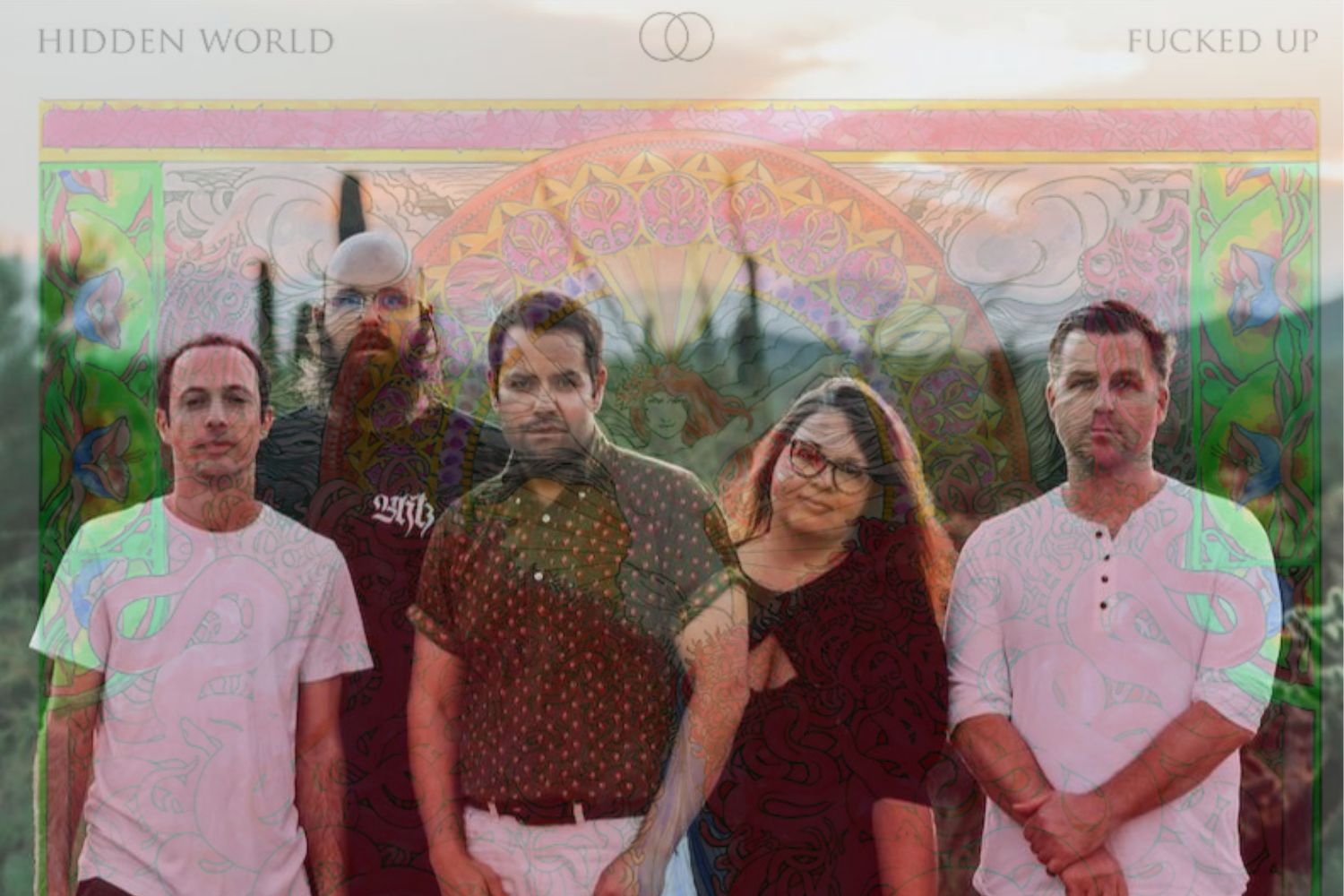
20 years ago this October, Toronto hardcore innovators Fucked Up released Hidden World, their debut full-length album. While the band have subsequently become known for constantly out-besting themselves in terms of their eagerness to embrace new narrative and sonic styles, and second album The Chemistry of Common Life journeys even deeper into epic territory, Hidden World marks one of the earliest points in the band’s career wherein they began to experiment with vivid, clear production values and relatively extensive song lengths, with only four of its 13 songs clocking in at under five minutes. That being said, it remains full of the aggression, energy, and chaos for which Fucked Up’s early shows became known, and one can still hear that the band playing its songs are the same band that put out abrasive early singles like “No Pasaran” and “Litany.” To mark the anniversary of this watershed point in Fucked Up’s discography, songwriter and lead guitarist Mike Haliechuk kindly took time out of his day to discuss the album’s writing, recording, and reception with Treble.
Treble: You had released an unusually high number of singles prior to this, your debut full-length album, but would you say releasing Hidden World increased the band’s prominence, both within the hardcore scene and more generally?
Mike Haliechuk: I mean, obviously, we were riding on a lot of hype with all the singles and limited-edition shit, but I think the album was our attempt to justify it because we knew we’d have to start interacting with more people and also the press once we did a full-length and started working with a label. We delayed it for five years because we weren’t ready to really show up in a meaningful way to have careers in music.
Treble: There has been a fair bit written in journalistic coverage of more recent Fucked Up albums like Glass Boys and Dose Your Dreams about there being a tension between lead vocalist Damian Abraham’s instinct for adherence to hardcore genre convention and your instinct for musical experimentation. Would you say your creative intentions were more in sync on Hidden World than they have been on later albums, and if so, why?
MH: If you have five or six people in a band who all want the same thing, to me, that’s a boring band. The people who [you] don’t have any kind of tension with in your life, those people aren’t gonna stick around that long. Tension is why you are able to climb higher, everyone needs something to push off against. I think more important than whatever beefs people still want to investigate, the important tension we had in the band at that point was tension against what punk was doing in 2006, tension about what our influences were and how we wanted the perfect punk band to act.
Treble: What bands were you listening to when you wrote and recorded the album, and would you say they influenced it, either directly or indirectly?
MH: I can’t remember what I was listening to 20 years ago. Throughout, my influences for heavy music have been Metallica and Poison Idea, in [terms of] the way they sounded and the way they ran their performances.
Treble: Lots of people talk about the multi-tracked wall of guitar sound on The Chemistry of Common Life, but for me, that aspect to the band’s sound is already present on Hidden World to a noticeable degree. Would you say this is true, and if so, how did you guys go about achieving it?
MH: On Hidden World, we worked with an engineer for the first time who had producer tendencies: Jon Drew. Prior to that with all the singles, it was more we just brought in whatever amps we owned and the guy set them up and we’d go. Jon had more of an eye for sound and aesthetic and understood what we were trying to do, so he was able to dial the guitars in more so than we’d been able to do up to that point. To me that record still sounds pretty bare, because for the most part me and Josh [Zucker, rhythm guitarist] are playing the same bed lines, I wasn’t a good enough guitar player yet to really let loose with leads, the only guitar pedal I knew about was delay, and we only had the kind that stopped the effect once you took your foot away rather than it sustaining over the music. But yeah, it started on Hidden World.
Treble: “Baiting the Public” had already been released as a single with much rougher, more lo-fi production values three years earlier. Was re-recording it for Hidden World fun, and what was the thinking behind removing the brass from the outro?
MH: It was fun, yeah. We wanted it to be a better-sounding and more cohesive version and also wanted people to have a really different version to listen to, since we’d already sold them the song as a 7-inch. That was our best song up to that point, I thought, and lent itself thematically to the LP more than a song like “Police,” which was mostly just a stitch-up. So instead of the brass, Jonah [Falco, drummer] did some guitar swirling for a few minutes.
Treble: “Year of the Dog” was released at roughly the same time as Hidden World. This is the closest, for me, a Zodiac single has come to sounding musically similar to a full-length Fucked Up album whose release it has accompanied. Would you say this is a fair assessment?
MH: To me, “Year of the Dog” sounds nothing like Hidden World. It was done at a shittier studio, we had no idea really how to play the song, and the idea was for it to just be a simple riff hung loosely onto the arrangement. The album is tight and creamy, “Year of the Dog” was more our attempt to do the nihilistic, visceral Stooges thing.
Treble: The David Eliade character is the focus of the subsequent albums David Comes to Life and Dose Your Dreams. He is ostensibly introduced in the song “David Comes to Life” on Hidden World, contemplating suicide. Did you have any idea when you wrote the latter song that he would become such a high-profile character within your discography?
MH: I probably did, because I’m stubborn and always have to follow through on things. I was already doing interviews during the Hidden World press cycle in 2006 where I’m explaining that we’re gonna do an opera called David Comes to Life.
Treble: Hidden World has always felt to me like it has somewhat less of an overarching narrative running within it as a through line than the Fucked Up albums that have followed it have. Would you say this is true, and would you say there any unifying thematic characteristics to the album’s songs?
MH: It was less of an album’s message being composed of what all the songs said, and more of a statement in total. The idea was we were emerging from this hidden world of hardcore, into a bigger scene. We did have intentions to becoming a bigger band, not only in the sense of having a bigger audience, but to be more important in a historic sense, like in the lineage of punk and hardcore. I was very insular back then and very protective of the things and people I cared about, pretty standoffish, but my entire life was made up [of] trying to build community—working at the record co-op, working at the food co-op, doing shows for out-of-town bands. I knew that my entire life was inside this progressive, community-based bubble, and all my interests at the time—punk, alchemy—were about rebelling against the mainstream. So the tension in the album was we felt we had done all we could with the little DIY world that had created us, and we were ready to strike out into the greater world to see what trouble we could get up to.
Treble is supported by its patrons. Become a member of our Patreon, get access to subscriber benefits, and help an independent media outlet continue delivering articles like these.
