
Nick Schofield : Blue Hour

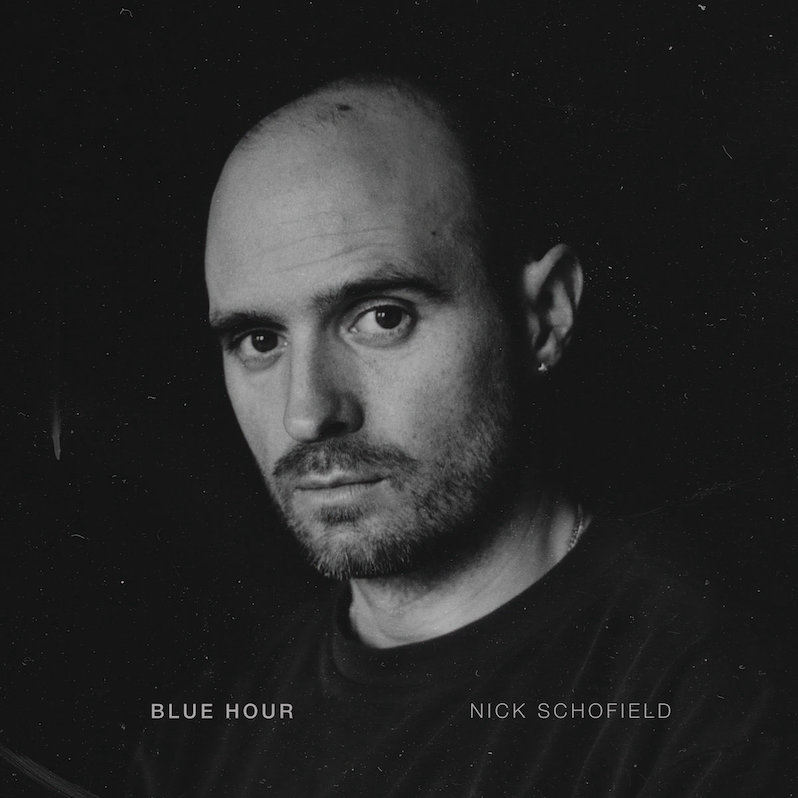
Patience is worthwhile. My first two listenings to Schofield’s Blue Hour, I was unimpressed; the compositions were pleasant, euphonious in a calming way, but didn’t grab me or present me with that sparkling sterling beauty that we use to mark greatness. It’s harder to critique a record that lands in the middle, accomplishes itself but leaves you with little luster, than it is to describe a smashing success or stalwart failure, so I put it aside to return to and refine my notes. The second listen, this time in my car as I drove, didn’t deliver much more insight into the ideal shape of the music. I resigned myself to discussing Schofield’s comfortable melodic sensibilities and ability to perhaps further explore this quite post-Weather Channel smooth jazz—not meant as critique by the way—and expand its melodic and harmonic sensibilities. On a whim, however, I gave a final pass over before beginning my drafting, this time while reading on the couch with my wife and a nice cortado. At last, the picture became clear.
Ambient music in particular is funny this way. So much music we are presented wants, or at least should want, to be an active participant in our lives, to use its melodies and rhythmic propulsion to interject into our thoughts and actions, use its harmonic language to color the emotional timbre of the events that comprise being-in-time. Ambient music, as well as much of Western art music, have a more complex role. They often want to slip behind the action, to be per Eno himself “wallpaper music,” to be the color of the walls and not the furniture on the floor.
Allowing Blue Hour to get out of the way revealed its real strength. Pages flew by, suspended on the warm, clean air of those breezy synthesizers, jostled by the ruminative trumpet improvisations over the pieces. Differentiating them piece by piece would be to miss the point; similar to the UNIFONY album series by Minco Eggersman and Theodoor Borger, these are tiles in a mosaic, something meant to be consumed whole even if developed in piecemeal fashion. In a flash, the record was over, my cup empty, the book tens of pages past despite its sparse and emotionally complex prose. So I started the record again.
Watching Blue Hour reveal itself as function-music to me was eye-opening. At its best, it did not create thoughts of its own but created architecture upon which other thoughts could be suspended. Its moods and tones existed to facilitate the better emotional processing of yet other moods. Music in general is an experiential-theoretical construct we developed to make existence, memory, event and being more explicable; much like poetry and prose and fine art, it exists to freeze a moment so that we can interrogate it further, feel it again and again, all to better understand who and what we are, what all of this is. I had to get out of the way of Blue Hour, allow it to be a part of the ensemble of thought rather than the clear focus, but in doing it revealed a consummate craft to its aims as ambient jazz. This was especially curious to me given my familiarity with the worlds of sound collage, field recordings and the more arthouse wing of ambient music, where the stillness is meant ironically to grab you in rapt attention to follow each subtle shift like the slow turn of the wind or the perpetual hieroglyphics of wave crests on the sea. Blue Hour is more humble than that and in its humility it is able to achieve precisely what Brian Eno set out all those years ago as the aim of ambient music as a distinct form. That Schofield also provided a challenge of perception to me as a critic was merely another treasured bonus.
Label: Backward Music
Year: 2026
Similar Albums: