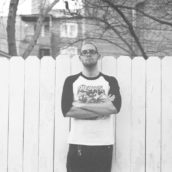

Primitive Man search for a better world


Ethan Lee McCarthy doesn’t turn away from life’s horrors. Over the past 13 years, McCarthy has funneled his angers and heartache into the emotionally draining sludge metal of Primitive Man with drummer Joe Linden and bassist Jonathan Campos. On previous albums like 2020’s Immersion the group ventures through darkness, and while they create an air of dread via their massive sound, McCarthy’s lyrics are just as essential in capturing that mood.
On the band’s fourth album Observance, out on Halloween via Relapse, McCarthy speaks to rising techno-feudalism and its oppressive effects. Tech companies are pushing AI without care for our planet or the livelihood of artists; companies lure people into a false comfort where they don’t own the art they enjoy; the police state intensifies, men in military gear storming cities and tearing families apart. We live in horribly bleak times, and no one would fault you for finding it difficult to feel a sense of hope.
And yet, while McCarthy also struggles and fears for the future, he’s driven to move forward and fight for a better world. Among a collection of other releases brimming with pessimistic lyrics, McCarthy says that Observance is Primitive Man’s “most positive” record to date. “I wish for a better version of myself, for myself and a better world for us all,” he said of the record’s overarching message.
I spoke to McCarthy about Observance, his writing process, the work he does to support other musicians, and more.
Treble: How has your writing voice developed over the course of your life? In the case of Observance, what ideas initially came to mind that got you to start penning the record’s lyrics?
Ethan Lee McCarthy: I think that it has gone from periods of having more metaphors and language in it, to a place that is just blunt with a little bit of extra language peppered in there. With Observance, I was concerned with how blunt my language was for these songs, but the subject matter calls for it. I think the first set of thoughts I had while writing these lyrics was that from my lived experience and perspective. Right now most things in the digital age are a scam, and as things fall apart, most people have just moved into the mode of making as much money as they can before things collapse. Artists work to please an invisible non-human algorithm. People pay for comfort, most people don’t own anything, basic necessities are not guaranteed. The constant dehumanization of people via the media, armed forces and the shock and awe tactics used in government along with the political theater are meant to break people’s spirit so that no one feels secure, united, or protected. Our laws and the way things run are the byproduct of a fever dream, one that is dreamt by some of the most morally and spiritually corrupt individuals in the history of the world who have little connection to the people who are actually living under these laws and contributing to society. Everything is an absolute joke. A dark comedy to which I don’t have any answers or clear idea of what the ending is going to be.
Treble: The poet and activist Tongo Eisen-Martin, and his book Blood on the Fog, are mentioned as inspirations. What is it about his writing that resonates with you? What other writers and works are you drawn to that have shaped your craft?
ELM: I appreciate how blunt and simultaneously poetic [Blood on the Fog] is. Like, there are moments where there is no space for flowery language and then there are moments where it is necessary, and I appreciate [Eisen-Martin] showcasing these different sides of his writing. Other writers/works that influenced me in the past and continued to influence me for the writing of this record are Gil Scott-Heron’s poetry and music, Werner Herzog books/films, Zora Neale Hurston, Marina Abramović, Cormac McCarthy, Malcolm X, and the sights and sounds of the world around me—so the work of nature.
Treble: Throughout Primitive Man’s existence you’ve explored an array of subjects pertaining to personal, professional, and socio-political struggles. As a writer, what’s a quality you care deeply about expressing through your lyrics?
ELM: I think an overarching theme with my writing is that, even though difficult times may require a lot of emotional lifting, it is important to retain one’s humanity and to not give up hope and the desire to improve. I continue to acknowledge the urge to lean into and embrace even temporarily the “darkness of things,” but ultimately, you cannot live that way. To live in spite of the things that one finds harmful is the most important goal and I think the true meaning of life.
Treble: There’s a grandiosity to the sound of Observance. To you, what makes effective doom? Technically and emotionally speaking. I’d also love to hear your thoughts on this question as it relates to noise, since it’s a more abstract genre compared to something like metal.
ELM: I think that my philosophy on what makes effective doom kind of extends to my philosophy on music in general, which is that I need to believe the creator. Same thing with noise or any form of music. Technicality isn’t as important to me as raw emotion is. If technicality, style, etc. comes before emotional weight then I am not interested.
Treble: Considering the many horrors happening here in the States and overseas, a lot of people are going through hell right now and struggling to feel hope. Along with the need for systemic change, art can be a powerful means of providing people with hope and comfort. On Observance you acknowledge the crumbling social contracts and structures harming our society, but also, as someone greatly looked up to in the music scene, what sort of practices do you strive to promote within your artistic community to help those in need?
ELM: I try to uplift musicians who are in a less visible place than I am in any way that I can. From talking to other bands, festival organizers, tour bookers, record label people, etc. about up-and-coming talent when I have the opportunity, to also trying to encourage collaboration between artists when I can. I book tours for other bands, bring smaller bands on tour, I’ve co-released things for bands, and tried to contribute in a positive way to the underground ecosystem over the time I have been involved. I have booked shows for bands of all sizes for over two decades in music. I’ve thrown fundraisers, festivals, and things like that for various causes. I think that my main “mission,” if you can call it that, through my time in underground music has been keeping the community and friendship aspect very much up front. The challenge here is that as people get older and their ambitions, needs, and worldviews change, this is harder to keep together. Somewhere along the way the DIY musicians of yesterday have become the businesspeople that pull the ladder up today. I think this is something that isn’t talked about enough. The culture has changed and in some circles has become very parasitic, transactional and individualized. I continually strike back against this idea through my words and actions, but I fear that the era of DIY touring and shows may have a limited life span due to the demands that capitalism continues to put on the working class, and the general malaise that is grinding people down and making them less eager for community that is outside of the internet.
Treble: How has your relationship to dark art changed over the years (if at all) as it relates to your mental health? When going through a difficult time, how does your approach to engaging with media change? When you’re struggling, do you just dive deeper into extreme art? Or are you the kind of person who says, I could use a breather from harsh noise and want a Pixar movie.
ELM: I have approached this issue over time in my life in several different ways. I think that it is good to continue to indulge in extreme forms of media when in a bad state of mind, but it is equally important to indulge in softer forms of media during these times as well. What you are doing outside of those things is the real question. If you are rotting on your couch and listening to nothing but CON-DOM then I’d suggest a pivot. Acknowledging the duality of life is important. My periods of active creativity are historically during the “in-between phase” of things. After I have acknowledged what is happening and am beginning stages of dealing with it. So, when I’m still feeling pain from it but am gaining enough clarity to have the energy to transfer my experiences into something. You have to strive for that place when you’re living in the dark part of it. Whatever it takes.
Treble: If you had any advice to give to young artists (or any artists just starting out for that matter) about how to navigate the struggles of being a working artist today, what would you share?
ELM: Follow through always. Even if it takes time. Do not overcommit. Do not get too comfortable. Do not compare. Live free. Follow the uniqueness of your own voice. Be financially mindful. Invest whatever you can in this. Do not be afraid to try something else or start over, but it usually takes about 10 years to know for sure. People will try to deceive you. Be careful.
Treble is supported by its patrons. Become a member of our Patreon, get access to subscriber benefits, and help an independent media outlet continue delivering articles like these.