

Car Seat Headrest : The Scholars

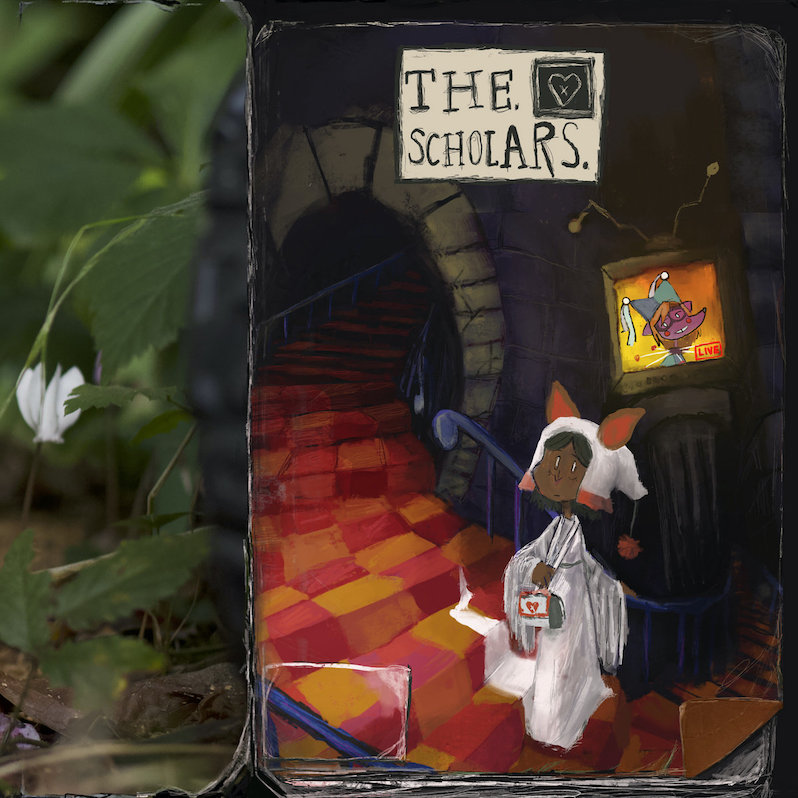
The most telling sign that The Scholars is a rock opera is that it has enough lore to fill a sleepytime ASMR YouTube video. This lore is split between that of the record itself and that of Car Seat Headrest, though the latter is infinitely more interesting than the former. Car Seat Headrest’s story has identifiable characters, multi-year-long arcs, stakes, and, until The Scholars, was left incomplete. The Scholars, meanwhile, concerns eight characters who are either students or the faculty of the fictional Parnassus University, and they are all likely furries. A schism separates the characters from the audience, and each only gets a few minutes to say their piece. Meanwhile, Will Toledo, the group’s main member, has had 15 years of character development.
After his early Bandcamp success, Toledo signed with Matador Records and concerns about how his lo-fi indie rock would translate to a larger label arose. They were disregarded upon the 2016 release of Teens of Denial, Toledo’s largest and most widely-celebrated record yet, and the 2018 rerecording of Twin Fantasy, which updated one of Car Seat Headrest’s cherished Bandcamp releases with a full band and adequate production. Toledo averted the pressure of following up those records by donning a gasmask and plunging into electronica with Making a Door Less Open in 2020. The album garnered mixed reception for its experiments. Between it and The Scholars, Toledo battled long COVID—confining him to bed at the end of 2022—and contracted histamine intolerance. So, not only was The Scholars battling against a middling predecessor, but also Toledo’s eventual return to working health and the five years of silence from Car Seat Headrest.
So it’s a tad surprising that The Scholars, a rock opera as you’ve no doubt heard, sounds freer than previous Car Seat Headrest albums. It appears unburdened despite its lofty premise and the road that led to it. Much of this can be attributed to the band’s jam sessions that laid the foundation for the album’s writing, allowed Toledo to gingerly approach performing again, and encouraged input from the entire group. In an interview with Billboard, Toledo revealed that this impression mirrored his own change in mentality: “What I’ve had to work on more is patience and not judging stuff right away. Because especially in a jam you want to let stuff build organically.”
It’s from these looser sessions that The Scholars became a rock opera, and Car Seat Headrest approach the medium more like Bat Out of Hell than Quadrophenia, which is to say that they prioritize mini-epics (and occasionally, outright epics) over a bloated tracklist. Four tracks account for 50 minutes out of a 70-minute record. For the most part, they are the most nurtured, in that, for example, trimming the fat from “Planet Desperation” would only please those who must simultaneously watch Subway Surfers footage to engage with music. Or, for a less inflammatory allusion, it’d accomplish the same goal as cutting down Sufjan Steven’s “Impossible Soul.” There’s no question about whether “Planet Desperation,” its 19-minute runtime, or the other lengthy pieces on the Scholars are overinflated. What’s more pressing is if they use their time wisely.
Fortunately, most of them use their stature well, whether that be the prolonged carpet unraveling on “CCF (I’m Gonna Stay with You),” the patience to let Toledo and guitarist/vocalist Ethan Ives hash out their duet on “Reality,” or all the minisongs comprising “Planet Desperation” that could’ve been their own tracks but, by transitioning from one to the next, are mightier together. The only longer song that suffers in the album’s context is “Gethsemane.” As a pre-release single, it flaunted how well the group composes unwieldy tracks that revolve around few ideas, but it pales when slotted between The Scholars’ shorter cuts and the closing sprawl of epics. It simply doesn’t hit as hard as it should given its size or intentions.
The issue underpining “Gethsemane” is felt elsewhere as The Scholars lacks anthems that are up to Car Seat Headrest’s high standard. Scattered throughout Parnassus University are references to cuts from the band’s catalog but absent is the catharsis central to “Something Soon” from Teens of Style, “Fill in the Blank” and nearly every other song on Teens of Denial, “Beach Life-in-Death” and especially “Bodys” from Twin Fantasy, amongst many others. It’s not an issue of song length; “Beach Life-in-Death” drops Mentos into a bottle of Coke and sprints around a high school track for 13 minutes, for example. The issue is that, on The Scholars, a core tenet is absent from Car Seat Headrest and what has replaced it doesn’t offer the same return.
Though, admittedly, this grievance is aggravated by the longer tracks and less apparent in the album’s first half. Depending on your personality, it’s the better side, filled with streamlined, hook-driven songs wherein Toledo’s affinity for ’60s pop music shines. It’s in the way “Devereaux” is as sweet as honey on the tongue and “Equals” pops off with an aplomb not too far from The Beach Boys. Also on this half is where Toledo brandishes how well he still, despite being in his early 30s, understands the alchemic concoction of youth, anxiety, hormones, romance, and existentialism that defines adolescence. When he sings a love song, you feel like falling in love. When he suggests starting a band on “The Catastrophe,” it’s because he knows you can sing to it, even if the song conflicts with that very idea.
While this stretch of songs is less scrappy than Twin Fantasy, it is just as twee, though the exchange would’ve been more beneficial if The Scholar’s story was emphasized. But, by design, it wasn’t. Toledo revealed to Billboard that he “was hoping for a record where you could put it on and not know that it was a concept album, or that there were these characters or this backstory, and still have a full experience. We wanted the music to speak for itself.”
Songs therefore do not lean into the architecture of Parnassus University. They’d rather parade through the sparks, looks, and sweat shared during an impromptu, depressurized band practice. For the sake of the song, one cannot knock this, but good luck navigating The Scholar’s multiple characters without a lyrics sheet, because there are stage directions and changing points of view that are only evident on the page. Conversely, Toledo has built a world of avatars that he could’ve used to their fullest extent, but he never taps into their backstories, leaving them as accessories. This, once again, is because The Scholars is a short story anthology with grand indie rock expanses as plot delivery services. The characters are second fiddle. So while Toledo’s knack for tapping into adolescence is strong as ever, there’s an underlying notion that it could’ve been even more were the bond between lore and delivery stronger.
But perhaps this middle ground comes from Toledo himself being in one. As he told Exclaim, “I’m definitely in the middle of things. That’s the thing about an album, is that you do have to finish it. But I guess that’s where art separates from life—art has a finishing point.” The Scholars’ endpoint is ultimately impressive, though not without underdeveloped areas, like a teen early in puberty whose frame has not filled out despite a growth spurt. If The Scholars was without lore, it’d strike with more power than it does. Its faults are mainly derived from the gulf between what it wants to be and what it is. Taking it for what it is, Car Seat Headrest’s first album in five years, featuring their most ambitious songs and a bit more world-weariness, is the best path forward.
Label: Matador
Year: 2025
Similar Albums:
Car Seat Headrest : The Scholars
Note: When you buy something through our affiliate links, Treble receives a commission. All albums we cover are chosen by our editors and contributors.

