
The Necks : Disquiet

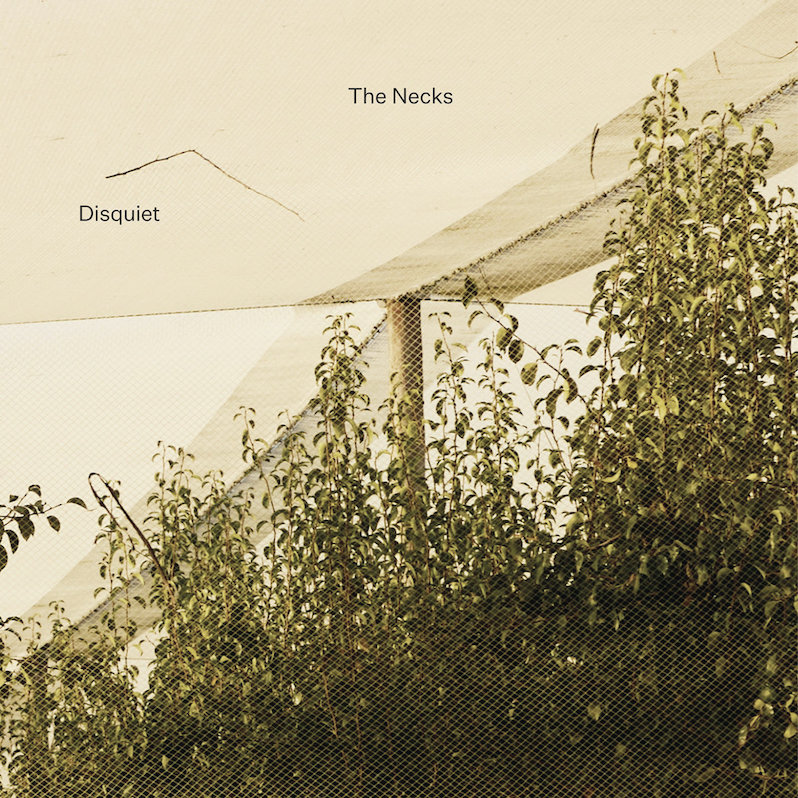
Three hours is a long time. I feel it would be irresponsible to discuss Disquiet, the new album by avant-jazz and minimalist trio The Necks, without dealing with that element right away. The Necks have always made patient music, having turned in more than one album-length single song, but this is a new extreme for them, delivering only four pieces over the three-hour span. It raises an immediate and obvious set of questions. First, how do you structure that? Their choice is in retrospect obvious.
The record plays like a novel, one of those vast generational epics, with a near-hour-long opening cut that steams like summer rain outside the window, cymbals and metals played like the slush and hiss and rain while organ simulates wavering heat and the bass calls to mind the stir and heave of insects and pollen. This gives way to the second cut, over 70 minutes in length, which clatters and bangs like the breaking of the sun. The band sounds as if they overdubbed two improvs over each other, with dual basses, pianos and drum sets loosely but not quite following each other. It evades cacophony of the (ha!) disquieting sort however, instead conjuring a sense of the bustle of neighborhoods and the seeming perpetual plurality of life, the way a glance down the road on a summer day reveals a dozen or more parallel summer days playing out in each of the houses, each a not-quite duplicate of the last. The third track, the mere half-hour long single “Causeway,” uses the wetness of reverbed guitar and synthesizer to conjure the kind of soundscapes Treble favorites like Mark McGuire or Steve Hauschildt might make.
That said, let me not present the record as without challenge. I’ve played the album for a number of friends, not explaining it or giving details, and even some who listen far more adventurously than your common music fan found the clattering rumbling palette a challenge even before discovering the megalithic lengths of these pieces. This is not a statement on the quality of these four pieces, let alone their summation as a record, as much as they are a testament to the commitment this work has to the collaborative process of art. Without getting too in the weeds in terms of aesthetic theory, there are roughly two competing worlds: one which places the primacy of a text within itself and its own relations, that we explicate a work from the work itself by studying its lines and its details and finding objective cumulative statements about them, and another, which says that art begins inside of the mind of the observing audience, that meaning and value are not stored inside of works but inside of people experiencing and internally comprehending those works. The Necks certainly skew far more to the latter than the former; despite the presumably ambient character of these pieces with their intense meditative qualities, it is, like good meditation, an act of intense commitment on the part of the audience. You have to let this music in. The cymbals rain down like slashes of water against organ drones and instantaneous, vanishing figures of melody, a replica of the ocean giving birth to life, but you have to be willing to do this image-processing inside of yourself.
My favorite experiences with this record have been in those wild three-plus hour sittings listening to it in its totality on headphones as I live my life, read novels, write, do puzzles, sit outside with my wife and dog. It roars like an inner monologue, that thing which is almost but not quite language. That this is not universal is something I had taken for granted. I cannot personally imagine being disappointed with a record this trio puts out; like their contemporaries in Dead Neanderthals, they simply approach aesthetic development in a way seemingly precisely calibrated for my mind. They are a group that rewards an adventurous listener, one not easily cowed, one that looks at these mighty runtimes and thinks something closer to “you can’t scare me off that easy” rather than “that sounds tiring.” It’s an interesting juxtaposition; you arrive at the meditative euphoria of this record not by being passive but by being active, that when you seize this record by the throat and peel it apart to braid into your mind’s eye yourself you get the peace and comfort that suffuses it. Despite the title, Disquiet feels anything but. If life in samsara is the constant turning of the breaking wheel, this album is Siddhartha at the river’s edge, watching thought and being pass like water. And just like sainthood that breaks open into nirvana, it is an arduous path that leads to that greater peace.
Label: Northern Spy
Year: 2025
Similar Albums: