
Lars Fredrik Frøislie : Gamle Mester

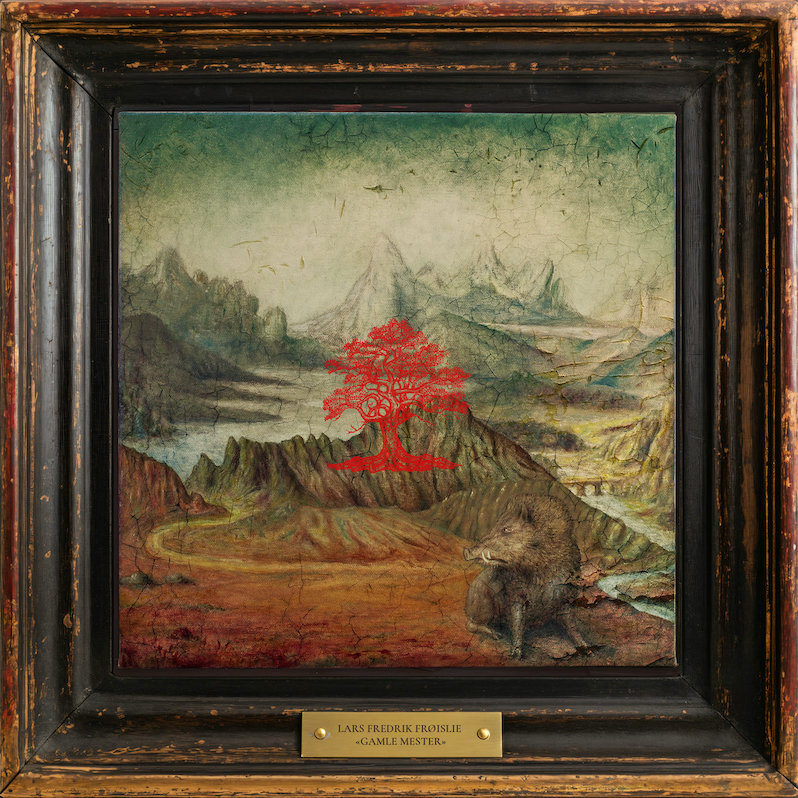
The first thing someone like me—familiar with Lars Fredrik Frøislie’s work in Wobbler, Tusmørke and White Willow—might notice when looking at the track times on Gamle Mester, his second solo record, are how wildly short they are. Three minutes? Seven? Is he shooting for pop radio? Jesting aside (he’s never exactly been afraid of concise arrangements), it is interesting seeing a player who once pushed some of his previous groups to write near-30 minute pieces suddenly find it in his interests musically to be brief and focused, even moreso in the wake of the three-part mega-project The Chronicles of Father Robin he was involved in. Granted, for a certain sector of listeners, pressing play on this record will produce an altogether different kind of shock; Frøislie, who always seemed to pay the bills with black metal projects in his native Norway, here not only plays quite explicitly progressive rock but a kind of dense, woodsy and almost medieval sort, a far cry from the intensities of groups he’s been a part of such as the self-harm obsessed Shining (the Swedish one, to be clear) or the somewhat campy folk metal of Trollfest. This is a testament more than anything to the hyperfertile and deeply strange musical lineage of contemporary Scandinavian players, who always seem to find themselves at most two degrees away from traditional folk, extreme metal, progressive rock and jazz ensembles.
Here, the baroque intensities of Wobbler’s first two records finds new footing, continuing the tightly-wound and deeply-knotted explorations of his debut solo record Quattro Racconti. Wobbler, who eventually moved on to producing easily the best music in the lineage of Yes that we’ve been graced with over the past fifteen or so years, started as a group blending jazz, folk, and medieval music into long braided compositions punched up by Rickenbacker bass stabs, Mellotron hum, Rhodes and electric harpsichord plucks and groans and lots and lots of flute. That same rustic aesthetic is applied here, manufacturing seemingly effortlessly what the Decemberists have spent the last twenty years laboring quite obviously (and, to be fair, to mixed success) at for the past twenty years. Sometimes I can be guilty of writing through the lens of programmatic music, an approach codified in the Romanic era of making music meant to evoke specific imagery, in a manner that can cloud more song-oriented artists. Here, that sensibility explains itself quite capably. Put on a song like the lengthy second cut “Jakten På Det Kalydonske Villsvin” and try not to imagine the dense pines of Norway, hills of moss and snow, the curling color of flowers and vines and hints of the Northern lights through the canopy of needles above you. Likewise the title track, which comes next in the track list, cannot help but put in the mind a sense of wind, ice, and open air. This is music that needs not guiding imagery to paint a clear picture in your mind.
Of course, we are pressed with a philosophical question: What use is music like this, which gestures so decidedly to past styles? We are best answered here in spaces such as the current disco revival occurring in pop songcraft, or the continuously-explored plains of fusion and avant-jazz, which have not radically upended their musical language in the past 10 or 20 years. It’s a worthwhile question, to be clear; while novelty is not the sole value music can offer, progressing the frontier of the language of music is a perpetually useful task and one that indicates the vivacity of a style or an era of artistic development and not just artistic practice. That said, a lengthy cut like “De Tre Gratier” arrives and, with the classic synthesizers everyone from Gentle Giant to Yes to Stevie Wonder used to make their deeply crenelated and detail-rich music paints what feels like an album-length concept piece in a mere 12 minutes explains the value quite plainly. We are given in 2025 music that confronts the abysmal and ferocious present state of things by artists like clipping. and Armand Hammer; here, we are painted a lush and richly-detailed watercolor portrait of forests, rivers, trees, skies, flowers and brambles, the world we fight and strive to protect and preserve against the evils outlined by those more avant-garde and forward-facing groups.
There is such a vivacious sense of fluidity on these pieces of music, where instruments slide in and out of frame, figures twist and curl over themselves like Baroque cadenzas or Bach enclosures, all while feeling superlatively natural and unaffected. It feels often less like music that someone has composed and more like music one might encounter out in the woods, the natural soundtrack to the world. This almost supernatural sense of authorlessness is a potent one, like gazing into the eye of the eternal without blinking. Note, for example, the heavenward choral patches on “Medusas Flåte,” which feel like being engrossed in a cathedral of sound flung high by trees and angels alike moreso than a man sitting at a rack of old synths pressing keys. It can be an exhausting listen, both imaginatively and emotionally; despite coming in at roughly 50 minutes, it feels closer to two hours, with its consistent intensity and complexity being a trying and overwhelming experience. But it is an overwhelm of constant richness of imagery, like being assaulted by color and form in some possessed and manic art gallery. In terms of valuable aesthetic experiences, I can’t think of much that surpasses that kind of delicious ruin.
Label: Karisma
Year: 2025
Similar Albums: