

Lifeguard boldly go into the deep

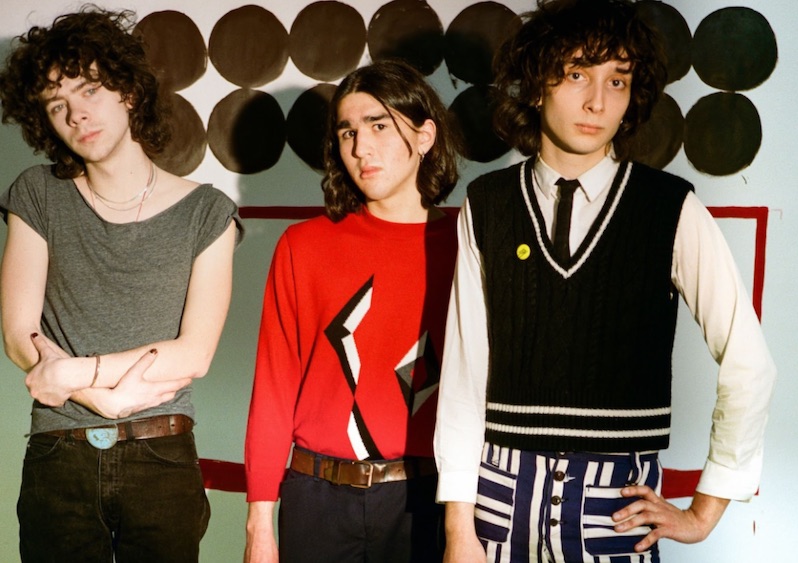
Imagine that many of the family members and other authority figures against whom you directed your rage and rebellious activities stopped punishing you and your friends for practicing your instruments in the basement during dinner. And, instead of grounding you from jamming with your friends for days or even weeks on end, began not only listening to you play instead of shouting at you to stop, but encouraging you to work on what they called your “preternatural talent.”
In an era when the word “privilege” is almost exclusively used as a reference to class or economic status, the privilege of high school buds Asher Case and Isaac Lowenstein—two thirds of Chicago trio Lifeguard—was that their dads are noted musicians who’d let them rock out in the basement while dinner was served upstairs. The teens had access to a veritable studio’s worth of equipment and vinyl, and gobbled up knowledge about music and nourished their talents and skills.
(Asher didn’t divulge his dad’s discography. But when this writer later learned that he was math-rock maniacs 90 Day Men and post-punk group FACS’s guitarist and interviewed him in college for his music mag, thoughts of mortality led to a cascade of tears from which his traceback barely survived.)
Gale-force winds of encouragement instead of parental skepticism or even disdain in always filled Case’s and Lowenstein’s sails. And guess what happened as a result: the respective bassist/vocalist and drummer/percussionist found stage fright to be an alien concept. Far from pompous or snotty or disinterested in life, they demonstrated themselves to be sweet, well-adjusted young men during our objectively pleasant conversation about music, life and the good fortune they’re keenly aware has befallen them and that they never seem to take for granted.
With that in mind, why wouldn’t Matador—one of the four record labels that belongs on the Mt. Rushmore of indie rock—have signed Case, Lowenstein and the third Lifeguard, guitarist/vocalist Kai Slater, in 2023? For that matter, why would they have experienced stage fright when they started playing gigs in earnest around the time of their signing to Matador Records?
“We all get pretty excited about just playing big shows,” Lowenstein shared. “I feel like we’ve always been kind of good about just hopping on there and doing it.”
In light of the label that scooped up Lifeguard, any suspicion that the label only signed the trio because of their currency in social media (friends, retweets and likes) should be dashed from your mind. Like sports scouts in a high-stakes industry, Matador took the matter of signing Lifeguard seriously by identifying Lifeguard’s strengths embedded in their early, self-released EP (2020’s In Silence) and full-length tape (the following year’s DIVE).
In addition to Matador’s clear confidence in Lifeguard, there’s at least one other reason Lowenstein doesn’t get bugged by jitters onstage—and it, too, is something of a family matter. If you were already impressed with Case’s and Lowenstein’s pedigree, your jaw will go slack when you learn his sister is Penelope Lowenstein, one-third of Horsegirl, another band that’s helped breathe new life into the middle-aged sound of indie rock.
In fact, Lifeguard’s and Horsegirl’s biographies are strikingly similar in myriad ways, beginning with both groups’ proclivity for post-punk, and what’s been in large part a parallel release schedule: the two trios also served up their newest full-lengths—Ripped and Torn and Phonetics On and On, respectively—earlier this year (on Matador, of course).
Case revealed that his top objective with Ripped and Torn was to mold the record with the benefit of making it with a more distinct studio sound that would naturally coat the record and provide a richer listening experience. That approach, which Lifeguard indeed ended up taking, stands in stark contrast to DIVE, which the band recorded in a studio in a single day and then mixed for two weeks, unreal as it sounds.
Another appeal to spending more time in the studio was so Lifeguard could use “a far greater selection of gear and equipment, much of it quite pricey and almost all of it incorporated into Lifeguard’s sound for the first time,” Case said. “We simply hadn’t had a lot of the sounds on Ripped and Torn in our previous work.”
“We knew sort of from scratch that we wanted to utilize more [studio] equipment and gear,” Lowenstein added. “We were just really interested in actually getting into the mode of writing songs that would all be together on one record. And we hadn’t done that before.”
It’s highly unlikely that Matador pushed the two bands on its roster to collaborate heavily, though Lifeguard and Horsegirl did it all the same by covering The Stone Roses’ “I Wanna Be Adored” in an immensely popular episode of the online music show Unacceptable Color.
Maybe the most impressive aspect of all is that Lifeguard is still quite a young troupe, and yet they’re already willing to step outside their comfort zone and perhaps even that of their audience. It’s the exploration that drives them.
“For a lot of our songs, the writing doesn’t really start with [the intention of] achieving a specific mood or tone,” Case divulged. “We just sort of play and let our songs take us along for the ride.”
Treble is supported by its patrons. Become a member of our Patreon, get access to subscriber benefits, and help an independent media outlet continue delivering articles like these.
