


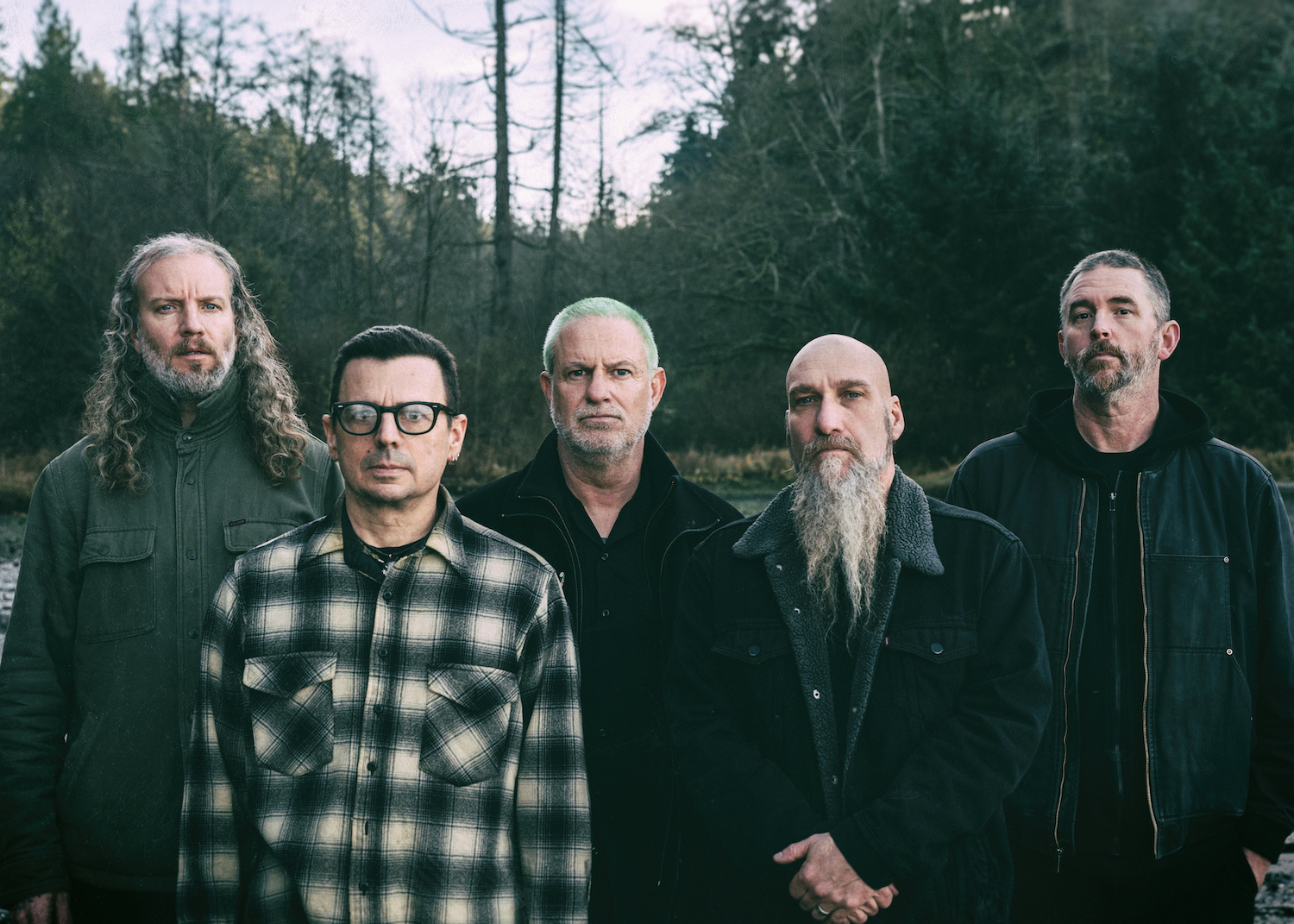
Throughout a more-than-four-decade career, Neurosis have established themselves as leaders of DIY, avant-garde metal. Their ethics and artistry have influenced generations of underground artists and bands, inspiring them to forge their own creative path and create art that challenges the status quo. Their status as heavy metal icons is cemented in history.
However, for as high as those highs have been, their legacy was almost cut short. In 2022, news came out that, three years earlier, Neurosis had kicked vocalist Scott Kelly out of the band upon learning about years long abuse he had been inflicting on his family. Discovering the severity of Kelly’s abuse tore into Neurosis, springing doubt and conversations about what their future may entail for them. The last album Neurosis had released at that point was 2016’s Fires Within Fires, which very well could have been their last. In the eight years following their last tour, the band had kept quiet, until finally breaking the silence in March of this year.
To the delightful shock of the metal community, Neurosis returned with a wave of news. They were not only back, but with a new member: guitarist/vocalist Aaron Turner of Sumac and Isis fame. They also announced their first performance in nearly a decade, at the 2026 Fire in the Mountains festival; and they had surprise released a new record, An Undying Love for a Burning World. For a band that already has a strong discography of emotionally crushing and cathartic metal, An Undying Love for a Burning World represents some of the band’s best material. Through sludge, doom, industrial textures, and gentle electronic ambiance, Neurosis offers an enriching experience that touches upon nature and a world fighting to survive in the face of adversity.
In a video call with Treble, I had the opportunity to talk with Turner and keyboardist/programmer Noah Landis. We discuss the conversations that the band had about their return, bringing Turner into the fold, playing at Fire in the Mountains, and what Neurosis’ return means for them.
Treble: Noah, following the news that came out about Scott, what conversations were happening in the band about the future?
Noah Landis: Our whole musical and creative lives and legacy just crumbled around us and that took a lot of time to process. The short answer is that we didn’t know. We didn’t know if we were going to be able to keep going. We all had other personal life transitions happening and we knew that we didn’t really want to bring in just somebody to fill the role. We talked about the possibility of doing it as a four-piece; there was some conversations of me playing guitar. We floated a lot of ideas, but we weren’t even sure that it was something that was going to be gratifying and fulfilling, and we had to kind of redefine what the next thing was going to be.
I think none of us wanted to start all over with a new project when we have this huge body of work and all of this time that we spent together doing this. It took a long time to figure some of that stuff out and for everybody to be in a position in their lives where they’re ready to do it. Because we don’t do anything in a like, “Let’s see what happens” [way]. We do things with a real conviction and a real purpose. It’s very well thought out. And then we all agreed that Aaron would be the person that could make it happen. I think there were still some unknowns when Aaron agreed, and we started playing music together. There were still some unknowns as to like, would I also be playing guitar? Who knows what other elements he might want to bring. As we started working on the new music, it just all fell into place really perfectly, really beautifully, actually.
What you’re actively pursuing is opening up these channels within yourself and within the group that allow for stuff to pass through you. It’s almost like providing a conduit for something that’s out there.
Aaron Turner
Treble: Aaron, what was your relationship with Neurosis prior to being invited to join the band? How did it feel being approached for this opportunity?
Aaron Turner: Neurosis is one of the more formative bands for me in my own personal musical history. I can kind of see my development as, first, just a fan of music, but then also as a musician in these certain phases from, like, early discovery to actively seeking things out, to then discovering underground music.
All of those were very important, but discovering underground music, and punk and hardcore specifically, it was like the big activator where I was like, “Oh, it’s not just these remote people up on a stage in a big stadium, it’s people who are doing exactly what they want to do, what they feel deeply and in the way that they most see fit outside of any kind of marketplace concerns.” It really means anybody can do it. And Neurosis had a huge impact on me for two reasons.
The first and most obvious one, which is the music, which was a revelation for me when I first heard it. But then also understanding the way in which Neurosis operated, which was from this very DIY punk background, and in a very community-minded fashion where everybody is connected, does things together, helps one another along, and doing as much as you possibly could on your own. Not like as an individual, but as a group that operates outside the parameters of the kind of standard music industry. So, the musical aspect and the ideological aspect were both very influential for me. It had a lot to do with how I saw the potential of music, but also how to operate as a person making music.
That was at first just an at distance experience, but then I had the good fortune to be able to tour with them with Isis, and then later on with Sumac. I also did some artwork stuff for them and a couple of smaller—I don’t know if smaller is the right word—but some releases for Neurosis that weren’t the main full-lengths. We did the vinyl for Sovereign and we did the split seven-inch as part of our Black Sabbath tribute series. So, there were all these different ways in which our work and our relationship became interwoven over the years.
So, in a certain way, though I never imagined I would end up in Neurosis, it makes sense in that we already had established a connection prior to this series of more recent events. I think that, as Noah was saying earlier, it makes a lot of sense if you think about how Neurosis is operated. It’s a very intentional, very thoughtful thing, and it couldn’t be like what you sometimes see with bands where they just get like a ringer. Like anybody will do. It had to be a good fit personality-wise, ideologically, and musically.
The fact that we’d all spent time together in one capacity or another was like a good indicator that at least there was the potential for success there. So as the conversations developed, there were, of course, a lot of questions. They had questions for me, and I had questions for them. I think the fact that it happened with all of us kind of at this stage of life where we are now, [made for] a much easier and better prospect than it would have been years ago. Like if I had been asked years ago when I was still just in like total fan mode, I don’t know if I’d have the perspective that I needed to be able to be an active contributor. And I think because everybody has established lives outside of the band and it’s not this thing that’s like a full-time job, that means we have room in our lives for whatever things we’re doing, whether it’s career or family or other bands.
That’s very important for me because, at this point, I couldn’t join a band if they were asking me to just set my life aside. It wouldn’t work. However, if there were any band that could ask me to join in a very committed way, it is this one. I can’t think of another band that could have asked me that I would have said yes to. So, it really honestly was like the perfect fit and made sense on so many levels.
Treble: It’s been a decade since the band released your previous record, Fires Within Fires. Noah, how does it feel writing in the mindset of Neurosis after so much time?
NL: I feel really grateful that I get to have this huge part of my life back. I know for a lot of us, Steve [Von Till] in particular, him running the label [Neurot Recordings] and just doing a lot of the day in and day out work that that takes; that that whole time when we weren’t active was really kind of pulling at the seams, because all this work has to keep getting done, but there’s this big mystery there.
For me personally, it was a grief process. It was, and that just takes time. It was a big loss. We were in touch, and we were good friends always, and we didn’t know if we could figure out how to stand it back up in a way that was worthy of doing it. So, the creative side, it kind of felt like a spigot that opened up. That really is what it felt like when I was writing the parts for these new songs. It was really like I poured myself into it in a way that was—it felt really special.
To go back to what Aaron was talking about, the thing that was weird about bringing Aaron into it was that it wasn’t weird. I think part of it is that we as artists and creative people are not closed-minded in a certain thing. Like we were open to new ideas and all of his input, like we are with each and every one of us. You know, one of the things that people might not know about this band is that every person’s ideas and opinions are valid. We take time to explore everyone’s thoughts. I remember Scott Evans [recording, mixing] coming into the studio one morning and he said, “I was telling my wife how different it is that this band really takes the time to go to explore everyone’s ideas.”
So, that was key to the music. Having that open artistic approach, because we just go where the music leads us, you know? We don’t have a preset idea. It’s like we take it all apart and we put it together and we build it the way that it is sort of like calling to us to be built. Having that kind of open approach to it was really important. And Aaron, I think, felt that and was able to contribute right away.
Treble: In terms of instrumentation and thematic ideas, what did you both bring to the table?
NL: Some of the things that made it into the songs that are on the record were things that we had been writing and playing with before Aaron joined. A lot of them were new. [Reflecting on Neurosis’ return], if we were to rebuild this band, what are some of the ideas that we could do to make it its own thing, make it redefining. Because it would have to be, changing the ingredients like that.
Steve had some good ideas about multiple layers of electronics and noise. Some of that made it onto “Last Light”. Those ideas started in Steve’s mind, sort of like the mechanical kick drum, just building off of that and making it relentless and more and more. A lot of the things that we did we actually did together in the room. What do you think Aaron?
AT: I think the mindset I had coming into it as a new addition was trying to find the balance between honoring the identity of the group that I was joining, seeing what the throughline was there that goes from their roots to the present moment, and then also understanding what my own personal voice is and trying to focus my energies in a way where it would be complimentary to what was pre-existing, while also bringing in things that feel specific to my point of view.
As far as like, thinking about the collective effort—I don’t know this for a fact because I haven’t talked to everybody in Neurosis about it—but it is my feeling that there is a kind of shared experience in being creative where you’re not purposely driving towards a real specific goal that’s predetermined. What you’re actively pursuing is opening up these channels within yourself and within the group that allow for stuff to pass through you. It’s almost like providing a conduit for something that’s out there.
For me, Neurosis has always exemplified that in a very powerful way. In that it feels like Neurosis is certainly generating sounds and has a vision that’s specific to the people involved, but also perhaps maybe more importantly, capable of harnessing energy that exists and really pushing it outwards and allowing it to flow through the group. To me, that’s one reason why I’ve always thought of Neurosis as being this very elemental force rather than like a group playing songs. It’s this almost, like, ceremonial approach to making music that manifests with these things that feel like storms or eruptions or seasons or the passage of time. Like these very potent energies that kind of…transcend music in a certain way.
That’s kind of what I was thinking about as we were writing all this stuff. It’s like, “How do I open myself up to this group and their way of practicing and how do I open myself up to this thing?” So whatever comes out feels like really pure manifestation of that, where you’re digging into something deeper and you’re not thinking about, “Oh, I want to write this type of song or this type of riff.”
It’s more like, “What do my hands, my voice, and my body need to do so I can really feel like I’m embodying that energy and sharing this energy with all the other participants who are in the group?” To me, that’s always kind of the highest ideal for music and art, when you can tap into those deeper experiences that go way beyond us as individuals and tap into not only like the collective unconscious, but like the world around us. The universe around us and all those things which are kind of intangible and hard to articulate except through these creative means. In that way, I think the new album is unique within the Neurosis discography in that there’s new ground that’s been tread, but also, it’s very much in keeping with the spirit that the band has embodied all along.
Treble: Neurosis returns to the stage with this year’s Fire in the Mountains festival. Along with an emphasis on nature, the festival is about mental health awareness and suicide prevention for the Blackfeet Nation and Indian Country. Could you both please share what this opportunity means to you?
NL: In some ways, I want to credit Fire in the Mountains for being the sort of light at the end of the tunnel for this whole process of rebuilding the band, of making the record of our lives. It was something that Steve’s been involved in for a long time. As an educator, as a father, just really important work that he saw as a place where he could be involved and help. [Steve Von Till is a board member of the Firekeeper’s Alliance]. So, it’s something that he’s discussed with us a lot.
When they asked him if there was any possibility that Neurosis could be [one of the big event bands], I think he saw a way that we can set a date. Like if we’re going to do this, we’re going to do this for that. And that is going to be the perfect place to kind of pull the curtain off and share it with everyone again. That’s a long way of saying I kind of want to credit that organization for, not just the important work that they do, but in a sort of a roundabout way, it helped make this whole thing happen for us in our lives.
I’m somebody who’s worked a lot with—I want to call them troubled teens. I’m somebody who’s in recovery myself. I worked for a group called Rock to Recovery where I was bringing musical instruments to young people who were in residential facilities […] The whole point of this organization was to help people heal through music. That is something that I’ve believed strongly in, the healing powers of music. Especially with young people, where music is such a big part of finding and forming your identity. The people at Fire in the Mountains or Firekeeper Alliance, they also are sort of operating from this principle that music—especially heavy, powerful music—can be a real healing force for people who are going through different kinds of challenges. I haven’t been there, but from what I hear, the challenges there are severe. There are generations of addiction and really intense levels of poverty. There’s also beauty in the land and in the people. I’m just really grateful that I get to be there and be a part of it and contribute.
AT: Most of what I would say would just be an echo of Noah’s statements. I think in so many ways, it really is the perfect place for Neurosis to return in this new iteration because not only is it just a wonderful event with a really clear and beautiful concept behind it, it is ideologically aligned with, I think, so many of the values kind of at the core of Neurosis’ existence. And I think there is a very clear desire within the band to return in a way that felt meaningful.
It’s hard in the current climate that we’re in with music, where I’d say perhaps more than ever before, reunion tours and reunion albums are increasingly common. In many cases, and this is purely subjective, in many cases, it often feels like the passion or the purity of intention behind these returns is questionable. And given the precedent that Neurosis has set up to this point, the return of this band or the reemergence could not feel trivial. It had to feel like it was done in the spirit that this band has always operated in.
[…] I think, without getting into the tricky waters of talking about destiny and things like that. I would say that I believe a lot of things happen for a reason. And this was simply the right time and place for the reemergence of Neurosis and for us to contribute to something that we all believe in.Treble: Noah, I’d like to touch upon a couple things you’ve shared during this conversation. You’ve brought up that there was a lot of grief with what’s happened to the band, and that this album is the “record of your lives.” Rather than ask what does this record represent—what does Neurosis’ return mean to you?
NL: Yeah, that’s a big question. [Pauses]. In some ways, it’s a relief that we were able to, um, [pauses again]. Yeah, sorry. I just, I want to think through this before I just answer.
It was heartbreaking the way that our band fell apart. Because for us, it’s not just a band. Before Aaron joined, I was the new guy, and I’ve been doing this for 33 years. This is our lives together. It’s very much a marriage. So, to have it torn down the way that it was, it was heartbreaking. In some ways, there’s a relief that we get to work together again, to create music and art together again. But in order for us to do that, it would have to be an incredible record. I don’t know how to say that or why. I mean, you know, it’s easy for people to say, “We do this for us and who cares if people like it or not.” But even with that, we are our own best and worst critics. We want to make the stuff that we are moved by. We want to do it in a way that is uniquely us.
I like to think that we are one of those bands that are kind of singular. There are plenty of people who’ve sort of taken their band through the gate that Neurosis helped to open as far as combining different musical elements the way we do. But to go back to what I meant by the album of our lives. It was like, if you only get to come back once, it’s important to see the weight that that carries. We didn’t just put this together and see how it goes, you know? We carry the weight of what this means.
When we were sort of doing all of this—in secret, by the way, for months—we knew that it needs to be special for us, but we also want it to be special for all the people who have been following us and the people who our music resonates with. And when we finally were able to unveil it on March 20th, it really reinforced how many people it resonates with. People were really uplifted by what we did. So, that is what I meant by the album of our lives. That is what it means, meant to me, to make this record.
Treble: I know many of us in the heavy music community are thankful for the art Neurosis has made. We’re happy to have you guys back. So, I have to ask: are we gonna see more Neurosis?
AT: Can’t stop us now. There’s no way. I mean, as much as Noah said, we’re not doing a “Let’s do this and see”—we are approaching this from a one step at a time perspective where it was like: “okay, let’s write music. Okay, let’s record the music. Okay, let’s play a show.” And that’s where we are right now. Whatever steps we take from this point forward will be thought about and considered in the same way.
Treble is supported by its patrons. Become a member of our Patreon, get access to subscriber benefits, and help an independent media outlet continue delivering articles like these.