
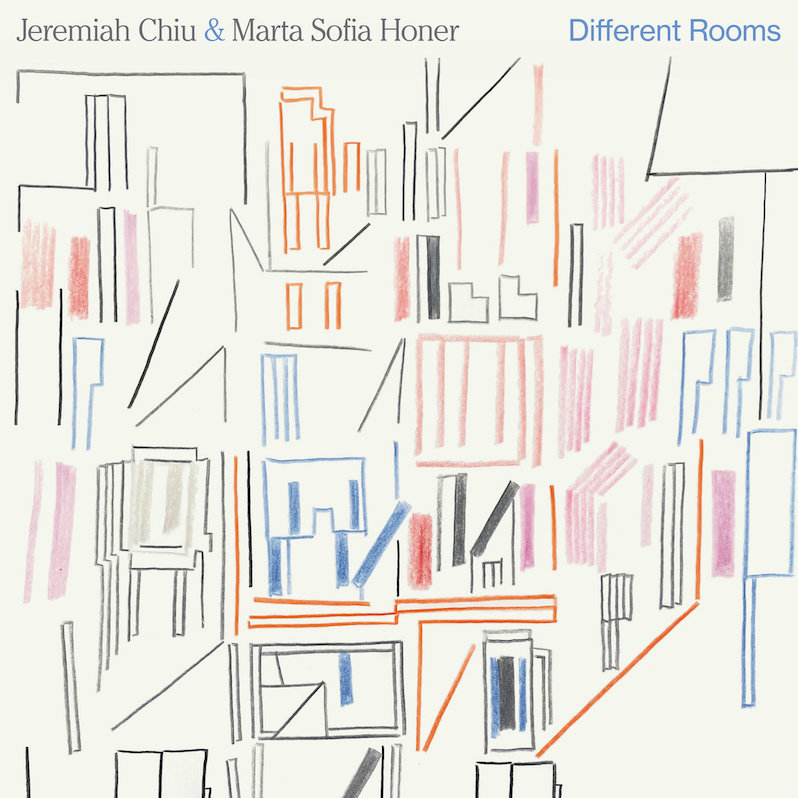
Jeremiah Chiu & Marta Sofia Honer : Different Rooms

As I write this, it is the fifteenth anniversary of my major suicide attempt and fourteenth anniversary of my father’s sudden passing. Time is passively cruel; music, our human architecture carved in time rather than matter, is a cryptic parallel to these events dropped like stones along a calendar. It can be overwhelming to think sometimes that every event in human history can be located on the calendar, that with proper awareness you could be suffocated by the infinite density of concatenated time, that every day is the layered anniversary of millions and billions and trillions of events forming strange hybrid geometries between those strange nodes. Sometimes music strikes you immediately, tapping the curve of your soul like a bell. This day was the first day I listened to Different Rooms; this becomes an immutable aspect of the world now, permanently binding these two elements of those black anniversaries and my first encounter with this work together. There is no way for me now to separate them.
The first moments after I pressed play on this record for the first time, I began crying. The main instrumental body of Different Rooms is modular synthesizer and strings, played respectively by Jeremiah Chiu and Marta Sofia Honer, while others such as Jeff Parker, Josh Johnson, Giovanna Jacques, Michael Hilger and Ben Babbitt also contribute across the runtime. The record is sequenced and mixed to play nearly as one continuous piece, split at the halfway point; the bracketings still allow each section to be comfortably withdrawn from the whole, but the effect of the record compounds upon itself when taken as a whole. For instance, there is the mirrored structure of the work. “Mean Solar Time” is both the first track and, in variation, the last; “Side By Side” is both two from the beginning and two back from the end, likewise in variation.
The instrumental nature of these piece along with their titles, both concrete enough to avoid the vagaries of certain types of poetics while evocative enough to not feel like mere placeholders, read as deliberately open-ended regarding the emotional character of the suites as a whole. My response was crying, feeling the pieces as beautiful mirrors to my grief, a sentiment that is intolerably alchemically bound to love, regret, desire, hope, fondness, bitterness, and so many other conflicting colors. Yet I can see this same open-handed set of works buffeting a number of other emotional states. Different Rooms doesn’t feel bound inexorably to one emotional context, yet feels sympathetic and resonant to those other states rather than simply being without firm enough identity to stake itself upon something.
This is a rather fascinating feat. Most music, most art even, we can often ascribe a kind of emotional character to, especially if there is a lyrical component. The emotion may be as simple as happiness or as specific as the poetic tangles of Dylan and Patti Smith, may be wide and laced with adjectives or stacked tall with wafer-thin transparent overlays of holographic emotionality. Here, the synthesizers, voices and strings run at odds with each other in a delicately and beautiful dialectical dance; one moment, the strings release a long yearning stretch of sound that feels like aching while the synthesizers outline a wide-voiced chord, major and touched by brightness but undecided on its specific character. Then a new string layer comes in, peppery and warm, while the synthesizers release a deep and melancholic drone. These moments don’t feel contradictory to each other but rather complicating, etching a complex set of overlapping emotional states without clear judgment on them. Do we take the lead melodic instruments as the surface of the feeling and the rhythmic and drone elements as their undertones? Or perhaps are those deeper elements the core of the sentiment while the melodies over top are flickering nothings like sparks off of a fuse? It is less so unclear as it is open, able to be inverted by emotional state rather than pre-decided by the composer.
That a piece of music can in one context feel like razor blades dancing in the sky and in another like a garden of summer kites resting like butterflies against one another in a brightly lit field of green grass is a delicate act. This kind of musical world, not quite new age, not quite ambient, not quite contemporary classical, within spitting distance of prog and kosmische but decidedly distant, is a tricky one, only made possible by the intense sensitivity of the players and composers, adding tensions carefully like an artist that can only use straight lines or simple curves in minimal movement. They are as much architectures as they are pieces of music, geometries the shape of rooms of your heart. Different Rooms crosses the threshold where mere sound seems to open up as if by magic, attain dimensionality and transform into some greater thing. It has depth and majesty. That this emerges in the midst of an ongoing spate of rapidly produced material by the duo both together and apart going back the past four years now is no surprise. They have tapped into something and are continuing to map its shape. Different Rooms is yet another gem in this sterling run from Recordings from the Aland Islands onward, a streak that seems unlikely to end anytime soon.
Label: International Anthem
Year: 2025
Similar Albums: