

Kelly Moran : Don’t Trust Mirrors

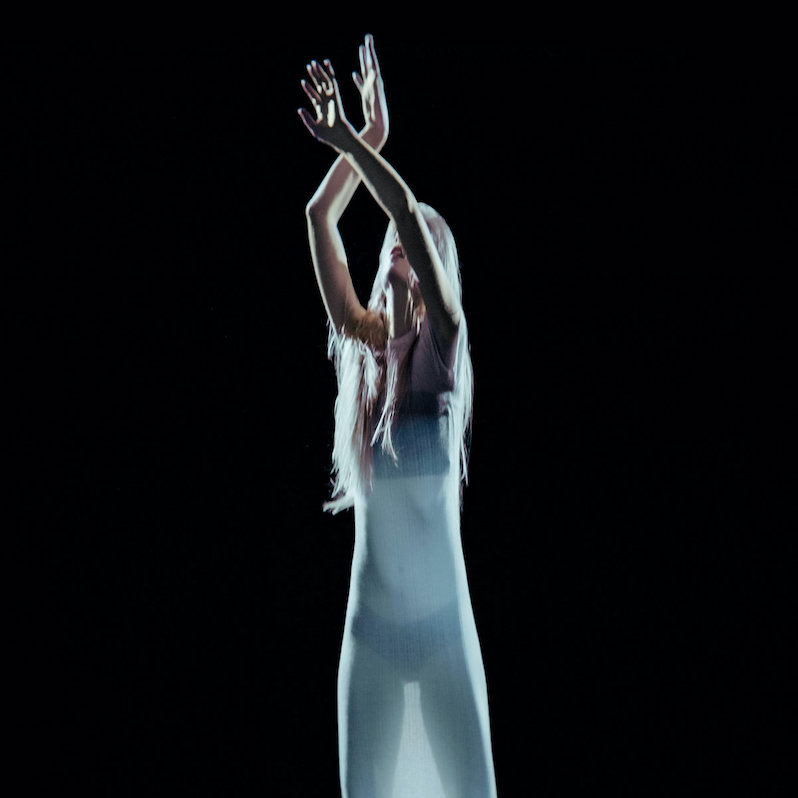
Some records, it turns out, don’t behoove themselves to be spoken of as a sequence of individuated moments across segregated tracks. Kelly Moran has spent her solo career developing precisely this kind of transcendentalist affect with her records; see our reviews of Ultraviolet and Moves in the Field for instance. Don’t Trust Mirrors, her newest solo album, remains in that same glistening, almost mystical psychic environment of her body of work.
“Echo in the Field,” the album opener, has a moment early on as synthesizers begin to layer that you can sense something approaching a pop music sense of hookiness and somewhat simplified approach to harmonic language, a song warmer and less psychically demanding than some of her previous work. But, ah!—then the prepared and the grand piano come in and, without drastically complicating the harmonic structure, suddenly it becomes a rich yet spacious braid of textures not unlike Massive Attack at their peak. It is hard, in its rushes, not to let go entirely and disappear into an icy dissociative fugue, to merge with the gleaming fog billowing out over the cool waters of the record. It feels wrong not to.
Moran prompts a question that’s fascinating to me, one that stretches back to the philosophical conflict between the idealists and the materialists. (Don’t worry, I won’t bore you with jargon.) There is a root question both in songcraft and art criticism of whether individuating details and brushstrokes, notes and timbres and songs matters more or whether it is the gestalt of the thing, almost more the spiritual motive and constructivist atmosphere that emerges like a corona from the work. I mention this because her work in generally, recapitulated here on Don’t Trust Mirrors, explicates well how you can’t have one without the other.
Take the omnipresence of prepared piano across this album’s songs and the metallic pizzicato, like a clockwork harpsichord, a sound that feels at once like something out of the Baroque or classical era emerging from Bach or Mozart’s fingertips as it does futuristic, the romanticism of broken machines. Then, against this, the perfection of a well-recorded grand piano, the greatest musical invention of the 1800s, a musical achievement only matched by the distorted electric guitar about a hundred years later. She uses these same textures in a recombination and algorithmic way, rarely strongly departing her limited aesthetic palette. But it doesn’t feel limiting; instead, it feels cohesive, like these are notes, melodies, yes, songs, but more than even a song suite it is a Romantic-era piece of impressionist music. It is a mood, an atmosphere.
“Sans Sodalis” and “Lunar Waves” both marry a business of the arpeggiated prepared piano against these wide spacious chords that almost plays for you a swooping violin-streaked guitar line like something the Edge or Robert Fripp might play. Instead, she leaves the negative space, which makes me feel like I’m on the edge of the abyss, like the guitar or the vocal is just moments from coming, that the drums might crash at any moment. This doesn’t feel like a missed opportunity; this great suspension feels very deliberate, the same heart racing I feel when I put on a Kate Bush record and in her similar taffeta cloud of ribbon- and lace-like notes feel like something great is about to come to smash the glass.
“Don’t Trust Mirrors,” her collaboration with Bibio, plays a fascinating trick of making Bibio himself nearly utterly transparent. This a testament to two things; one, the remarkable discipline of Bibio to play as an ensemble player, not taking a lead role but instead one providing supportive structure, and two, of the strength of Moran’s overall compositional acumen and discipline herself. There is a sudden warmth that takes over the song, like a southern wind thawing icy waters, but the affect of the piece makes this subtle shift feel nearly implacable. Pointing out, say, the wind-chime arpeggios and the more alien synth tones clearly provided by Bibio feels less like critical insight and more like shattering the illusion, explaining the magic trick. That together they are able to achieve a near-Aphex Twin level of clatter and complexity while retaining that warm ambient atmosphere is a marvel.
Moran’s ties to the world of extreme, progressive and experimental metal music offer a fascinating counterpoint to the record. One of her earliest recording bands was an avant-garde metal group called Voice Coils featuring a young Mitski on vocals; her record Bloodroot was engineered by experimental, progressive and technical metal wunderkind Colin Marston; she has performed as part of Haela Hunt-Hendrix’s (Liturgy) all-star ensemble supporting Origin of the Alimonies alongside Tony Driver of Kayo Dot. Alongside this, we have her brief foray as part of Oneohtrix Point Never’s touring ensemble. The throughline here is a similar sense of headiness, a cerebral element to the compositional pen, but one that is still ultimately guided by that great Romantic compositional move of the profundum. Where in baroque or classical music, you might have been encouraged to follow the enclosures and counterpoint, suddenly, a piece was meant to feel like a river, a storm, an execution, the end of days, light falling on a field. Is Don’t Trust Mirrors summer rain or the gleam of winter ice crystals forming on the window? Are these the plucked threads of a spider’s web or the dense etching of bare winter limbs in palimpsest? That she makes the obviously cerebral into something of commanding beauty is a sterling achievement, one well-practiced and clearly not on the verge of being exhausted yet.
Label: Warp
Year: 2025
Similar Albums:
Kelly Moran : Don’t Trust Mirrors
Note: When you buy something through our affiliate links, Treble receives a commission. All albums we cover are chosen by our editors and contributors.

