
Coroner : Dissonance Theory

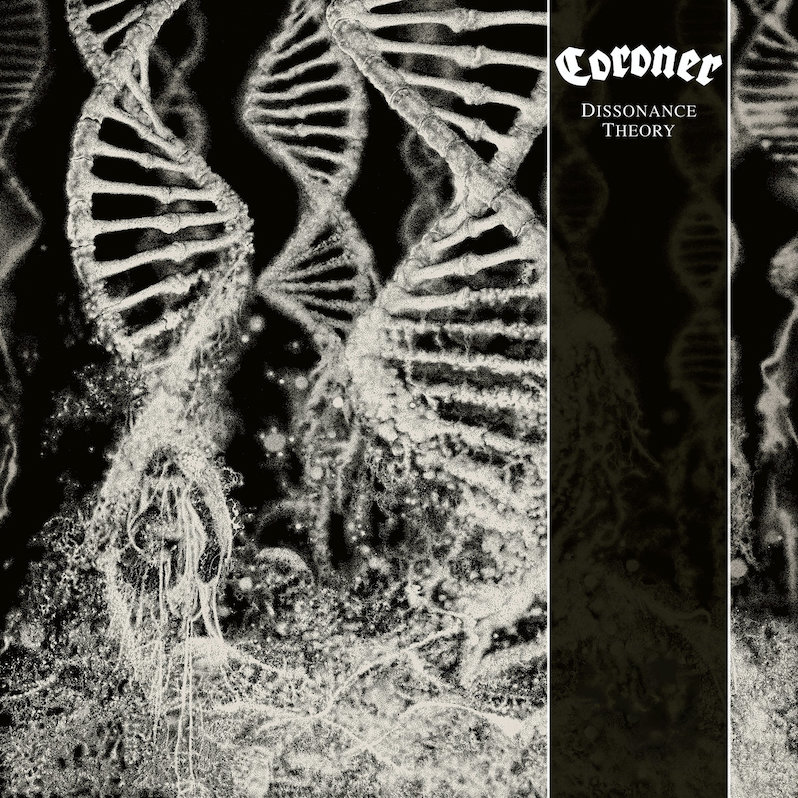
Comeback records are tough no matter who you are, but especially, it seems, for progressive bands. In that genre space, you are not just striving to write great songs and cohesive records but also to fill them with ideas that feel like gainful advancements. Gorguts delivered one of the greatest comeback records in that world with Colored Sands but Cynic’s Traced In Air and Cirith Ungol’s Forever Black aren’t far behind; meanwhile, you need only look at Psychotic Waltz’s The God-Shaped Void for an example of a record dotted with great material but lacking that necessitating urge. Coroner‘s Dissonance Theory lies somewhere between these two poles, a record with excellent songs that struggles sometimes to forge for itself a firm identity.
Coroner’s initial five-album run is a storied one in underground metal. Their 1987 debut R.I.P. was raw and ugly thrash tinged with the same amount of black and death metal as Sepultura and Dark Angel’s early runs, then a tighter focus on 1988’s Punishment for Decadence, the prog/tech thrash of 1989’s No More Color, the outright progressive metal of 1991’s Mental Vortex and finally the alternative and industrial-tinged fifth and final record, Grin. They always made sure a new record was in fact a new statement; even listeners and critics who struggle with those final two records tend to acknowledge they at least represent a band that does not sit on their laurels, even if it seemed to shake a stable fan base off of them at the time. Dissonance Theory, to its credit, also follows this mode. It harkens back most clearly to No More Color, the third record and most acclaimed, having stripped away most of the outright prog save for moments like that utterly fucked riff in “Crisium Beyond.” But there is a sense of melodicism and yearning to their chord choices that brings them right up to the edge of folk metal territory, sounding at times more like Amorphis than, say, beloved German tech-thrash band Mekong Delta.
Coroner likewise keeps the tempos often quite moderate over the span of the record, more often slowing it even further than pushing themselves into a light speed thrash attack. Of course, this is cut against with double-bass driven sections that feel plucked out of some parallel universe’s Rust In Peace, the fabled Megadeth record, such as during the opener of “Symmetry” (which with only a minor vocal change could slip onto Rust or maybe Countdown to Extinction without notice) or “Renewal.” However, placed alongside the mid-tempo melodicism of cuts like “Transparent Lie” or album opener “Oxymoron,” these moments feel less like ways to flesh out the record as they do one of a band struggling to find something new to say. That this material can safely be described as a mid-point between No More Color and Mental Vortex underscores that it feels recombinative rather than innovative. Metallica tried a similar tack with Death Magnetic, attempting to produce an imaginary record between Master of Puppets and …And Justice For All likewise to mixed results. (Admittedly Hardwired with its similar conceit but between Justice and the Black Album fared quite a bit better.) There’s rarely a moment on this record where it feels like a new idea is being presented and given center stage, which gives off the unpleasant odor of a reunion record existing for reasons other than the inner necessity of the material.
I don’t mean this to seem overly damning, however. My presumption is that this material was made more to slot into live sets already dotted with their established material, that this album wasn’t meant to seize focus but instead to live comfortably with its siblings in that kind of heavy guitar music live environment. On this mark, the material fares quite well; hell, even unexpected flourishes like the Yes-like organ solo on “Prolonging” that comes out of nowhere feels like it would be an exciting surprise. It’s hard, however, not to hear moments like that, where an unexpected instrument isn’t just thrown in but incorporated well in a way that opens up angles of their sound you’d never have expected and wish what we got was an album exploring those kinds of ideas. You’d be hard pressed to find a song on Dissonance Theory that’s bad or even average; Coroner replicating themselves after all is still Coroner, and they are recombining the DNA of a handful of correctly acclaimed albums, so the finished project was always going to satisfy. But we get these brief glimpses through the fun of the album at something more progressive and adventurous, and it is hard not to yearn for that—something that doesn’t just celebrate a legacy but expands it. It’s not unfair, I feel, to have hoped for more evolution after a near 30-year gap. One hopes that those exciting jagged edges here become the basis or inspiration for a more advanced follow-up; the group clearly sounds rejuvenated and lively enough on this recording to expect another.
Label: Century Media
Year: 2025
Similar Albums: